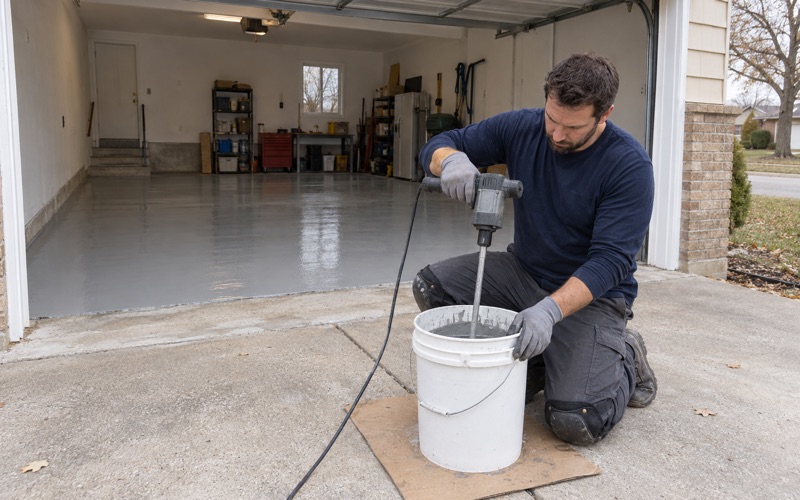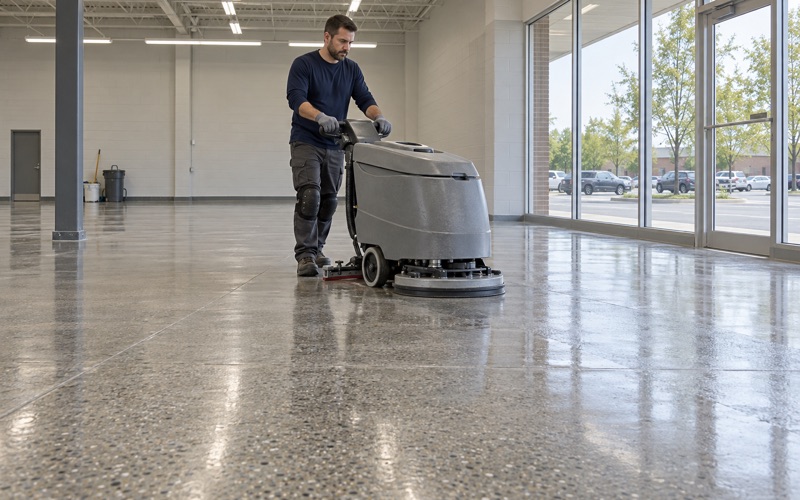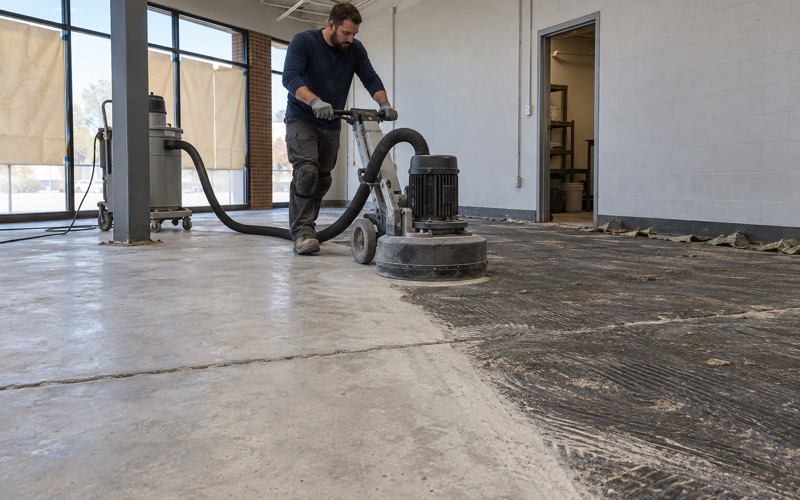
Lombard Epoxy Flooring has spent more than 20 years on epoxy flooring in Bellwood, and the floors we coat here are mostly the plain working kind: garage slabs, basement workshops and the light-industrial bays that keep a small trade going. Each job starts the same way, with a diamond grinder or a shot blaster opening the concrete so the coating has a real profile to bite into. We do not acid etch a slab to save an hour.
This page is about one particular floor problem: what happens under a soldering bench. Acid soldering flux is corrosive, it drips, and the way it is cleaned up matters as much as what it lands on. Below we explain why a sealed, seamless coating helps at a flux bench, where it stops helping, and what still has to sit between the work and the floor.
Before any price is final, the written scope includes a moisture test, and the proposal names the product line, the coat count and the finished thickness. That gives you something to check the finished floor against, rather than a promise.
Where Bellwood’s Sheet Metal Apprentices Learn to Solder
Sheet Metal Workers Local 73 runs its apprenticeship school at 2701 Van Buren Street, inside the village of Bellwood. The village sits in Proviso Township in Cook County, about 13 miles west of Chicago’s Loop, between the Eisenhower Expressway to the south and the Proviso rail yards to the north. The local describes four years of classroom and on-the-job training, with 1,360 classroom hours and the possibility of 8,000 hours on the job. Its program page says the classroom replicates the work apprentices will do in the field, fabricating and installing heating and cooling systems.
What the curriculum lists
The subjects on that list run from sheet metal mathematics and shop layout to drafting, AutoCAD and field installation, with welding, architectural sheet metal and soldering and cutting among them. Soldering is the one that puts a liquid chemical on a bench, and liquids on a bench end up on the floor.
Why we use it as a reference point
To be plain about it, we have no relationship with Local 73 or its school, and we have not seen its shop, its benches or the fluxes it uses. We name the school because it is the clearest sign that soldering is a working trade in Bellwood, not a hobby. The same bench work turns up in HVAC and gutter shops, and in home garages where someone forms their own flashing or ductwork.
Who signs off in the village
For shop work inside Bellwood, the Village of Bellwood Building Department is the building authority, and it reports its building code as the 2006 IBC, adopted in 2008. A specification copied from a town on a newer code edition does not transfer automatically, so we check with the village before scheduling rather than assume. That check includes whether the work is a coating over the existing slab or a replacement of it.
Looking for epoxy-flooring closer to Western Springs? See Epoxy-Flooring Services in Western Springs.
Acid Flux on Bare Concrete and on Steel
The flux in question here is the zinc-chloride kind used for soft soldering. One maker’s safety data sheet, for Superior Rubyfluid, lists zinc chloride at 30 to 45 percent with the rest stabilizers and water, classes it as corrosive, and gives a pH of 4 to 5. That is one product, and other fluxes may differ, so we treat it as an example rather than a rule.
What a drip does on its way down
Flux drips from the brush, from the can and from a freshly fluxed seam before the joint is made. The SDS says the solution mixes with water without limit, so it travels with any wet mop or rinse, and it lists metals as a condition to avoid. The sheet also notes that it gives off small amounts of hydrogen chloride as it decomposes, which is what heat from an iron or torch can cause.
Bare concrete holds onto it
An uncoated slab is porous, so an acidic drip does not sit on top waiting to be wiped. It works into the paste, the pores, the control joints and any crack near the bench, and the next cleanup with plain water spreads it further. That is why we grind and clean a slab that has lived under a flux bench before we prime it, rather than coating over whatever has soaked in.
Steel in the floor shows it first
Steel set in or on the floor near a flux bench is where the damage usually appears first: a trench grate, a base plate under a machine, the heads of the anchors holding a bench or rack down. Those are the edges we look at hardest on a site visit. Where we can, we bring the coating up tight to the plate or grate frame so there is no bare ring of concrete around it, and we tell you plainly that the exposed steel itself still needs its own protection and cleaning.
Neutralize First, Then Rinse: The Maker’s Spill Order
The spill instruction on the Rubyfluid sheet is short and the order is the point: first neutralize with soda ash or sodium bicarbonate, then dilute with water, then dispose of it under EPA rules. Baking soda is sodium bicarbonate, so a box kept on the shelf by the bench puts the first step within arm’s reach. Reaching for the hose or a wet mop first just spreads an active acid across a wider area and into every joint it meets.
How we leave the floor ready for that order
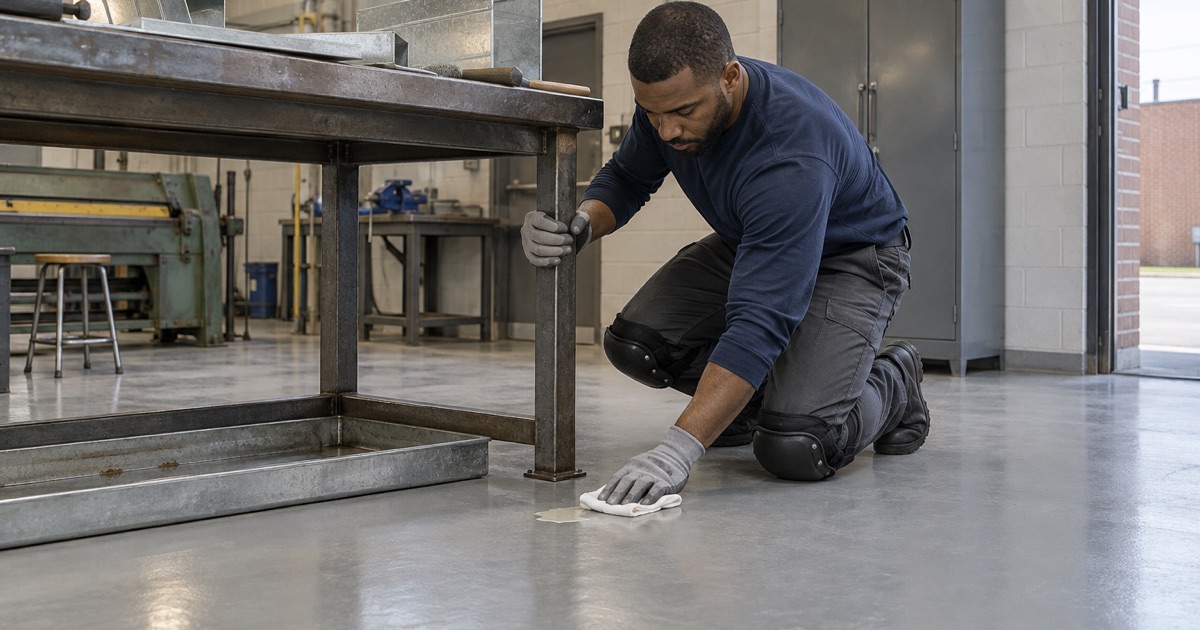
A sealed, seamless coating changes what the spill order can achieve. The neutralized residue stays on the surface instead of soaking in, so it can be wiped and lifted rather than chased into pores. We ask how the bench is cleaned today and choose a system that suits that routine, often a 100% solids epoxy body coat under a polyaspartic topcoat, with the exact product line named in the proposal.
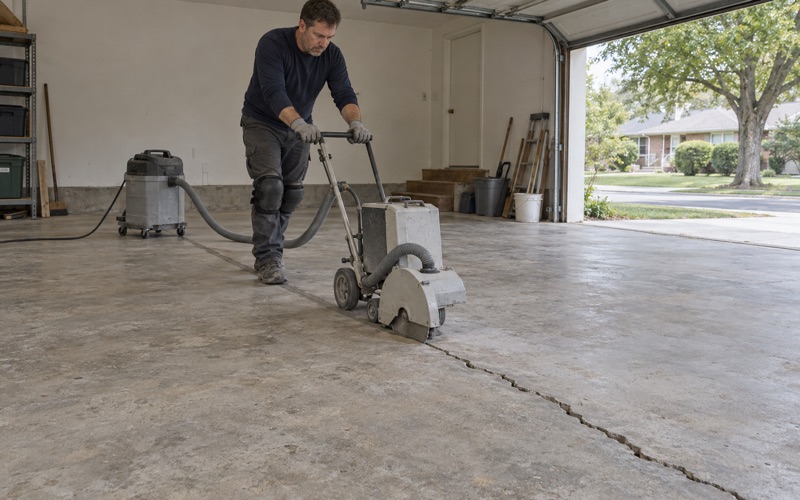
Where the bench backs onto a wall, we can run the coating up into a short integral cove so drips that run down the wall or the bench legs meet a curved, sealed corner instead of an open joint. Control joints and cracks inside the bench zone are filled before coating, because an open joint is exactly where a diluted drip would settle.
What a coating does not do
A coated floor is not a containment system, and we will not sell it as one or describe it as resistant to anything the product data does not support. It does not stop a puddle of flux from doing harm if it is left overnight, and it is not a substitute for the trays and habits that keep flux off the floor in the first place. What we can say is that it gives the maker’s spill order a clean, continuous surface to work on.
A routine for the end of the day
At the end of a soldering session, the routine we suggest follows the same order: baking soda on any drip first, then a damp cloth, then clean water. A wet mop comes last, and the rinse water is disposed of the way the maker’s sheet directs, not poured into a floor drain. On a coated floor that sequence lifts what it neutralizes; on bare concrete some of it has already gone into the slab.
Where the grinding dust goes
When we grind a slab that has sat under a flux bench, the dust is captured at the machine with a vacuum rather than washed toward a floor drain, a sump or a storm inlet. Old flux residue in that dust is one more reason not to rinse it anywhere. Our own cleanup water before priming is kept out of the drains for the same reason.
Drip Trays, Bench Zoning and the Home Workshop
The floor is the last line, not the first. Most of the flux at a well-run bench never reaches it, because the work happens over something that catches the drips.
Trays under the pot and the work
Drip trays under the flux pot and under the piece being soldered keep most of the residue off the floor altogether. A plastic tray suits the material, since the same SDS says to store the flux in plastic containers, and a tray can be carried away from the slab to be neutralized and cleaned. We plan the coating around those trays, never in place of them.
A bench zone you can see
We can mark the soldering area on the floor itself, with a contrasting color band or a separate field around the bench. A light, solid color in that zone shows a dried flux spot or a white bloom of neutralizer that a busy flake pattern would hide. Keeping the zone clear of the main walkway also means fewer drips get tracked through the rest of the shop or garage.
The bench in a garage or basement
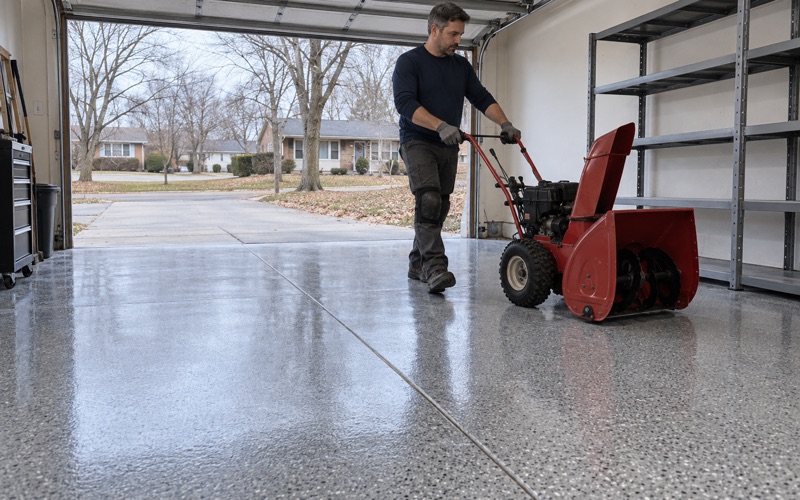
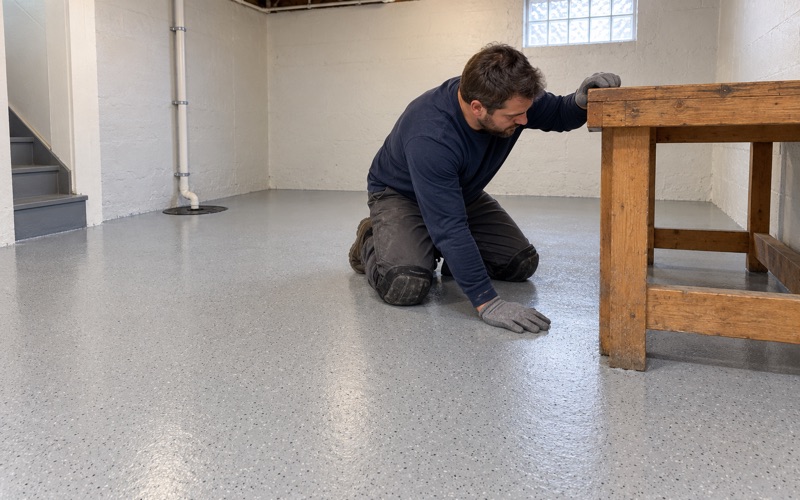
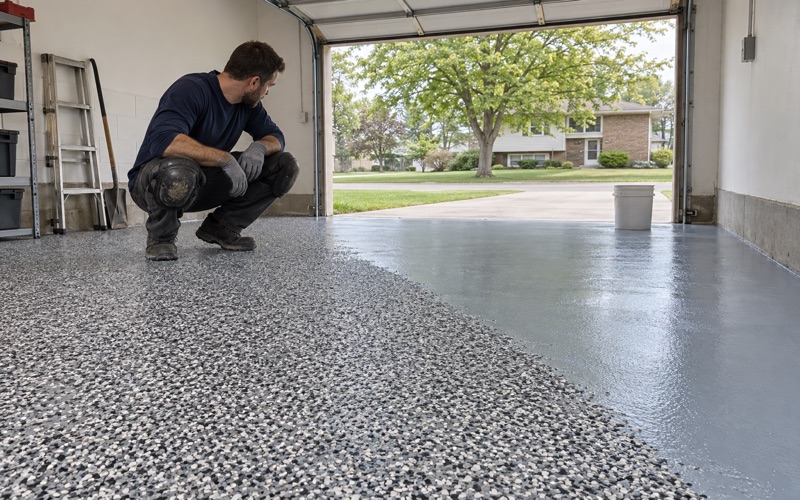
A soldering bench also turns up in home garages and basement workshops, where the same spill order applies. In a garage, we choose a system that also stands up to the brine and rock salt that ride in on tires every winter, and the slip-resistant texture comes from a specified broadcast and topcoat rather than a promise. In a basement, we read the floor for past water first, because a coating does not stop seepage, a backup or a sump that cannot keep up.
Timing, paperwork and what the warranty leaves out
Cure schedules follow the slab’s temperature and dew point rather than the calendar, so an unheated garage in deep winter may be told to wait. On a home job above the state threshold you get a written contract and the state’s Home Repair: Know Your Consumer Rights pamphlet before any grinding begins. We also walk through the warranty exclusions before you sign, starting with moisture, and we map cracks, spalls and old coatings so you know if the slab needs repair first.
If you run a flux bench, it helps to have the label or SDS for the flux you use on hand when we visit, along with a sense of how often the bench is used and how it is cleaned now. That lets us match the topcoat to the actual product instead of to a general category. We will also want to see the grates, plates and anchors around the bench, and any patch where the concrete already looks stained or soft.
- 20+ Years Coating Concrete
- Moisture Tested Before Pricing
- Free Written Estimates