Lombard Epoxy Flooring brings more than 20 years of epoxy flooring in Bensenville to the floors that work hardest in a finishing shop: the ones under a spray gun. A paint line sends a fine mist of coating into the air all shift, and whatever misses the part settles underfoot. That floor gets scraped, swept and cleaned far more often than any warehouse aisle, and it has to survive the routine.
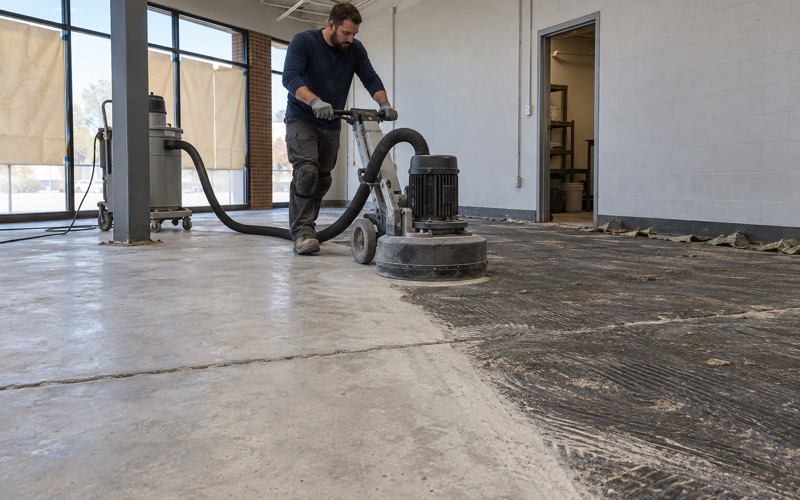
Our approach to a spray area starts with the slab, not the resin. We open the concrete with a diamond grinder or a shot blaster, never an acid etch, and map every crack, spall and old coating before we recommend anything. When a slab needs repair first, we say so in writing.
This page covers what that means for a booth floor specifically: what the federal spray-finishing rule asks of the surface, why texture works against cleanup, how a sacrificial booth coating fits on top, and where the floor’s job ends. Each of those points shapes the system we put in the proposal.
Spray Finishing on Industrial Drive and What OSHA Says About the Floor
Bensenville is a village of 18,813 people that borders the southwest corner of O’Hare International Airport, sits mostly in DuPage County with a portion in Cook, and is home to over 1,500 businesses. One of them, Apex Plastic Finishing at 1040 Industrial Drive, describes both robotic and manual spray painting of plastic parts in a 25,000-square-foot facility. The company also lists EMI and RFI shielding of plastic parts using copper and nickel coatings.
We have not seen the inside of that building, and nothing here describes how any particular shop is laid out. What a line like that does show is the kind of work this village carries: parts painted by robot and by hand, plus metallic shielding coats, all in rooms where the floor collects whatever the guns put in the air.
The Rule Text, Read Plainly
OSHA’s spray-finishing standard, 29 CFR 1910.107, defines a spray booth as a power-ventilated structure that encloses or accommodates a spraying operation. Its floor paragraph, (b)(3), says the floor surface of a spray booth and the operator’s working area, if combustible, shall be covered with noncombustible material of such character as to facilitate the safe cleaning and removal of residues. The same section adds, in its drying-apparatus language, that the interior of spray enclosures, especially floors, shall be kept free of overspray deposits.
Read that way, the rule is about cleanability during operations. It does not ask for a particular resin, and it does not treat any coating as a safety device. It asks for a surface that lets residue come off safely, day after day, which is a floor question we can actually help with.
The Operator’s Area Counts Too
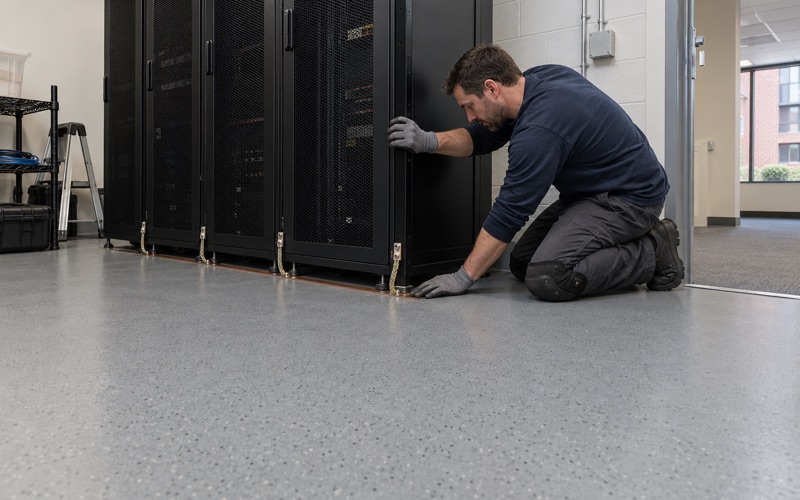
The rule names two floors, not one: the booth itself and the operator’s working area around it. On a manual line that working area is where a painter stands, steps back and sets down parts, so overspray and drips land there as well. We coat and detail both as one zone, with the same smooth finish carried out to a clear edge rather than stopping at the booth frame.
Who Else Has a Say
Bensenville Fire Protection District No. 2 is a separate taxing district from the village, and it conducts annual inspections of non-residential businesses. Building permits run through the Village of Bensenville Community Development department. We check permit questions with the village before we schedule, and we leave fire-code judgments to the people who make them.
Looking for epoxy-flooring closer to Winfield? See Winfield Epoxy-Flooring.
Overspray, Nonsparking Scrapers and Why Texture Matters
Section 1910.107(g)(2) requires that scrapers, spuds and other tools used for cleaning be made of nonsparking material. Paragraph (g)(3) calls for approved metal waste cans wherever rags or waste are soaked with finishing material. Together those lines describe the daily reality of a booth floor: someone is down there with a nonsparking blade, working dried overspray loose, and the rags go into a metal can.
What a Scraper Needs From the Floor
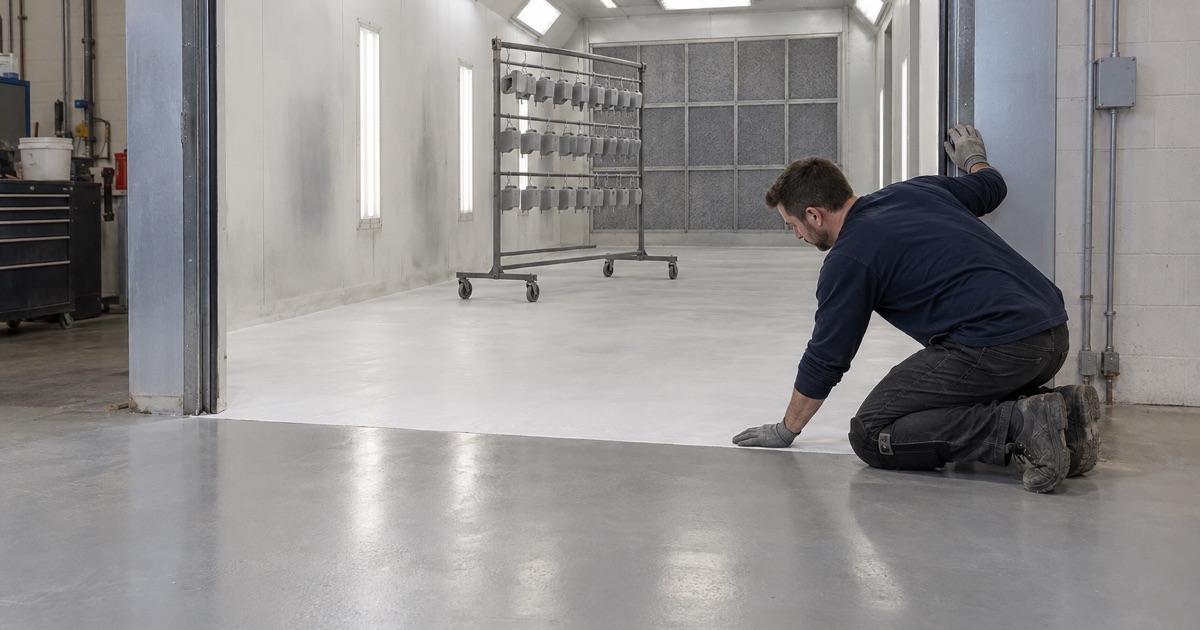
A scraper works best on a surface that is dense, hard and smooth enough for the blade to ride on rather than dig in. A floor that is soft, porous or poorly bonded lets overspray key into it, and every cleaning pass takes a little of the coating with it. Our usual answer for a finishing room is a 100% solids epoxy over a ground profile, finished with a chemical-tolerant topcoat chosen for the solvents actually used in the room.
We pick that system from the maker’s own data for those solvents, not from a general-purpose product. The proposal then names the product line, the number of coats and the finished thickness, so the floor that goes down can be checked against the quote.
On a robotic line the pattern is different: a robot repeats the same path, so overspray tends to land in the same places every day, and those spots see the most scraping. We look at where buildup concentrates before setting thickness, and a heavier build can go into those zones instead of across the whole floor.
Why Coarse Texture Works Against You
A heavy quartz aggregate broadcast or a deep vinyl flake texture gives good footing, but in a booth it becomes a trap. Overspray fills the valleys between the grains, the scraper skips across the peaks, and residue builds in exactly the places a blade cannot reach. Over months that buildup is the deposit the rule says enclosure floors are kept free of.
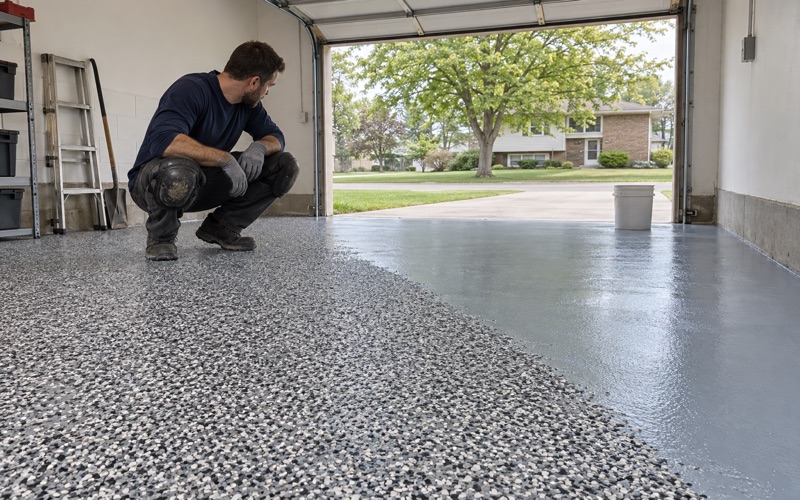
That does not mean a booth floor has to be slick. Slip resistance can come from a fine broadcast or an additive in the topcoat, and we specify it by the exact broadcast and topcoat used rather than promise it as a slogan. Outside the booth, in mixing areas and aisles, a stronger texture often makes sense, so we zone the floor instead of forcing one finish across the whole room.
Peelable Booth Coatings Over a Sealed Floor
Many finishing shops do not ask the floor itself to take every pass of the scraper. They lay a sacrificial layer on top, a peelable booth coating or paper, and change that layer when it loads up instead of grinding at the floor beneath. The resin floor then becomes the sealed, stable base the sacrificial layer sits on.
Why the Base Still Matters
A peelable coating only peels cleanly if what is under it is sound. Over bare concrete it can bond into the pores and tear out in patches, leaving a dusty, stained slab that holds residue. Over a well-bonded, smooth resin floor it releases in sheets, and whatever overspray slipped past an edge comes off the floor with a scraper rather than staying in the concrete.
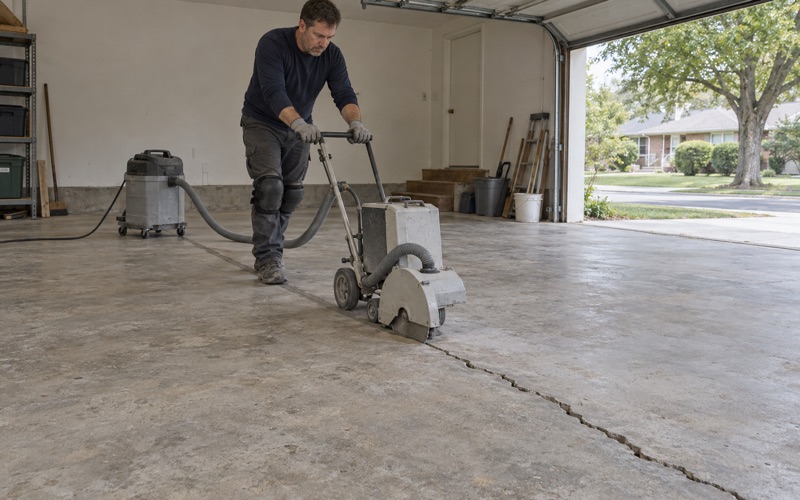
Joints and cracks under a booth deserve their own attention. Overspray and solvent find an open joint quickly, and a crack that shows through the coating becomes a ridge the scraper catches and a seam the peelable layer tears along. We fill them flush as part of the scope, so the finished surface reads as one continuous plane.
Before we coat, we ask which booth coating the shop uses, because some are water-based and some are not, and the base topcoat should tolerate the product that will sit on it and the method used to strip it. That conversation happens before the proposal, not after the first peel.
Preparing a Floor in a Working Shop
Grinding dust and fresh paint do not mix, so we capture dust at the machine with a vacuum rather than sweeping or rinsing it toward a floor drain. We phase the work around the production schedule, booth by booth where the layout allows, with overnight and weekend windows when a line cannot stop.
Cure follows slab temperature and the dew point spread at the slab surface, not the calendar. A cold slab in winter can leave amine blush on an epoxy, a greasy film that weakens the bond of the next coat, so we measure before every coat and wait when the numbers say to. We also choose products inside the Illinois VOC limits for floor and industrial coatings, which bind whoever applies them.
Conductive Overspray and What a Floor Coating Is Not
Copper and nickel shielding coats add a wrinkle that ordinary paint does not. When that overspray builds up on a floor it is metallic debris: conductive, and abrasive underfoot once it dries and gets ground in by carts and boots. A smooth, dense floor lets that buildup come off cleanly before it becomes a gritty layer that wears through a topcoat.
Treat It as Debris
We treat conductive shielding overspray as housekeeping debris to be removed, the same as any other residue. Our floors for these rooms are not sold as electrical control surfaces of any kind, and we do not suggest a coating changes how a shielding line should be run or cleaned.
Because the debris is abrasive, we weigh a topcoat’s wear resistance as heavily as its chemical resistance. Polyaspartic and polyurea topcoats each have a place in these rooms, and the choice comes down to the solvents present, the cleaning routine and how much cart traffic crosses the booth.
Where the Floor’s Job Ends
A resin floor is not a fire rating. It does not make a spray area meet the federal rule, it does not replace booth ventilation, and it does not replace the residue housekeeping the standard expects. What it can do is make that housekeeping faster and more complete, because residue sits on top of the floor instead of in it.
Whether a given booth floor is combustible, what covering it needs and how the space is inspected are questions for the shop’s own safety staff, its booth supplier and the fire district. We will tell you plainly what our system is and is not before you sign anything.
Moisture Comes First Here Too
Bensenville’s floodplain information names three flood sources, Willow Creek, Silver Creek (also called Bensenville Ditch) and Addison Creek, and we never assume a slab is dry because a building looks it. A moisture test is part of the written scope before the price is final, using ASTM F1869 calcium chloride kits or ASTM F2170 in-situ relative humidity probes as the slab calls for. Moisture is also the first exclusion we name when we explain what a coating warranty does not cover. When a reading comes back high, a moisture-mitigation primer joins the system and the proposal says so.
- 20+ Years Coating Concrete
- Moisture Tested Before Pricing
- Free Written Estimates