Lombard Epoxy Flooring brings more than 20 years in the trade to epoxy-flooring in Bridgeview, and this page covers one kind of floor in particular: the kind a state rule describes in its own words. When a regulation tells an owner what a floor must be, the coating stops being a style choice and becomes the finished surface of a requirement.
That changes the order of the work. The repair that happens before any resin goes down carries more weight than the color on top, the coat has to survive a cleaning routine that runs every working day, and the edges of the floor have to line up with walls the rule also cares about.
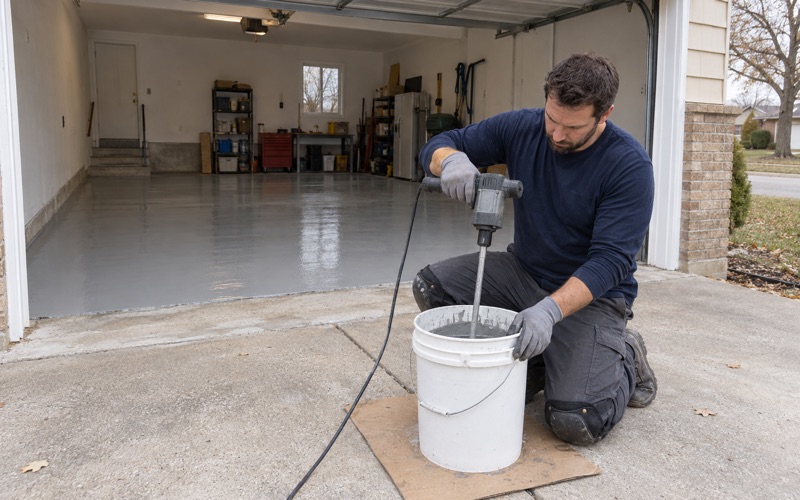
We open every slab mechanically, with a diamond grinder or a shot blaster rather than an acid etch, and we write the product line, the coat count and the finished thickness into the proposal. That way an owner, or anyone else who looks at the floor later, can hold the finished surface up against what was quoted.
Body-Art Studios on Harlem Avenue and the Rule That Names the Floor
Where the Studios Are
Bridgeview is a village in Cook County, about 15 miles southwest of the Chicago Loop, and it counted 17,027 residents at the 2020 census. The village’s motto is “A Well Balanced Community,” and its zoning is divided equally among residential, commercial and industrial uses. Harlem Avenue carries a district of Arab-American businesses, from groceries to Middle Eastern bakeries and candy shops, and body-art studios sit among its storefronts.
Several tattoo and piercing studios appear in directory listings along the avenue. Marc’D Up Tattoo & Piercing Studio is listed at 8520 S. Harlem Avenue, an address that geocodes inside the village in Lyons Township, with services listed as tattooing, tattoo removal and nose, ear and body piercing. Firehouse Tattoos is listed at 7269 S. Harlem, and Resurrection Tattoo & Piercing at 7344 W. 79th Street.
BrowBar, a microblading and cosmetic clinic, is listed at 8258 S. Harlem Avenue. We have not seen the floors in any of these businesses, and none of them is a customer of ours; they are named here only because they show what kind of tenant the avenue holds.
What 77 Ill. Adm. Code 797.1100 Says About Floors
The Illinois Body Art Code sets out requirements for premises in 77 Ill. Adm. Code 797.1100, and its first paragraph is unusually direct about floors. It opens: “All walls, floors and procedure surfaces of a body art establishment shall be smooth, free of open holes and cracks,” and it goes on to require that those surfaces be washable. Walls, floors and ceilings are to be kept in good repair and clean, and procedure surfaces are cleaned and disinfected after each client.
The same section carries other premises items an owner will plan around during a remodel, such as an operator hand sink serving no more than six stations and at least 20 foot-candles of light. Those are not floor items, but they tend to land in the same project, so we ask about them when we schedule the work. For the floor, the three words that matter are smooth, crack-free and washable.
Looking for epoxy-flooring closer to Hickory Hills? See Hickory Hills Epoxy-Flooring.
Free of Open Holes and Cracks: The Repair Under the Coating
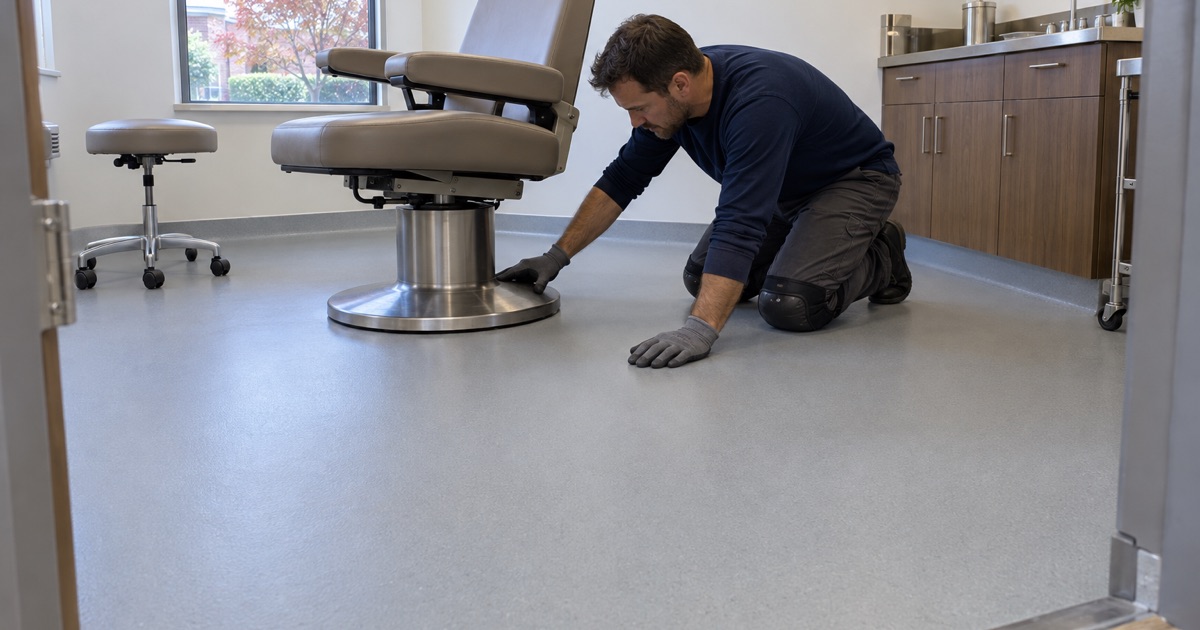
In most homes, filling a crack before a coating is about looks and longevity. In a body-art studio, the rule names open holes and cracks directly, so the repair under the coating is the compliance item and the coating is what keeps that repair smooth and sealed. A seamless coat laid over an unfilled crack will usually telegraph it back to the surface, and an open hole hidden under a thin film is still an open hole once the film breaks.
Mapping the Slab Before the Price
We map cracks, spalls and old coatings before we write a number down, and we say so plainly when a slab needs repair or replacement before it should be coated at all. A storefront floor may have been through several tenants, so the map tends to include things a garage floor never has: anchor holes from removed fixtures, cut lines from old plumbing, and patches of different concrete laid in at different times. The map goes into the proposal, so the owner can see which repairs are priced and where they sit on the floor.
We also test for moisture as part of the written scope, before the price is final, with ASTM F2170 in-situ relative humidity probes or ASTM F1869 calcium chloride testing. An older slab-on-grade storefront can push vapor up through the concrete, and a coating that lets go in a patch reopens exactly the kind of gap the rule prohibits. Moisture is also the first exclusion we explain when we talk about what a coating warranty does not cover.
Filling Flush, Then Profiling
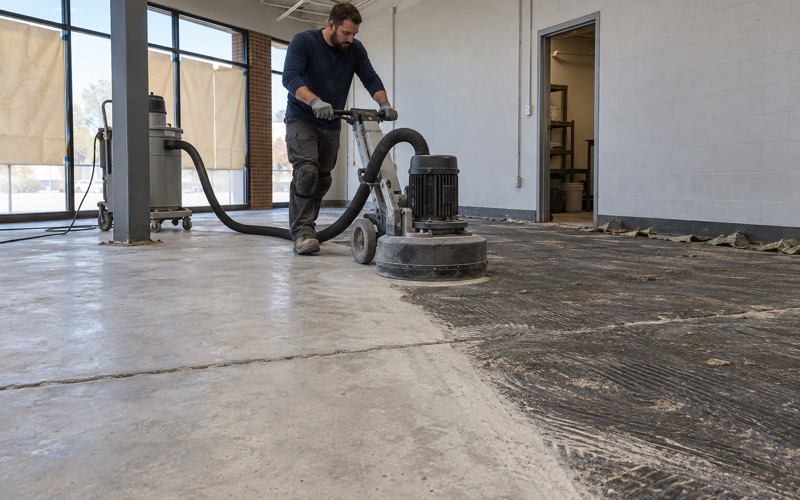
Old tile anchors, cracks and patched openings are filled flush with the surrounding slab before the seamless coat goes down, not mounded over and not left as shallow dips. Then the whole floor is ground or blasted to an ICRI CSP profile the primer can grip, so the repair material and the original concrete take the coating the same way. We capture grinding dust at the machine with a vacuum rather than rinsing it toward a floor drain, which matters in a shared storefront where dust can carry into the next tenant’s space.
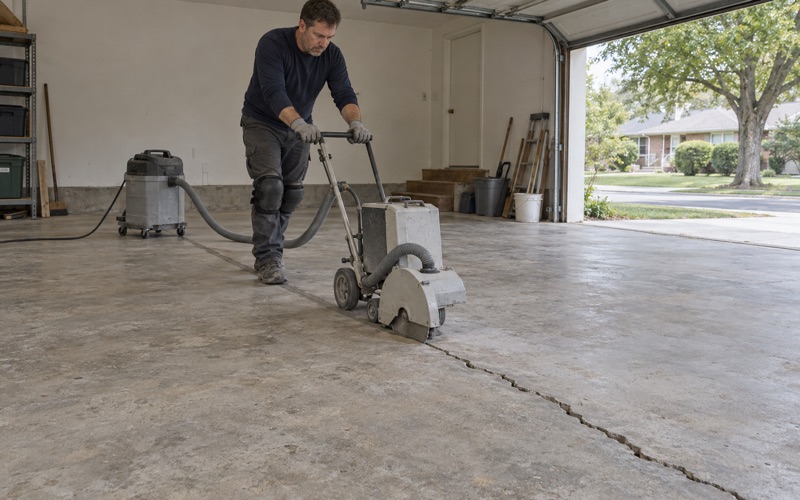
Deeper spalls and old anchor holes get an epoxy mortar or a patching compound, struck off level with the slab and ground again once it has cured. Narrow cracks are chased open and filled with a rigid crack filler so the coating does not simply sag into them. Control joints are a separate decision, because a rigid fill across a joint that is still moving will crack again and leave the open line the rule is written against.
Washable Every Day: What the Coat Has to Stand Up To
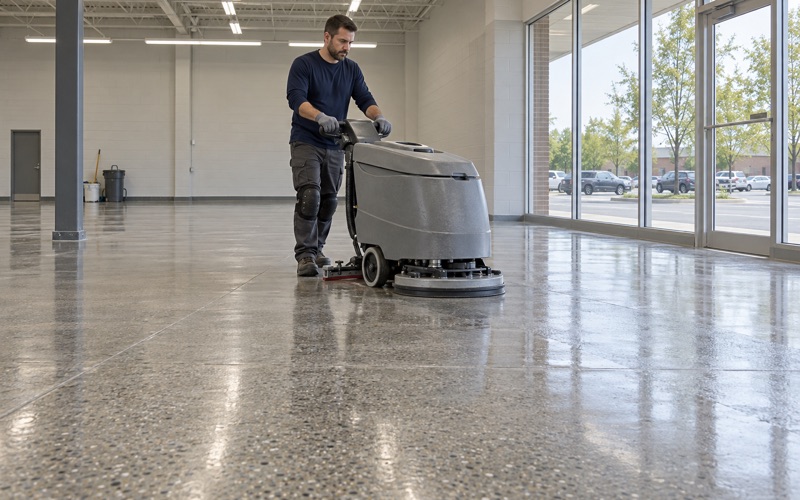
Washable is the second word in the rule that shapes the job. The floor around a station is typically mopped on a routine that runs as often as the studio is open, so the coating is chosen for repeated wet cleaning far more than for heavy loads or impact.
A Seamless System, Not a Sealer
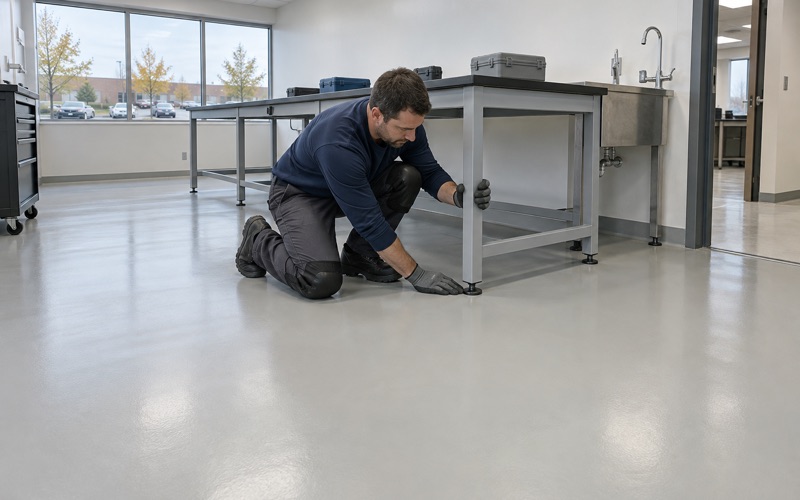
For that kind of use we lean toward a 100% solids epoxy base with a polyaspartic topcoat, which gives a continuous film with no grout lines or seams for residue to sit in. A lithium silicate densifier hardens bare concrete and a penetrating sealer slows staining, but neither produces the smooth, closed surface the rule describes. Where a client wants decorative color, a vinyl flake broadcast can be locked under the clear topcoat so the surface stays smooth to a mop.
At the base of the walls, an integral cove can carry the coating a short way up the wall, so a mop meets a rounded corner instead of a crevice where floor and wall meet. It is an option rather than something the rule spells out, and we price it as a separate line so the owner can decide.
Texture Without Trapping Dirt
A studio floor also has to be safe to walk on when it is wet from cleaning. We specify slip resistance by the broadcast and topcoat we use, such as a fine quartz aggregate in the final coat, rather than promising it as a slogan, and we keep the texture fine enough that a mop still clears it. A coarse texture holds grime, which works against the washable standard the floor is supposed to meet.
Working Around Appointments
A studio that works by appointment can rarely close for a week. We phase commercial floors around operating hours, with overnight and weekend windows where a space cannot close, and we set cure schedules by slab temperature and dew point rather than the calendar. A floor that is put back into service before it has cured is the floor that scuffs and wears first under foot traffic.
Shared Storefronts: Where the Studio’s Floor Has to Stop
Paragraph (b) of the same section opens: “All body art establishments shall be completely separated, by solid partitions or by walls extending from floor to ceiling,” from rooms used for human habitation, food establishments, hair salons and other activities that may contaminate work surfaces. On a commercial strip where a studio can sit beside a salon, a bakery or an apartment, that is a layout question before it is a flooring question.
The Floor Ends at the Partition
Under that rule, the studio’s floor ends at a solid partition rather than running through a shared room. When we coat a studio in a building it shares with another use, the coating stops at the base of the partition and is finished there cleanly, so the procedure area reads as its own space from wall to wall. If a remodel is still moving walls, we schedule the floor after the partitions are in place, not before.
Where a doorway in the partition opens to a shared hallway, we end the coating at a straight, sealed edge under the door rather than feathering it out, so the edge does not lift and open into a gap. A metal or resin transition strip at that line is often the cleanest finish.
Running one continuous coat under a later-built wall can leave fastener holes and chipped edges along the wall line, which are exactly the defects the rule names. Coating after the walls go up avoids that, and it lets us finish the floor to the edge of each room the way the rule draws the rooms.
A Coating Is Not a Registration
A finished floor helps an owner meet the surface language in the rule, but it is not approval of anything. Illinois registration and inspection of a body-art establishment are separate from the floor, and we do not describe a coating as health-code approval or promise any inspection result. If an owner is opening a new studio or moving one, we build the floor schedule around the dates the owner is working toward, but the registration itself is between the owner and the state.
The Same Logic at Home
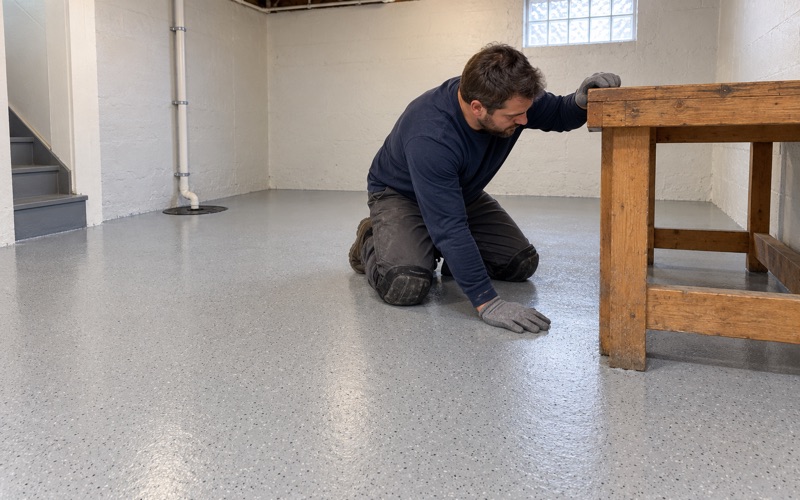
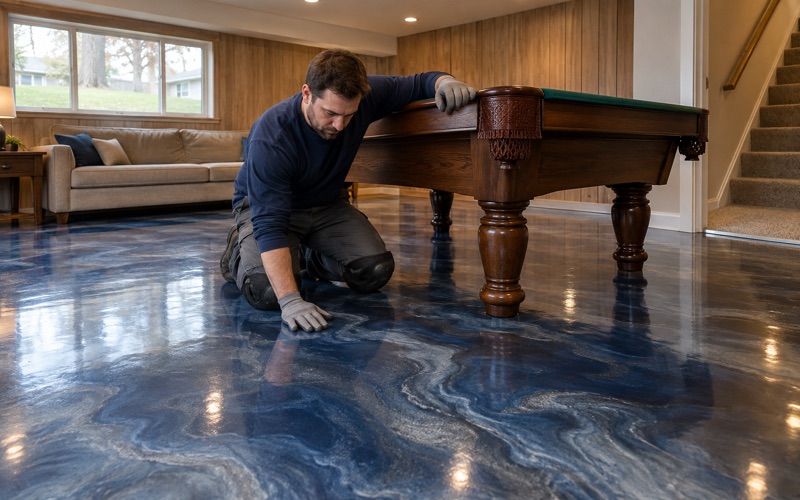
The seamless, crack-free approach also suits a home studio or a basement hobby room that gets wiped down often. Basement floors are read for past water first, because a coating does not stop seepage, a backup or a sump that cannot keep up. In Bridgeview, where the village reports repeated flood losses and most of its area sits in a high urban flooding susceptibility zone, that check comes before any color decision.
- 20+ Years Coating Concrete
- Moisture Tested Before Pricing
- Free Written Estimates