Lombard Epoxy Flooring has spent more than 20 years putting down epoxy flooring in Brookfield and the rest of our service area, and some of the most careful work we do is in rooms built for small children. A playroom asks a floor to do two different jobs, and only one of them belongs to a resin coating. Knowing where that line falls is the part of the job we plan first.
A seamless coated floor is easy to wipe, holds up to spilled juice and stroller wheels, and has no grout lines to trap crumbs. It is also a hard surface, and hard surfaces have no place under equipment a child can climb or slide from. So our playroom quotes show both zones on the floor plan: where the coating goes, where tested surfacing takes over, and how the two meet.
Our crews have done this long enough to know a playroom floor fails at its edges and its assumptions, not in its middle. The sections below walk through where the coating goes, where it stops, and why.
An Indoor Playspace and the Federal Line Under Climbing Equipment
Winnie’s Playroom on Monroe Avenue
Winnie’s Playroom on Monroe Avenue, near Eight Corners, is a good picture of the kind of room we mean. According to the Riverside-Brookfield Landmark, its owners turned a 2,400-square-foot vacant space into an open-concept play area for children up to age 6, with a play kitchen, a grocery store, play structures for gross motor skills, a padded area for crawling babies and a cafe for parents. The operator describes the space as designed for ages 6 months to 6 years, and a local listing mentions a climbing dome and a slide.
We have no connection to the business and have not seen its floors or measured any of its equipment. We bring it up because one room with a cafe, a pretend kitchen and a climbing dome holds every floor question a playspace owner or a parent planning a playroom will face.
What the Consumer Product Safety Commission Says
The Consumer Product Safety Commission’s Public Playground Safety Handbook is blunt on this point. Section 2.4.2 says a playground should never be installed without protective surfacing of some type, and that concrete, asphalt or other hard surfaces should never be directly under playground equipment. Carpeting and mats are not appropriate either unless they are tested to and comply with ASTM F1292.
A 2015 note from the Commission adds that it has always recommended against installing playgrounds over concrete, asphalt or paved surfaces because of head injuries from falls. The handbook is guidance rather than a rule, but it is the clearest written line we know of between a floor a child walks on and a floor a child may fall onto. We treat it as the starting line for any playroom floor plan.
What the Handbook Leaves Out
Section 2.4.1 lists equipment the surfacing recommendations do not cover, including ground-level activity walls, play houses and any other equipment children use when their feet remain in contact with the ground surface. Section 1.3 also excludes soft contained play equipment and points child care facilities, especially indoor ones, to ASTM F2373 for children 6 through 23 months. Those exemptions are what make a coated floor reasonable in much of a playroom.
Looking for epoxy-flooring closer to Schiller Park? See Epoxy-Flooring in Schiller Park.
Two Floors in One Room
Once the guidance is laid over a floor plan, a playroom splits cleanly in two. One zone is everything a child does standing up; the other is everything a child does above the floor.
Ground-Level Play, the Cafe and the Walkways
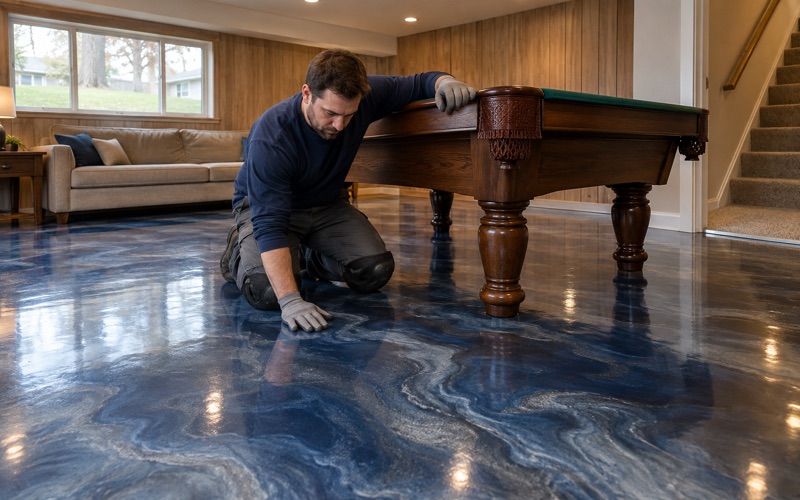
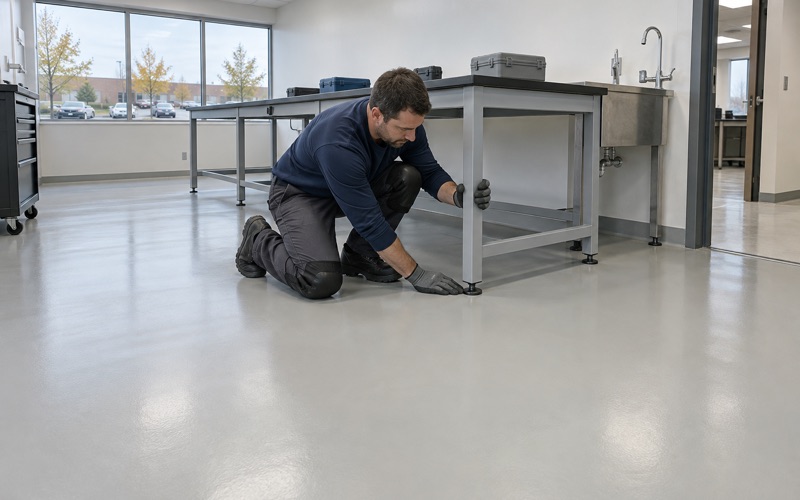
A play kitchen, a pretend grocery aisle, a board-game table, the cafe counter and the paths between them are all places where feet stay on the ground. That is where a seamless resin floor earns its keep: no seams for spilled smoothie or shaved ice to sink into, a surface that takes daily mopping, and a finish that cleans the same in the corner as in the middle of the room.
For these zones we usually spec a 100% solids epoxy base with a polyaspartic topcoat, and the slip resistance comes from the broadcast and topcoat named in the proposal rather than from a promise. A fine quartz aggregate broadcast gives texture without making the floor hard to wipe. A satin topcoat keeps glare down under bright overhead lighting.
Anything a Child Climbs
Under a climbing dome, a slide, a raised platform or anything else a child can fall from, the floor needs impact-attenuating surfacing tested to ASTM F1292 for the fall height of that equipment, or the mats the equipment maker specifies. That zone is sized from the equipment, not from what looks tidy on the plan. The equipment supplier and the surfacing maker set those numbers, and we build to the boundary they give us.
Why a Coating Is Never Fall Protection
A cured resin film is bonded tight to the concrete beneath it, so it is a hard surface in exactly the sense the handbook means. No topcoat, broadcast or flake changes that, and we will not sell a coating as impact protection of any kind. If a quote for a playroom shows resin running under climbing equipment, that quote has the plan wrong.
The Edge Where a Coated Floor Meets Tested Surfacing
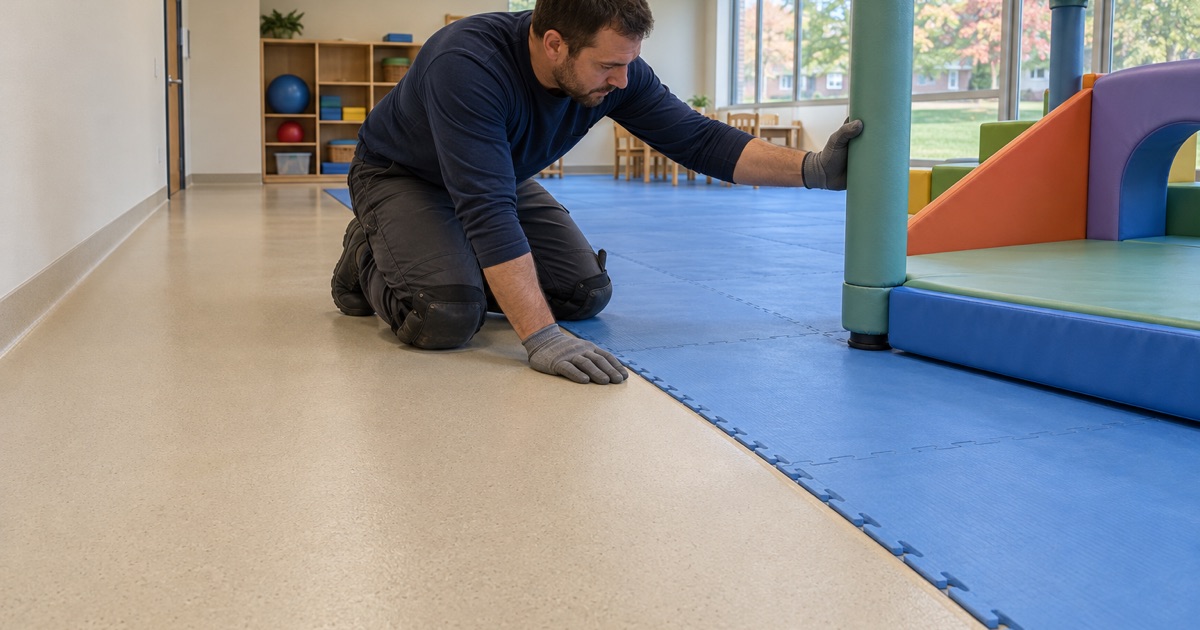
The transition is where most of the thinking goes on a playroom job, because it is the one place both floors have to agree. A lip or a gap there becomes a trip edge in the middle of the busiest part of the room.
A Flush, Bonded Line
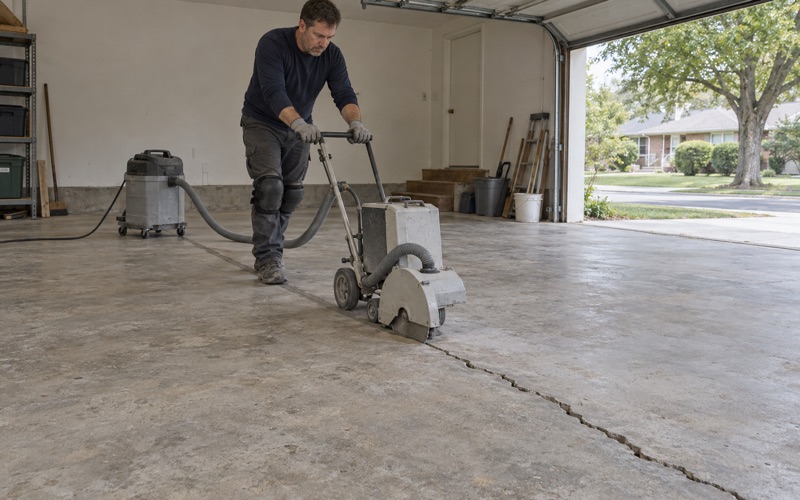
We find out what the surfacing will be before we grind, because its thickness decides the detail. Where the surfacing sits on top of the slab, the coating stops at a clean, saw-cut or taped termination and a transition strip or ramped edge brings the two flush. Where an owner wants the surfacing set into the floor, that recess is a concrete job that happens first, and the coating is terminated at its edge afterward.
The coated edge itself is ground and keyed into the slab rather than feathered thin, so it does not lift or chip where mats get pulled up for cleaning. A chipped edge is a crumb trap and the first place a coating starts to peel. A thicker surfacing product added later can change the detail, so the edge should be revisited whenever the surfacing is replaced.
Sequencing the Work
In a commercial playspace we coat first and let the surfacing installer work on a cured floor, so mats and tiles are never set onto resin that is still soft. Cure times follow slab temperature and dew point rather than a fixed day count, and we tell an owner plainly when the room needs another night. For a space that cannot close, the grinding and coating are phased into overnight or weekend windows.
Grinding dust is pulled into a vacuum at the machine, which matters more than usual in a room where toddlers will be on the floor within days. Nothing is rinsed toward a floor drain, and the room is cleaned before the surfacing crew arrives.
When the Equipment Moves
Playspaces and playrooms get rearranged as children grow, and a climber moved across the room takes its surfacing zone with it. That is a reason to settle the layout before the coating goes down, not after. When a family expects to move things later, we leave a clean, sealed termination that a future crew can tie new coating into, rather than coat the whole room on a guess.
Home Playrooms and Basements: The Same Line
Brookfield’s housing stock is old and mostly owned by the people who live in it. Of 7,927 housing units in the village, 2,543 were built in 1939 or earlier and another 2,086 between 1950 and 1959, and 81.8 percent of occupied units are owner-occupied. A basement or a spare room in one of those houses is a common place for a playroom, and the same line applies there.
Coat the Play Floor, Not Under the Climber
A home climber, a toddler slide or an indoor gym frame gets the same treatment as commercial equipment: the coated floor runs to the edge of a zone left for the maker’s specified mats or tested surfacing. We mark that zone with the family before grinding, so the edge lands where the equipment will actually sit. The rest of the room, where a train table or a play kitchen goes, is where the coating makes cleanup easy.
Basement Slabs Get Read for Water First
A basement playroom is only as good as the slab under it, so we look for signs of past water before we talk about color. A coating does not stop seepage, a sewer backup or a sump that cannot keep up, and moisture vapor pushing up through the slab is the first exclusion we name in any warranty. That is why a moisture test, such as ASTM F2170 in-situ relative humidity probes or an ASTM F1869 calcium chloride test, is in the written scope before the price is final.
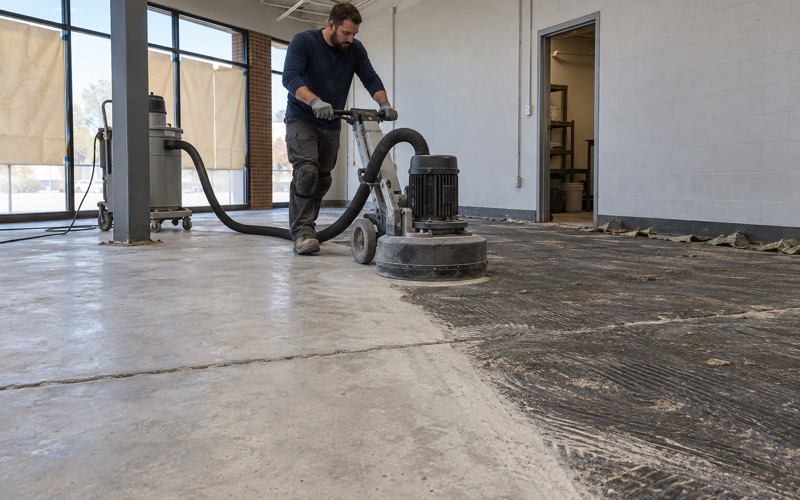
Floors in houses this age also tend to carry a history of paint, patches and old sealers. We map cracks, spalls and old coatings before quoting, and when a slab needs repair or replacement before it should be coated, the estimate says so rather than hiding the problem under a thicker coat. Each slab is then opened with a diamond grinder or shot blaster, never an acid etch, so the coating has a real profile to grip.
Permits and Paperwork in Brookfield
The Village of Brookfield’s permit page lists replacing existing flooring among the jobs that need no permit, while finishing a room in a basement, installing drain tile or altering interior plumbing each require one. A coating on an existing slab most likely falls on the permit-free side, but the page does not name floor coatings, so we confirm it with the village’s Building and Planning divisions before scheduling. If the playroom plan includes finishing the basement around it, that part of the project crosses to the permit side.
Home jobs above the Illinois threshold get a written contract and the Home Repair: Know Your Consumer Rights pamphlet before any grinding starts. Families planning a playroom can expect a proposal that shows the coated area, the surfacing zone and the edge between them, with the product line, coat count and finished thickness spelled out.
- 20+ Years Coating Concrete
- Moisture Tested Before Pricing
- Free Written Estimates