Lombard Epoxy Flooring has spent more than 20 years putting epoxy flooring in Burr Ridge homes and businesses, and the rooms that teach us the most are the ones that have to come clean quickly. A veterinary exam room, a treatment area, a cat ward, a laundry room where a sick pet sleeps for a few weeks: each one is judged by what a mop leaves behind.
That standard matters most with a fungal skin infection that spreads on shed hair. The cleaning that removes it is mechanical before it is chemical, so the floor underneath either helps that first step or fights it. Seams, grout lines, cracks and a deep, rough texture all hold hair against a mop, and a seamless coated floor with a fine finish does not.
We want to be plain about the limit up front. A floor coating does not treat a pet, kill a fungus or replace a veterinarian’s plan. What it can do is make the cleaning the veterinarian asks for faster, more complete and easier to repeat.
A Dog-and-Cat Hospital in Burr Ridge Village Center
Harvester Veterinary Hospital of Burr Ridge sits at 807 Village Center Drive, on the Cook County side of the village in Lyons Township. Its own site describes a locally owned practice for dogs and cats, with preventive and diagnostic care, surgery, dental work, puppy, kitten and senior pet care, and emergency and urgent visits. Directory and job listings describe it as a Cat Friendly practice; that is their description, and we repeat it only as theirs.
We have not seen its floors, and nothing here suggests the hospital has a problem with them or with any infection. It is simply the clearest local example of the kind of room this page is about: exam rooms, a treatment area and, where a practice has one, a cat ward. Rooms like these are cleaned over and over, and the floor decides how well that cleaning works.
The System Under a Clinic Floor
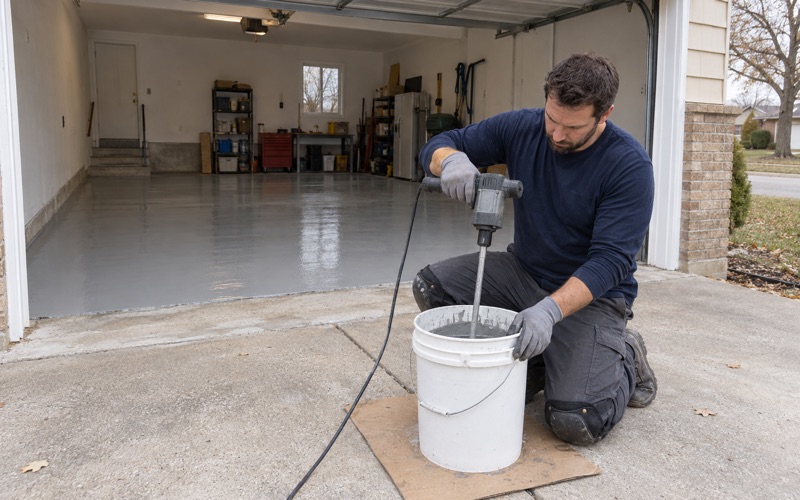
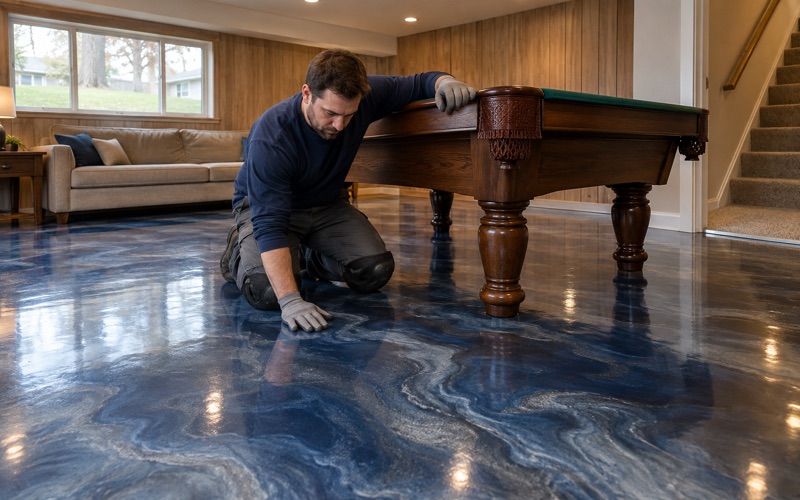
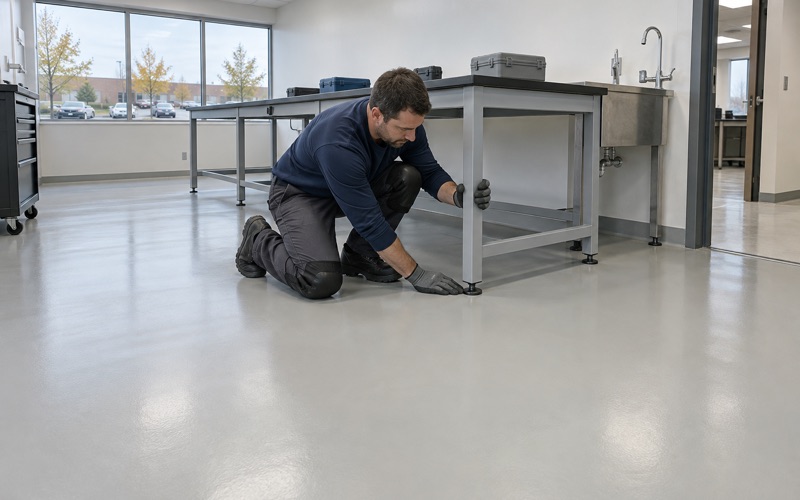
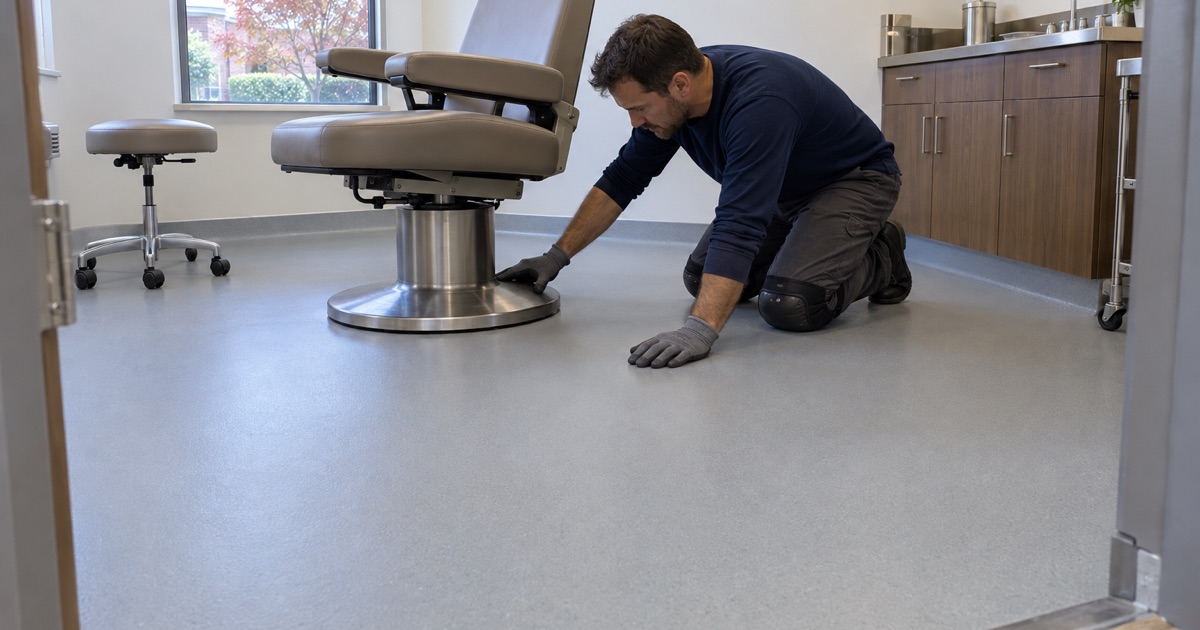
For a clinic exam or treatment room, we usually build a 100% solids epoxy body coat over a ground slab and finish it with a polyaspartic or urethane topcoat chosen for wear and cleanability. Where a slab tests high for moisture, a moisture-mitigation primer goes down first, or the room waits. The goal is a surface with no pores, no seams and nothing loose for hair to catch on. Every product is picked inside the Illinois VOC limits for floor coatings, which bind whoever applies them.
Working Around Clinic Hours
A practice that takes same-day appointments cannot close for a week while a floor cures. Harvester’s posted hours run weekdays from 8:00 a.m. to 6:00 p.m. with a midday break and on Saturday until 1:00 p.m., with Sunday closed, which is the kind of week a clinic floor job has to fit around. Clinic floors are done in phases, one room or zone at a time, using overnight and weekend windows so the rooms still in use stay open.
Each phase is timed to the slab, not the calendar. We read slab temperature and the dew point spread at the surface before we coat, because a resin that cures cold or damp can blush and stay soft, and a room returned to service too early wears marks into a finish that never fully hardened. A polyaspartic topcoat can shorten the time a room is out, where the system and the slab allow it.
Looking for epoxy-flooring closer to River Forest? See Epoxy-Flooring Services in River Forest.
Ringworm Travels on Hair, So Cleaning Starts With the Hair
Ringworm is not a worm. It is a dermatophyte, the fungal skin infection a veterinary clinic sees most often in cats, and its spores ride on shed hair and the debris that comes with it. That is why veterinary dermatology guidance treats the environment as a hair problem first and a disinfection problem second.
Step One Is Mechanical
The guidance we lean on is the VIN Veterinary Partner article on ringworm environmental decontamination, revised in 2022 and built on Karen Moriello’s work at the University of Wisconsin. It lays the job out in two steps. First, remove pet hair: wipe, sweep or vacuum the surface, then wash it thoroughly until it is visibly clean of hair. Second, apply disinfectant and let it sit for five minutes.
The article calls step one the most important step, for two reasons. Many surfaces can be rid of ringworm simply by removing the hair, and many disinfectants do not work in the presence of debris. In other words, disinfecting a floor that still holds hair skips the step that matters most.
Order matters on a floor as much as anywhere. Hair picked up dry comes away cleanly; hair hit with a wet mop first clumps, smears and gets pushed into whatever corner or groove the mop leaves behind. That is why the dry pass comes before the wash.
What That Asks of a Floor
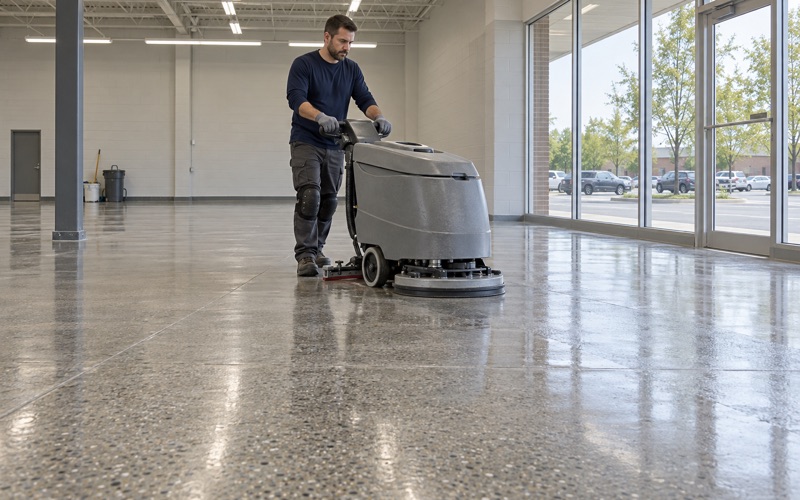
Read as a floor specification, step one is a demand on the surface. Hair has to come up with a dry pass and then wash off completely with a wet one, without leaving strands packed into a joint, a pore or a pocket of texture. A floor that lets a mop glide over it and carry everything away makes step one quick; a floor that snags and holds hair makes it slow and uncertain.
Step two, the disinfectant and how it is used, is the veterinarian’s decision, not ours. Our part ends at giving the clinic a surface where that step lands on a floor that is already clean.
Seams, Grout and Deep Texture Are Where Hair Stays
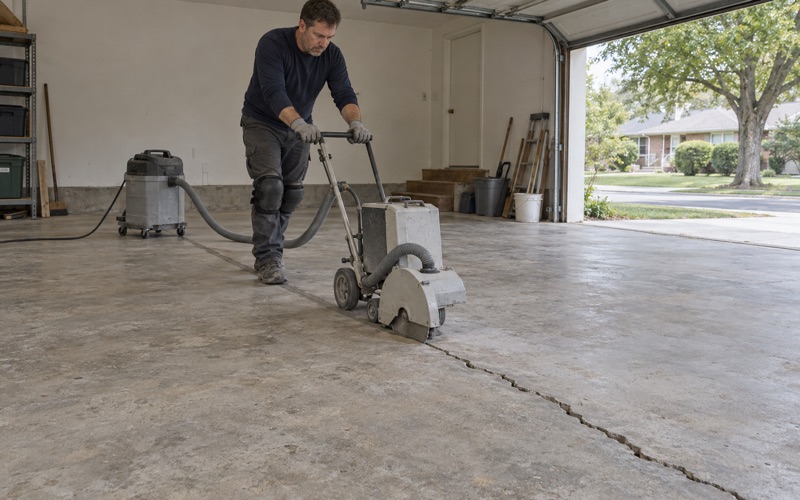
Hard floors tend to fail step one in the same few places. Tile has a grout line every few inches, sheet goods and plank have seams, and an old slab has cracks and saw-cut joints that collect fine debris. Each of those is a groove a mop rides over, and shed hair is light and fine enough to settle into it and stay.
Seamless and Coved
A resin floor removes the grout and the seams by being one continuous surface. Before it goes down, we fill cracks and treat joints according to what they are doing, because a moving joint that is simply buried can crack back through the coating. At the walls, a coved base carries the floor a few inches up the wall in one piece, so the corner where hair drifts during sweeping becomes a curve a mop can follow.
The FDA Food Code asks for coved floor-to-wall junctures in food rooms for the same reason: a square corner is hard to clean. A veterinary room is not a kitchen and that code does not govern it, but the cleaning logic carries straight across.
Bare Concrete Holds It Too
Leaving the slab bare does not solve the problem. Concrete is porous, and even a slab hardened with a lithium silicate densifier keeps a surface texture and open pores that hold fine debris. A sealed resin floor closes that surface, which is the whole point in a room where the cleaning has to finish visibly clean.
A Fine Texture, Not a Deep Broadcast
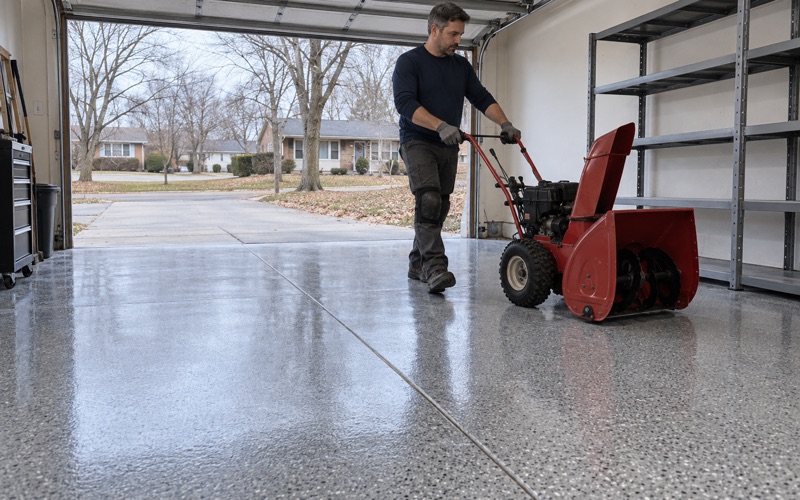
Texture is where a well-meant floor goes wrong. A heavy quartz aggregate broadcast or a dense vinyl flake broadcast left with a rough top builds the very pockets step one is trying to clear, and on a garage floor that grip is welcome. In an exam room or a cat ward, we specify a fine-texture topcoat instead, with the texture set by the broadcast size and the number of topcoats rather than promised in a brochure.
The balance is real, because a floor still has to be safe to walk on when it is wet. That is why the written proposal names the product line, the number of coats, the finished thickness and the texture, so the room can be checked against what was quoted.
A topcoat also wears, and a worn traffic lane slowly opens texture that was not there on day one. We would rather plan a recoat of the topcoat before the lane wears through than grind off a floor that has started to hold hair.
A Hard-Floored Room at Home While a Pet Is Treated
The same guidance carries home. It advises keeping a pet under treatment in an easily cleanable room without carpeting or clutter, and it names bathrooms and other hard-floored rooms as working well. Wall-to-wall carpet is the hard case: it needs steam cleaning, or disinfecting followed by shampooing.
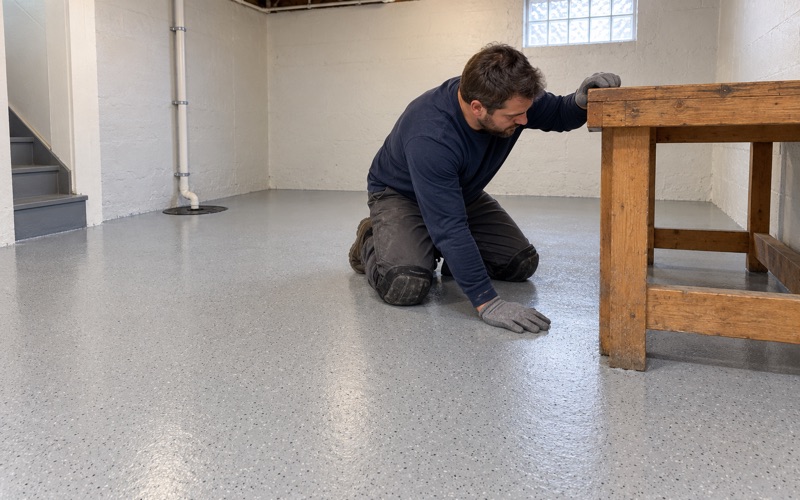
Burr Ridge housing is 94.0 percent owner-occupied, and 61.6 percent of it was built between 1980 and 2009. Where one of those houses has a basement, a laundry room or a mudroom on a concrete slab, a coating can turn it into the room the guidance describes: seamless, sealed and quick to sweep and wash every day of a treatment.
Choosing the Room
The best candidate is a room with a door, no carpet and little stored in it, because clutter is the other thing the guidance warns about. A laundry room or mudroom is often easier than a finished basement, which tends to carry carpet, furniture and boxes that would all have to come out. Whichever room it is, a coved base at the wall keeps the daily sweep free of a square corner.
Test the Slab Before It Becomes the Pet Room
A basement floor that looks dry can still push moisture up through the concrete. Whether a slab from that era was poured over a vapor retarder is not recorded anywhere we can look up, so we test rather than assume, using an ASTM F1869 calcium chloride test or ASTM F2170 in-situ relative humidity probes, and the moisture test is written into the scope before the price is final.
We also read the room for past water first. A coating does not stop seepage, a sewer backup or a sump that cannot keep up, and moisture is the first exclusion we name when we explain what a coating warranty does not cover.
Grinding Inside an Occupied House
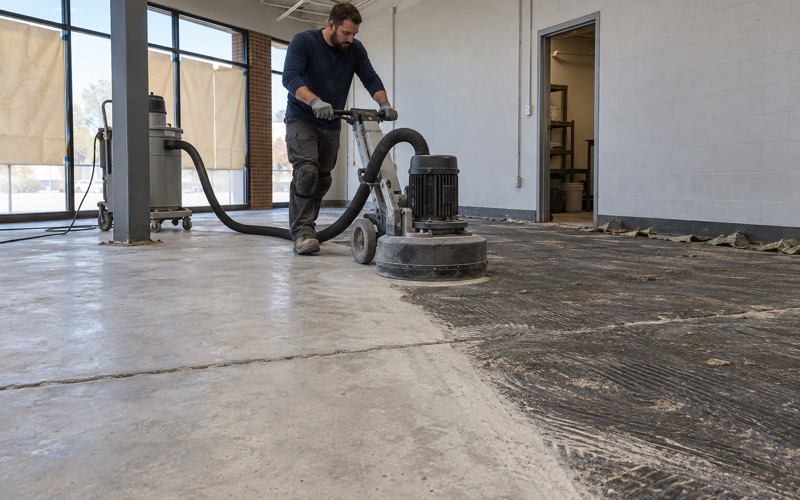
Every slab is opened with a diamond grinder or a shot blaster, never an acid etch, so the coating has a real profile to grip. The dust is captured at the machine by a vacuum rather than washed toward a floor drain or a sump. For a household planning ahead, the room is prepared and fully cured before a pet is kept in it. Home jobs over the state threshold get a written contract and the Home Repair: Know Your Consumer Rights pamphlet before any grinding starts.
- 20+ Years Coating Concrete
- Moisture Tested Before Pricing
- Free Written Estimates