Lombard Epoxy Flooring brings more than 20 years of work to epoxy flooring in Chicago Ridge, and a lot of that time has gone into floors that are mopped more often than they are walked dry. Spills that look harmless, a splash of smoothie or a dripped syrup, ride the mop bucket into the surface of bare concrete and stay there. Our job is to put a sealed, seamless coating between that traffic and the slab.
Every job starts the same way, whether it is a shop counter area or a basement bar. We map cracks, spalls and old coatings, run a moisture test as part of the written scope, and only then put a price on paper. If a slab needs repair or replacement before it should carry a coating, we tell you that first.
The proposal names the product line, the number of coats and the finished thickness, so you can hold the finished floor up against the quote. What the warranty leaves out is explained before anything is signed, and moisture is the first exclusion on that list.
A Ridgeland Avenue Cafe Open Past Midnight
Breakfast to 1:00 a.m. on Weekends
Bora Bora Smoothie Cafe at 9943 Ridgeland Avenue sells smoothies, acai bowls, specialty coffee, waffles and crepes. It opens at 8:00 a.m. every day and stays open until midnight Sunday through Thursday and until 1:00 a.m. on Friday and Saturday. That adds up to sixteen or seventeen hours a day of blended drinks, coffee and waffles being poured, carried and occasionally dropped.
We have not been inside the cafe and offer no view on its floor. We use it because it is a clear Chicago Ridge example of a business whose day is built on sweet drinks and food, and the floor questions it raises reach well beyond one counter.
Ridgeland Avenue is where much of Chicago Ridge’s retail sits, from the Chicago Ridge Mall at 95th Street to the Commons of Chicago Ridge at 9900 Ridgeland. A counter serving sweet food along that corridor shares its basic floor problem with a food court stall or a snack bar in a bigger box. What differs is scale, not chemistry.
How a Sweet Spill Reaches the Cement
A sugary spill rarely stays a small sticky spot. It gets wiped, then mopped with water, and the sugar that sat on top is now dissolved and spread across a wider patch of floor. On a sealed coating that solution stays on the surface until the next pass of the mop lifts it.
On bare or worn concrete it goes differently, because the slab is porous and the mop water carries sugar into the pores and the joints. Each cleaning adds a little more, and the floor starts to feel tacky underfoot even right after it has been washed. Those sticky floors are often the first sign that the surface is holding what it should be shedding.
Behind a counter the pattern concentrates in a few places: the blender station, the floor below the topping rail, the path between the counter and the dish sink, and the spot in front of the trash. Those are the zones where a floor gets wet many times a day and seldom dries fully between mops.
Looking for epoxy-flooring closer to Lincolnwood? See Epoxy-Flooring Services in Lincolnwood.
What a Sugar Mill’s Spalled Floor Shows
The closest documented record we have of sugar acting on concrete comes from far outside any cafe. Belzona, a coatings maker, published a case record, KHIA 236, from a 1992 application in the raw sugar storage area of a Minnesota sugar beet mill.
Raw Sugar and Ambient Moisture
The record puts it plainly: “Raw sugar and ambient moisture create an erosive environment over the concrete surface.” It goes on to say that over time the floor’s surface spalls and creates safety hazards, and that conventional concrete products offer poor chemical resistance against organic substances. At the mill, the spalled areas and cracks were repaired with Belzona 4111.
What we take from it is the pairing. The record does not single out sugar or water alone; it describes the two together wearing at the surface until it spalls. A sweet-drink counter over an uncoated slab puts both there at once, many times a day.
Reading a Case Record for What It Is
A manufacturer’s case record is not an independent test, and a mill storage floor is not a cafe floor. The mill stored raw sugar, while a smoothie counter sees syrup and sweet drinks in small, frequent spills. The link between the two is our inference, not a finding anyone has measured in Chicago Ridge.
Even with those limits, the record points toward what a sweet-spill floor needs. Bare concrete is the vulnerable layer, so the useful step is to keep sugar solutions from reaching it at all, with a coating that stays continuous where the mopping is heaviest.
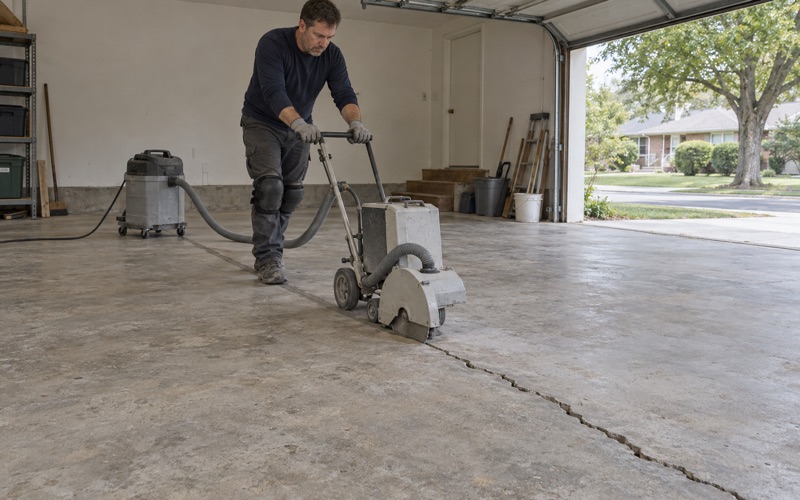
That also shapes how we handle a slab that already shows damage. Spalled patches, open cracks and scaling are mapped before we quote and repaired with a compatible patch material before anything is coated, because a coating laid over a crumbling surface fails along with it.
Sealed and Seamless So Syrup Mops Off
Opening the Slab for a Real Bond
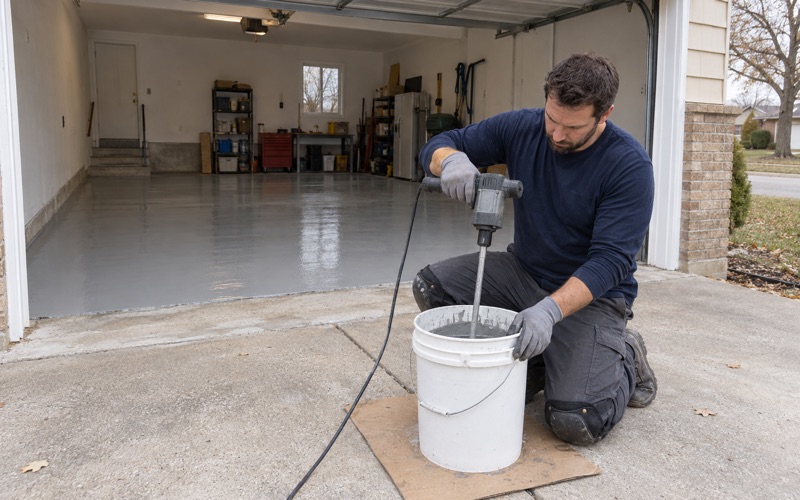
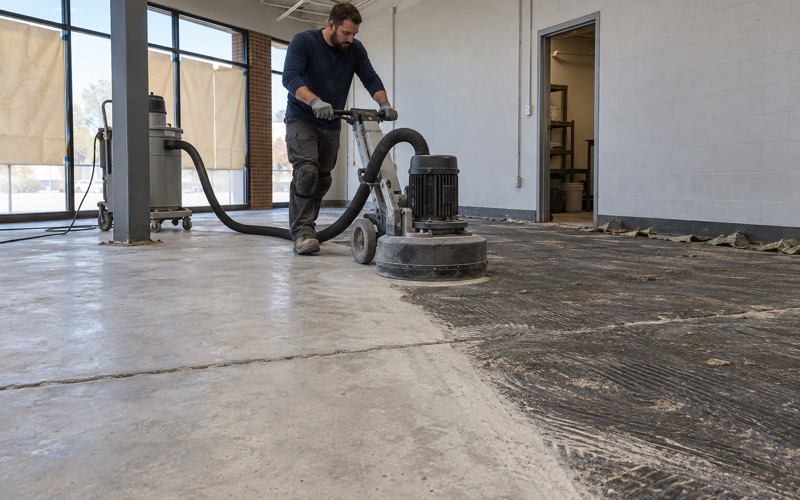
A coating that takes daily wet mopping needs to grip the concrete mechanically. We open every slab with a diamond grinder or a shot blaster to a profile matched to the system, using the ICRI CSP 1-10 concrete surface profile scale as the reference. Grinding dust is captured at the machine by a vacuum, not rinsed toward a floor drain or a sump.
Old sugar residue matters at this step. A floor mopped with sweet spills for years can carry residue in its pores, so we clean and grind until we reach sound, clean concrete rather than sealing a film in.
Choosing a System for Wet, Sticky Traffic
For a spill zone, a 100% solids epoxy base builds a continuous film with no solvent to flash off. A polyaspartic or polyurea topcoat adds wear resistance, and urethane cement is the option we raise where hot water and heavy wash-down are part of the routine. Every product is picked inside the Illinois VOC limits for floor coatings under 35 Ill. Adm. Code Part 223 Subpart C, which bind whoever applies them.
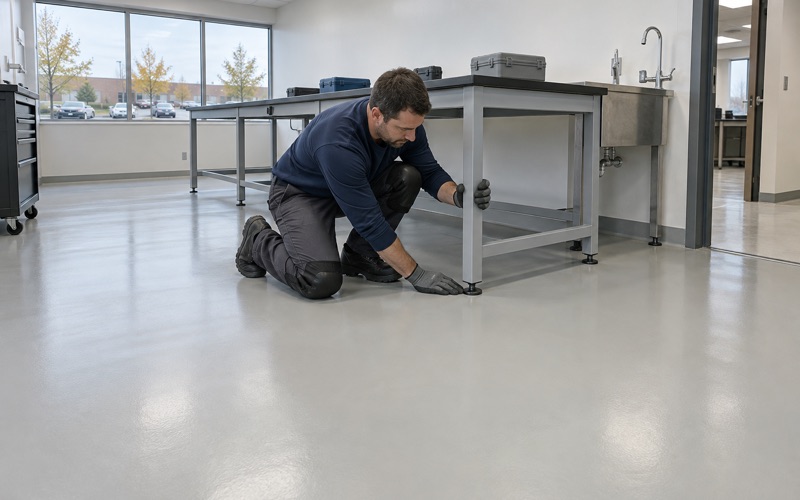
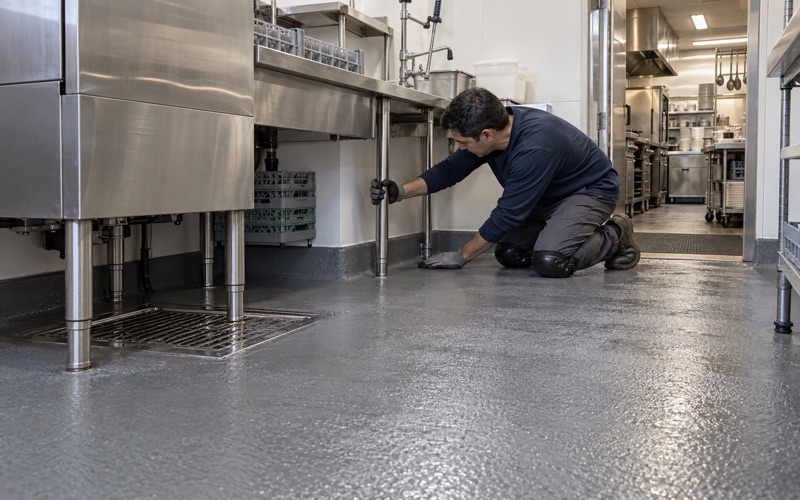
Seamless is the point. Grout lines, tile edges and open joints are where syrup collects and where a mop pushes it around instead of lifting it, so joints are filled and the coating can turn up the wall as a coved base, the floor-and-wall juncture FDA Food Code 6-201.13 addresses.
Texture Without a Trap
A wet floor still has to be walked on. We specify slip resistance by the broadcast and the topcoat, usually a fine quartz aggregate broadcast locked under the final coat, so the texture is real without being coarse enough to hold sugar. FDA Food Code 6-201.11 calls for smooth, easily cleanable floors but makes an exception for antislip floor coverings or applications used for safety reasons.
Cure schedules follow slab temperature and the dew point spread at the slab surface, not the calendar. Amine blush, the waxy film some epoxies form in cool, damp air, is checked for and removed before a topcoat goes down.
Mopping a Sealed Floor
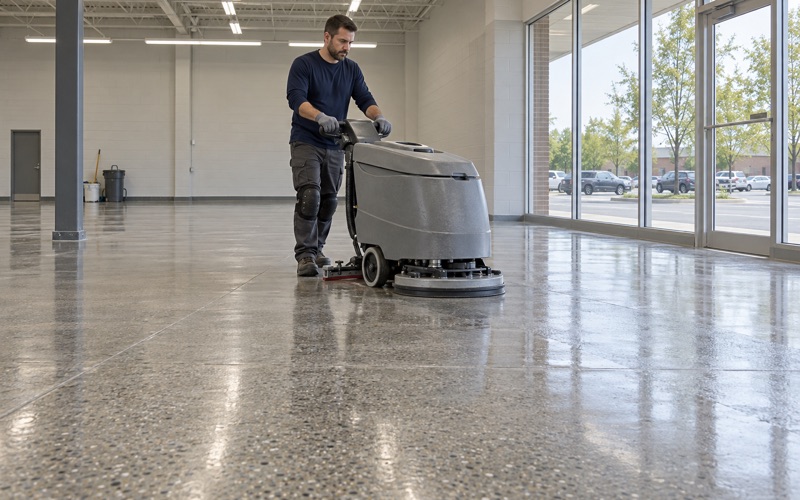
Once the coating is down, the cleaning routine gets simpler. Sticky residue that used to need scrubbing out of the concrete comes up with a damp mop and clean rinse water, and changing the mop water often keeps a sugar film from being spread back across the floor. A neutral cleaner suits most resin floors better than a harsh one, and we leave written care notes with the system name on them.
Sticky Basement-Bar and Garage-Fridge Floors at Home
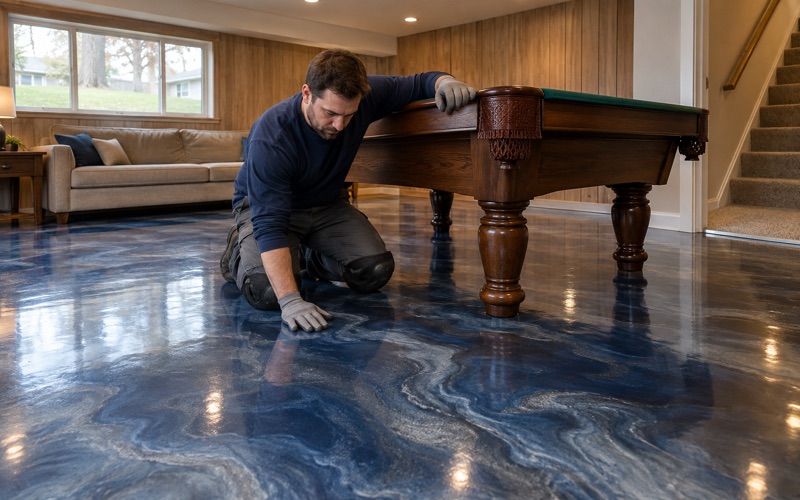
The same sugar-and-water problem shows up at home on a smaller scale. A basement bar with a soda line or a blender, and a garage fridge stocked with pop and sweet tea, both put sweet spills onto concrete that tends to get mopped rather than sealed.
The Basement Bar
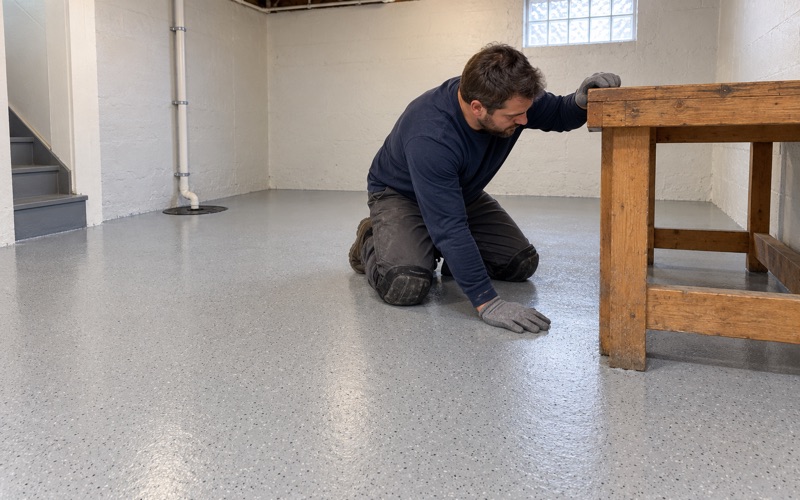
Before a basement floor is coated, we read it for past water, because a coating does not stop seepage, a sewer backup or a sump that cannot keep up. The village has reported storm-related sewer backup and cleaning deployments, so a basement with a history of water gets that conversation first. The moisture test sits in the written scope: an ASTM F2170 in-situ relative humidity probe or ASTM F1869 calcium chloride test, with the ASTM D4263 plastic sheet test as a quick first look.
Chicago Ridge’s housing leans on 1960 to 1989 construction, which makes up 58.3 percent of the stock. A slab of that age has had decades in service and may already carry an old paint or sealer, which has to come off before a new system will bond. Where the readings run high, a moisture-mitigation primer goes down before the epoxy.
We never present a basement coating as radon reduction. In Illinois that is licensed mitigation work under IEMA, and it is a separate job from a floor.
The Garage Fridge Corner
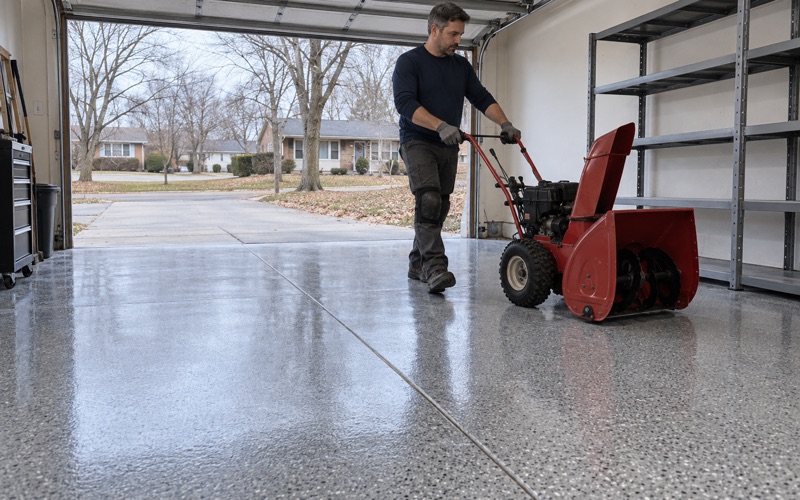
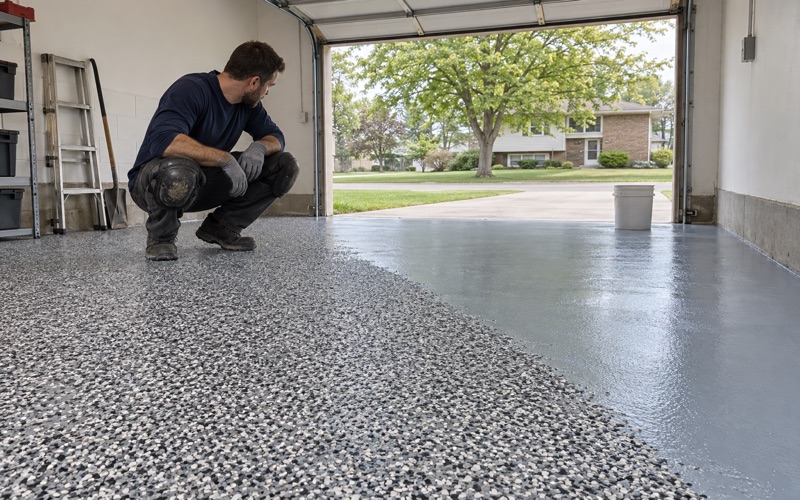
In a garage, the soda puddle under the fridge shares the floor with winter brine and rock salt riding in on tires. We choose garage systems to stand up to both, usually an epoxy base with a vinyl flake broadcast and a polyaspartic topcoat that resists hot tire pickup. The flake hides the odd stain, and the sealed topcoat lets a dried spill come up with a damp mop.
An unheated garage in deep winter is told to wait. The slab has to be warm and dry enough for the coating to cure properly, and we would rather move a date than lay a floor into cold that it cannot cure through.
Before the Work Starts
We check permit questions with the Village of Chicago Ridge Building Department before a job is scheduled. The village permit sheet says all construction or remodeling work on or in any type of building needs a permit, with the application completed by the contractor doing the work, and it does not list floor coating as exempt.
Home jobs over the state threshold get a written contract under the Illinois Home Repair and Remodeling Act, along with the Home Repair: Know Your Consumer Rights pamphlet, before any grinding starts. That way the scope, the moisture findings and the coating system are all on paper while there is still time to ask about them.
- 20+ Years Coating Concrete
- Moisture Tested Before Pricing
- Free Written Estimates