Lombard Epoxy Flooring installs commercial epoxy flooring in Lombard, IL, serving surrounding cities including Northlake, Westchester, Wood Dale, Hinsdale and Bensenville. With more than 20 years of grinding and coating concrete, we know that a commercial floor is as much a scheduling job as a coating job: the space usually has to stay open, the floor has to handle carts and cleaning chemicals, and the work has to fit around tenants, patients, guests or students.
Commercial floors carry more traffic and heavier loads than a home, they are cleaned more often and more aggressively, and they are judged by building managers, inspectors and customers. A resin floor that is ground, repaired and built to the right thickness gives a seamless, easy-to-clean surface that stands up to all of that, while a thin coating over a poorly prepared slab shows wear in months.
Every commercial proposal we write names the system, the coat count and the finished thickness, the moisture result and the repairs, along with the phasing plan. Building owners and facility managers can check the finished floor against it and plan budgets around a scope that is spelled out rather than implied.
Commercial Spaces We Coat
Offices, Mechanical Rooms and Storage
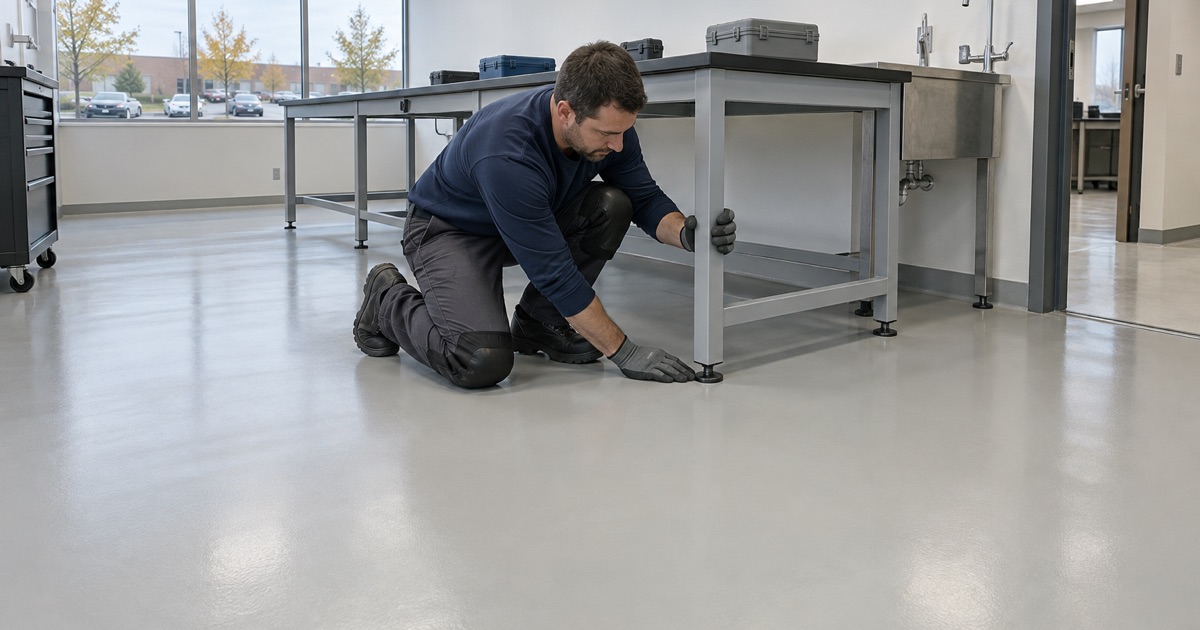
Office buildings have plenty of concrete outside the carpeted areas: mechanical rooms, storage rooms, janitor closets, loading areas and stairwells. Those floors see oil, coolant, water and carts, and bare concrete dusts and stains. A sealed epoxy system with a chemical-resistant topcoat keeps them clean and bright, and it makes leaks easier to spot.
In mechanical rooms especially, a light-colored floor helps maintenance staff see drips from pumps, boilers and chillers before they become larger problems. We detail the coating around equipment pads and drains so the room stays easy to clean.
Medical Offices and Clinics
Clinics need seamless floors that stand up to frequent cleaning with disinfectants. Utility rooms, sterilization areas, storage and back corridors are good candidates for resin flooring with an integral cove base that carries the floor up the wall. We phase the work so patients and staff keep moving through the rest of the office, and schedule the noisiest and most odorous steps after hours.
Schools and Colleges
Locker rooms, kitchens, science rooms, workshops and corridors in schools and colleges take heavy use. We schedule those projects around the academic calendar, usually during summer and extended breaks, and plan cure times so floors are ready before students return. Slip-resistant textures are specified by the broadcast and topcoat used.
Hotels and Conference Centers
Behind the guest areas, hotels and conference centers run service corridors, laundry rooms, storage and dish areas that carry carts all day. We coat those spaces in sections so operations continue, adding texture where floors get wet, and use systems that clean easily and resist the chemicals housekeeping uses.
Retail Stores and Tenant Spaces
Retail floors need to look good, resist carts and foot traffic, and go in between one tenant leaving and the next opening. Decorative epoxy, flake systems and polished concrete all work well, and we schedule around landlord rules and turnover dates.
In a shopping center or strip of storefronts, a tenant build-out often has its own construction hours, delivery rules and noise limits. We work within those, coordinate with the general contractor when there is one, and time the floor so fixtures and shelving can go in on schedule instead of waiting on a coating that is still curing.
Systems for Commercial Floors
High-Build Epoxy
A 100% solids epoxy built to the right thickness forms a hard, seamless surface that handles foot and cart traffic and resists many chemicals. It can be finished in solid colors, with flake or quartz broadcast, and with safety striping or zones marked directly into the floor.
Thickness is what separates a commercial floor from a residential one in most spaces. A thin roll-on coat wears through under rolling carts and pallet jacks, while a high-build system keeps a protective layer over the concrete for years. We state the target thickness in the proposal so the facility can verify it.
Polyaspartic and Urethane Topcoats
Polyaspartic and urethane topcoats add abrasion and chemical resistance and cure quickly. They are often used to get a floor back in service overnight, and they resist the yellowing that epoxy shows near windows and doors.
Urethane Cement for Wet and Hot Areas
Where floors see hot water, steam cleaning or harsh cleaners, as in commercial kitchens and some processing spaces, urethane cement handles thermal shock and chemical exposure far better than standard epoxy. We recommend it where an epoxy floor would soften or fail.
Static-Dissipative Floors
Server rooms, electronics areas and some labs need floors that control static discharge. Static-dissipative and ESD systems are designed to a measured resistance range and are tested after installation.
Working Around an Open Business
Phasing, Nights and Weekends
We break large floors into sections and work nights or weekends when a business cannot close. Faster-curing products shorten the downtime, and each section is closed off with barriers and signage until it is ready. The phasing plan is written into the proposal.
We agree on the sequence with the building manager before the first night, including where staff and customers will walk, where equipment and furniture will be staged, and which doors stay open. That plan keeps the work predictable, and it keeps a freshly coated section from being walked on before it is ready.
Dust, Odor and Air Quality
Grinders run with vacuum dust collection at the machine, and we isolate work areas from occupied spaces. Products are chosen within the Illinois VOC limits for floor and industrial maintenance coatings, which apply to us as the applicator, and many high-solids systems keep odor low.
Moisture and Slab Condition
Commercial slabs are tested for moisture before pricing, the same as residential floors. When readings are high, a moisture-mitigation primer is added to the scope, and cracks, spalls and failed joints are repaired before coating.
- 20+ Years Coating Concrete
- Moisture Tested Before Pricing
- Free Written Estimates