
Lombard Epoxy Flooring installs ESD flooring in Lombard, IL, serving surrounding cities including Northlake, Westchester, Wood Dale, Hinsdale and Bensenville. After more than 20 years of grinding and coating concrete, we treat a static control floor as an electrical system as much as a floor: it has to bond to the slab, survive traffic and cleaning, and stay inside a measured resistance range for years.
Electrostatic discharge, or ESD, is the sudden release of built-up static electricity. People walking across a floor, carts rolling and materials being moved all generate charge. In most buildings that is just a small shock, but in spaces with sensitive electronics, data equipment or certain materials, a discharge can damage components, corrupt equipment or create a hazard.
An ESD floor gives that charge a controlled path to ground. We specify the system from the facility’s own requirements, name the product line, coat count, finished thickness and grounding layout in the proposal, and test the finished floor so there is a recorded baseline to check against.
Types of ESD Floors
Static-Dissipative Resin Floors
Static-dissipative floors have a higher resistance range than conductive floors and drain charge in a slower, controlled way. They are common in electronics assembly, server rooms, telecom spaces and many labs. A dissipative epoxy system looks and cleans like a standard resin floor while carrying conductive fillers through the coating.
Because they bleed charge gradually, dissipative floors are often chosen where people work at benches and move around equipment all day. They pair with grounded workstations and footwear to keep both people and products at a controlled potential.
Conductive Resin Floors
Conductive floors have a lower resistance range and drain charge quickly. They are used where faster dissipation is required, such as some explosives, munitions and highly sensitive electronics areas. The choice between conductive and dissipative comes from the facility’s standard and the materials being handled, not from a sales preference.
A conductive floor is not automatically the safer choice. In some spaces, draining charge too quickly is itself a risk to sensitive devices, and a very low resistance floor can raise electrical safety questions around live equipment. That is why the facility’s own engineer or ESD coordinator sets the range, and we build to it.
Matching the Floor to the Standard
Many facilities follow an ESD control program built on an industry standard, which sets the resistance range for floors, footwear and workstations. We work from the range the facility specifies and pick a system designed to land inside it. If no range has been set, we talk through the use of the space with the facility manager before proposing one.
How an ESD Floor Is Installed
Slab Preparation
The concrete is ground with diamond tooling or shot blasted to the profile the system requires, with vacuum dust collection. Cracks, spalls and joints are repaired, and old coatings, tile and adhesive are removed completely, since leftover material can interfere with both adhesion and electrical performance.
The slab is also tested for moisture before the scope is final. Moisture can affect how some conductive primers behave as well as how well the system bonds, so a high reading may call for a moisture-mitigation primer that is compatible with the ESD layers above it.
Grounding Points and Conductive Layers
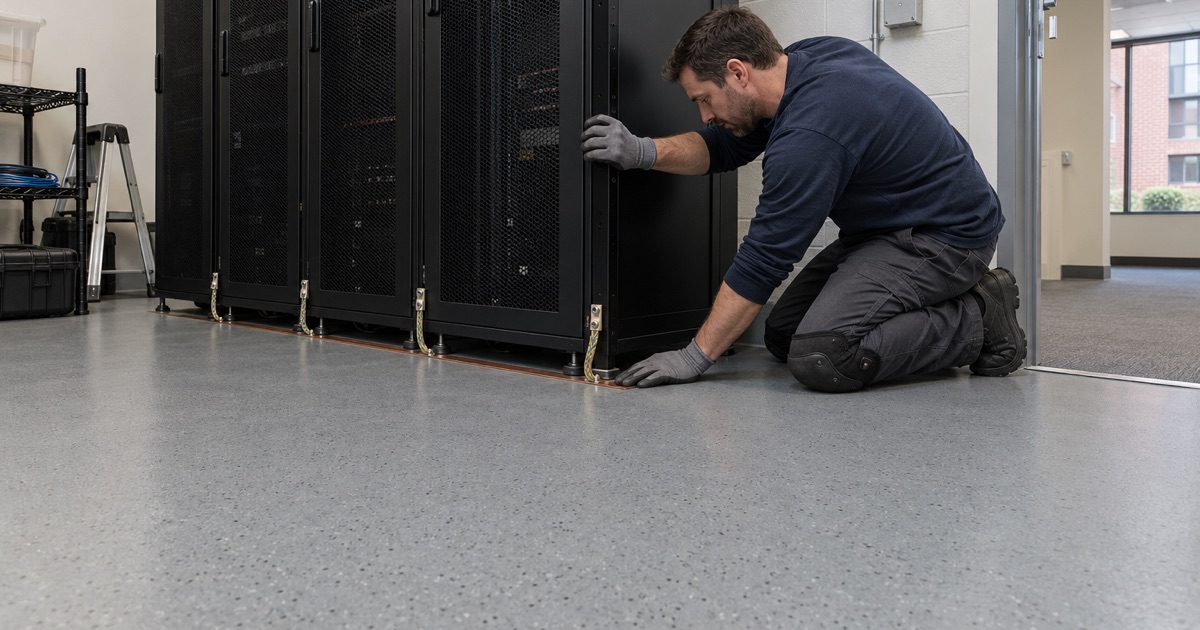
Copper grounding strips or ground points are laid out across the floor and connected to the building ground. A conductive primer or layer ties them into the system. The number and spacing of grounding points follow the manufacturer’s design for the floor area, and their locations are recorded on the layout.
The connection to building ground is usually made by the facility’s electrician, and we coordinate the location and type of each connection with them before the floor is installed. Getting this right is what turns a coating with conductive fillers into a working static control floor.
Dissipative or Conductive Topcoat
The topcoat carries the conductive or dissipative properties to the surface where people and carts touch it. It is applied at a controlled thickness, because too thin or too thick can push resistance outside the target range. The finish can be smooth or lightly textured, in a range of colors.
Testing and Records
After cure, we measure resistance point to point across the floor and from the floor to ground at multiple locations. Readings are recorded and handed over, giving the facility a baseline for its periodic checks. A floor that tests out of range is addressed before handover.
Testing is done after the floor has fully cured and before furniture, benches and equipment are moved back in. That timing gives a clean reading of the floor itself, and it means any area that needs attention can be corrected while it is still open and easy to reach.
Keeping an ESD Floor in Range
Cleaning and Maintenance
Ordinary waxes, polishes and some cleaners leave insulating films that raise resistance. Use only cleaners approved for ESD floors, and avoid sealers or finishes that are not part of the system. We provide maintenance instructions specific to the products installed.
Footwear, Carts and Workstations
The floor only protects people and products that are connected to it. ESD footwear or heel grounders, grounded workstations and conductive casters or drag chains on carts and chairs complete the path. Without them, a person standing on an ESD floor in ordinary shoes is still insulated from it.
Periodic Testing
Resistance can drift as the floor wears or picks up residue. Facilities usually retest at set intervals and after any major cleaning or repair. When a reading drifts, it often points to a maintenance issue that can be corrected without replacing the floor.
- 20+ Years Coating Concrete
- Moisture Tested Before Pricing
- Free Written Estimates