Lombard Epoxy Flooring has handled epoxy flooring in Forest Park and across the area for more than 20 years, and the floors we think about hardest here are the ones someone has to clean in a hurry after close. A dining room or bar floor is judged on its worst night of the year, not its best. When something goes wrong on it, the question is whether a mop and a bucket of disinfectant can actually reach the whole surface.
That question has a practical answer, and it lives in the slab. Seams, grout lines, chipped tile and open cracks hold liquid where no wipe gets it out, while a seamless resin floor ground to a real profile and closed at the wall leaves a spill nowhere to hide. We open every slab with a diamond grinder or a shot blaster, never an acid etch, so the coating grips sound concrete instead of a weak surface skin.
Homeowners ask the same thing about a basement bar or a family room where guests and kids spill. Below, we walk through how a written cleanup procedure meets a real floor, and what we check before we put a price on one.
A Madison Street Bar Open to 1:00 a.m.
Late hours and a full room
Scratch Public House at 7505 Madison Street pours craft cocktails and craft beer, books live music and trivia nights, and takes private parties. Its posted hours run to midnight most nights and to 1:00 a.m. on Friday and Saturday. We use it only as a picture of the kind of room this street is known for; we have not seen its floors and have no connection to the business.
A late room like that sees a lot of feet, a lot of glassware and a lot of spilled drinks, and the floor carries all of it until the last table clears. The dining room and the bar are where the guests are, so they are also where an unplanned mess is most likely to land. The Madison Street business district, with its antique merchants, boutiques and eating establishments, was voted Chicago Tribune readers’ Best Neighborhood Dining, and its dining rooms are the main commercial floor buyer on the corridor.
What Food Code 2-501.11 asks for
The 2022 FDA Food Code, which Illinois adopted, includes section 2-501.11 on cleaning up vomiting and diarrheal events. It says a food establishment shall have written procedures for employees to follow when vomit or fecal matter is discharged onto surfaces. Those procedures must address the specific actions employees take to minimize the spread of contamination and the exposure of employees, consumers, food and surfaces.
Forest Park sits in Proviso Township, and in suburban Cook County the health authority is the Cook County Department of Public Health, with the village’s own Health and Safety Department administering local public health and safety code. The procedure itself belongs to the restaurant, and we do not write or interpret one for an owner. What we can tell an owner is whether the floor in front of the bar is one that procedure can actually be carried out on.
Where the floor enters the plan
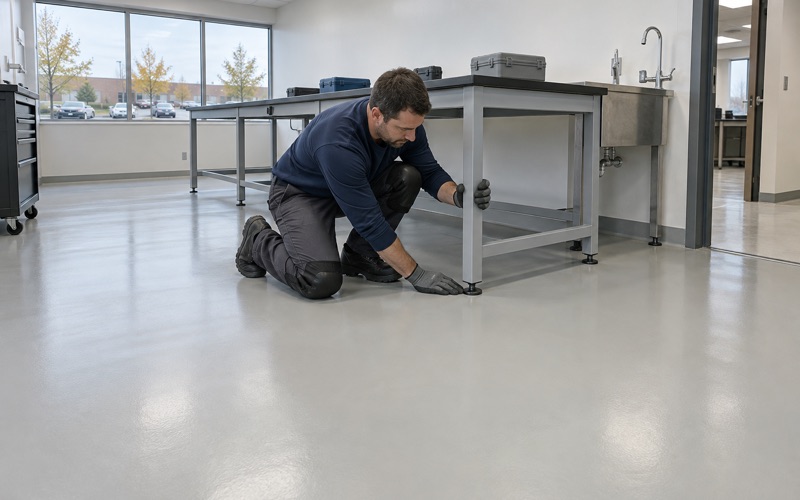
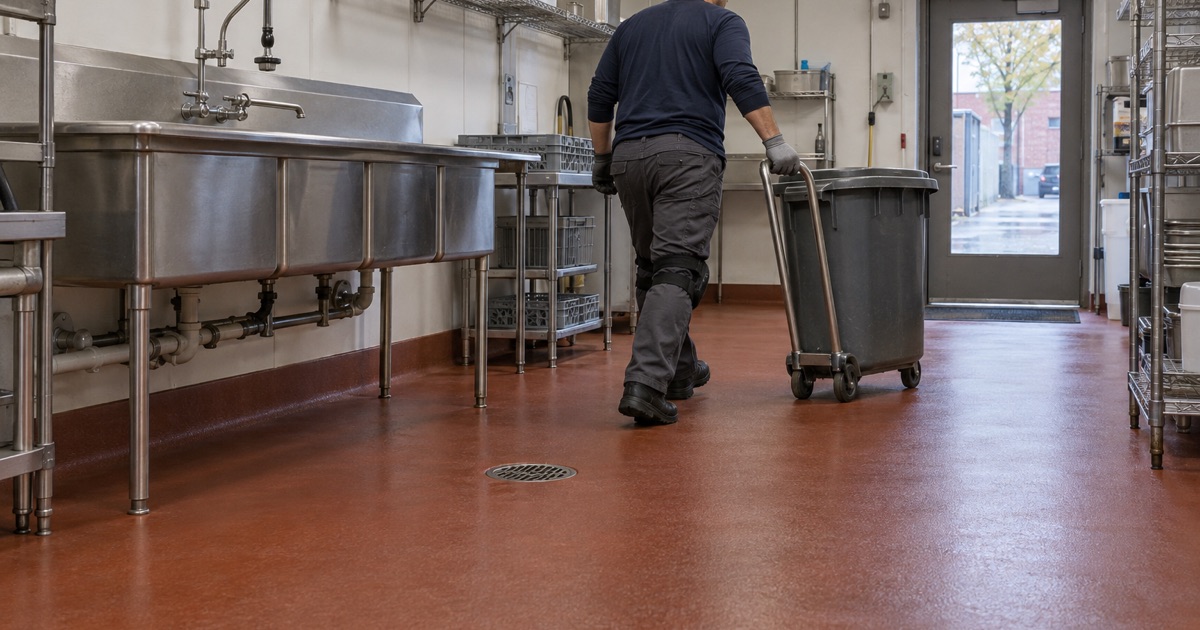
A written procedure describes steps, and every step assumes a surface. If the plan says to disinfect the entire area, the floor has to behave like one area, not a field of tile with hundreds of feet of grout between the pieces. That is the gap between a plan on a clipboard and a cleanup that works.
Staff working a cleanup at the end of a long shift will do what the floor lets them do. A surface that wipes clean in one pass gets cleaned properly; one that needs a brush in every joint gets the quick version, however good the written plan is.
Looking for epoxy-flooring closer to Lyons? See Epoxy-Flooring in Lyons.
Bleach for Five Minutes, Then Soap and Hot Water
The CDC sequence
CDC guidance for cleaning after vomiting or diarrhea is to clean well and disinfect the entire area immediately. Staff wipe the area with paper towels into a plastic trash bag, then apply a product used according to its label or a bleach solution at a concentration of 1,000 to 5,000 ppm. CDC puts that at 5 to 25 tablespoons of household bleach, 5% to 8%, per gallon of water.
The solution stays on for at least 5 minutes, and then the entire area is cleaned again with soap and hot water. The guidance gives no floor-specific instruction, which is exactly why the floor deserves a look of its own.
What the floor does during those five minutes
For five minutes a wet disinfectant sits on whatever the floor is made of. On a sealed, nonabsorbent resin surface it stays on top where it was put, and the soap and hot-water wash lifts it away with what it was applied to. On bare or worn concrete, or on porous grout, part of that liquid soaks in, and so does part of the spill.
To be plain about the limits: a floor coating does not disinfect anything, and it does not kill a pathogen. The bleach and the staff do that work. The coating’s job is to give them one continuous surface, so the contact time and the rinse reach all of it.
Choosing a system for the room
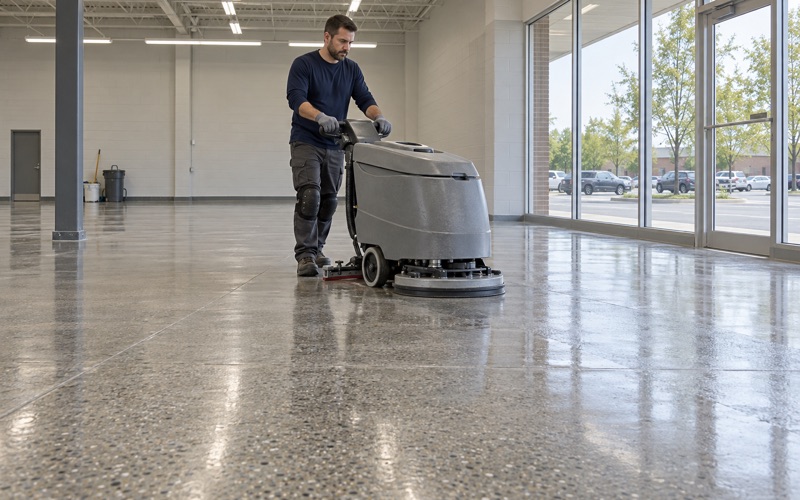
For a dining room or bar floor we usually look at a 100% solids epoxy base with a polyaspartic topcoat, or at urethane cement where hot water and heavy washing are routine. The proposal names the product line, the number of coats and the finished thickness, so an owner can hold the finished floor up against the quote.
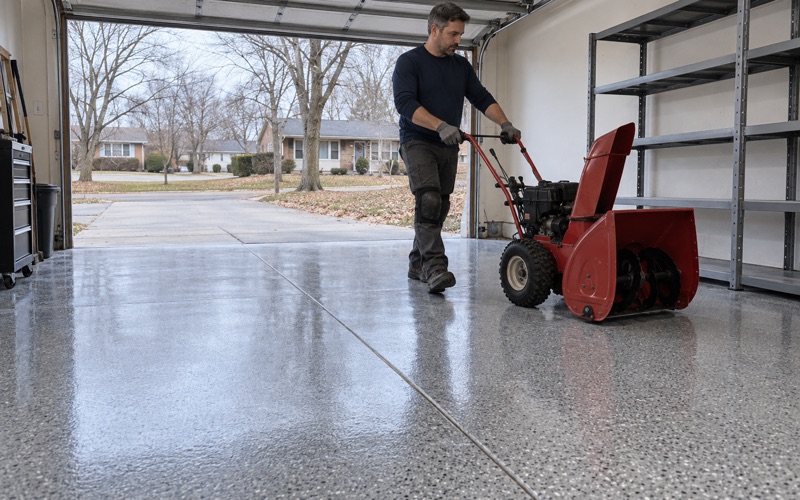
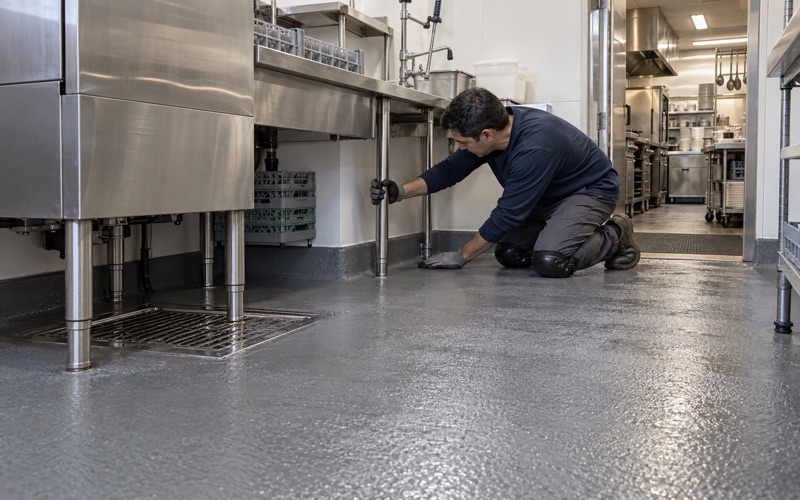
Grip near a wet service well comes from a quartz aggregate broadcast and the topcoat chosen over it, specified rather than promised. Food Code 6-201.11 asks for smooth, easily cleanable floors but makes an exception for antislip floor coverings or applications used for safety reasons, so a textured finish and a cleanable one are not at odds. We tune the texture so a mop still clears it.
Why Grout Lines and Open Cracks Defeat the Cleanup
Grout is a channel
Ceramic and quarry tile can look clean and still hold a spill in every joint. Grout is more porous than the tile around it, and years of mopping wear it below the tile face into a shallow trough. A bleach solution reaches the tile tops easily and the bottom of the grout poorly, and the wash that follows pushes residue along the joints rather than out of them.
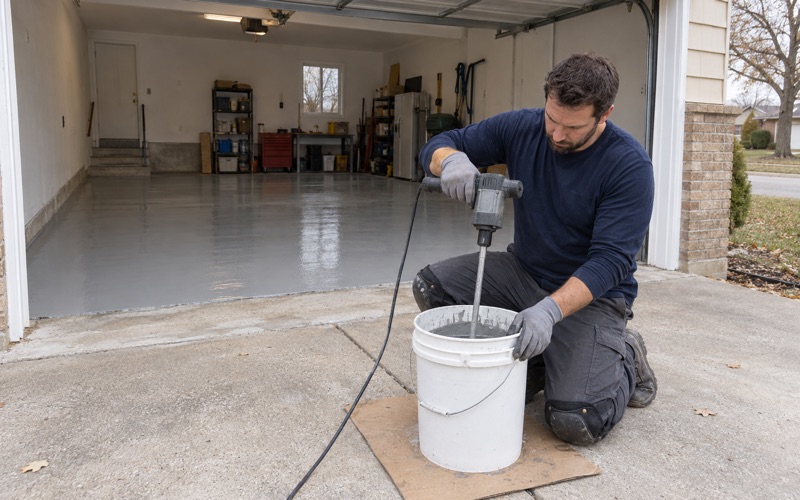
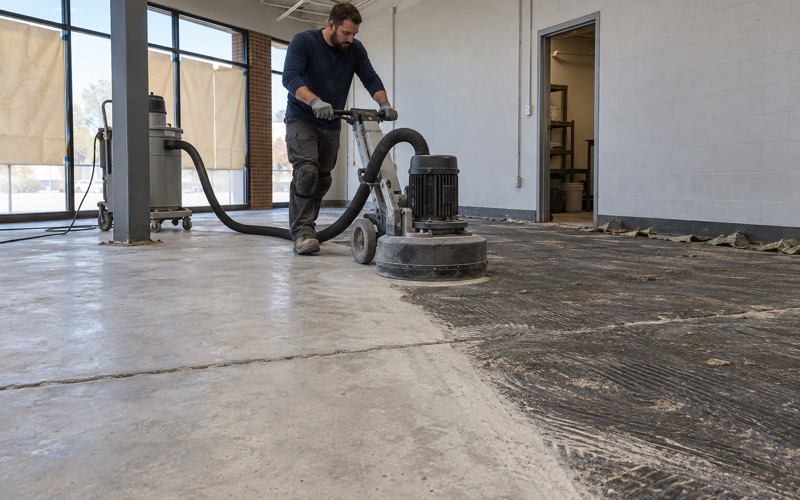
Swapping tile for a seamless system means taking the tile up and preparing the slab beneath it, not coating over the top. Thinset and old adhesive are ground off, because a resin floor laid on loose leftovers inherits every weak spot under it. The result is one surface from wall to wall, with no joint left for a spill to sit in.
Cracks and failed coatings
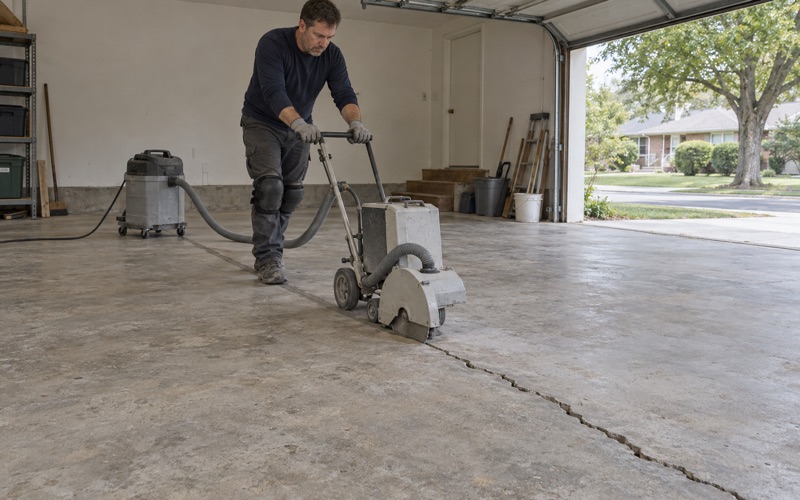
An open crack in a concrete slab is a slot with a bottom nobody can wipe. A peeling old coating is the same problem in another form, because liquid runs under the lifted edge and stays there. We map cracks, spalls and old coatings before we quote, and when a slab needs repair or replacement before it should be coated, we tell the owner.
Old coatings come off down to sound concrete, and grinding brings the slab to an ICRI concrete surface profile the new system is rated for. Repaired cracks are filled and ground flush, so the new floor runs across them in one piece. That continuity is the point on a floor that has to be disinfected edge to edge.
The line where floor meets wall
The floor-to-wall joint is the other place a spill lingers. Food Code 6-201.13 calls for floor and wall junctures to be coved and closed to no larger than 1 mm, one thirty-second of an inch, where cleaning methods other than water flushing are used. A resin cove base carried up the wall closes that line instead of leaving a gap behind a baseboard.
A room that serves guests until 1:00 a.m. cannot close for a week. We phase restaurant floors around operating hours, using overnight and weekend windows when the room has to stay open. Grinding dust is captured at the machine by a vacuum, not rinsed toward a floor drain.
Basement Bars and Family Rooms at Home
The same question in a smaller room
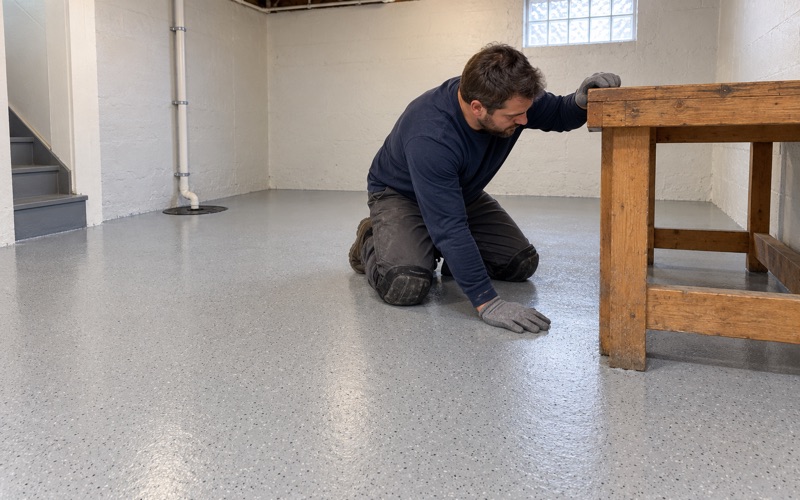
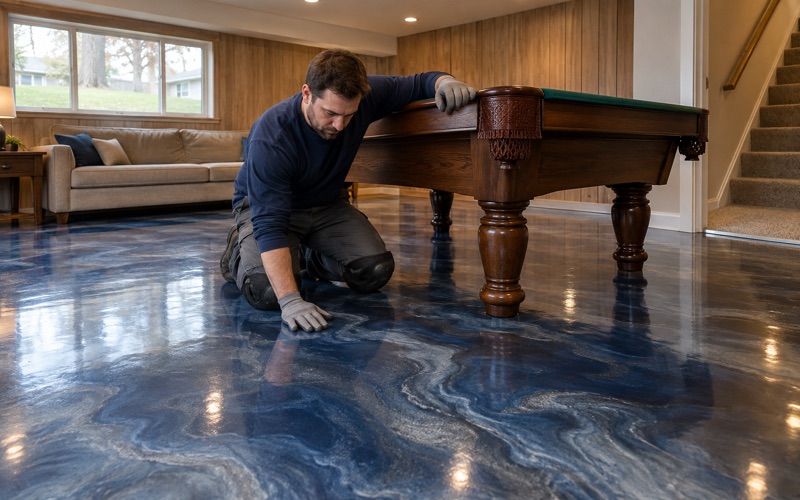
The cleanup logic does not stop at a restaurant door. A basement bar, a playroom or a family room where a sick child or a late party leaves a mess faces the same bleach, the same five minutes and the same rinse. Carpet, laminate seams and tired tile all hold onto what a seamless floor lets you wipe up and wash away.
Forest Park’s housing leans old: 3,653 of its 7,649 units were built in 1939 or earlier. A prewar basement slab can be thin, patched or damp in places, which is why we read it for past water before anything else. A coating does not stop seepage, a backup or a sump that cannot keep up, and we say so before anyone signs.
Testing and the written scope
A moisture test is part of the written scope before the price is final, using ASTM F2170 in-situ relative humidity probes or an ASTM F1869 calcium chloride test as the slab calls for. When readings run high, a moisture-mitigation primer may be the right first coat. Whatever the result, we explain what the coating warranty leaves out before the job is sold, and moisture is the first exclusion we name.
At home the finish choice is usually lighter on texture than a bar floor, since the traffic is socks and slippers rather than work shoes, and a vinyl flake broadcast gives the surface color and hides the small marks a family room collects. Cure timing follows slab temperature and dew point, not the calendar, which matters in a cool basement.
Paperwork before grinding
Home jobs over the state threshold get a written contract and the Illinois Home Repair: Know Your Consumer Rights pamphlet before any grinding starts. Permit questions for a Forest Park job go to the Village Building Department before anything is scheduled, including whether the slab is being coated or replaced. Whether the floor is behind a bar on Madison Street or under a pool table in the basement, the test is the same: can it be cleaned completely when it counts?
- 20+ Years Coating Concrete
- Moisture Tested Before Pricing
- Free Written Estimates