Lombard Epoxy Flooring has spent more than 20 years on epoxy-flooring in Franklin Park and across the western suburbs, and the floors that ask the most care from us are the ones held below freezing. A freezer slab looks like any other warehouse floor from the top. Underneath, it is a layered assembly built to keep cold from reaching the ground, and a coating crew that treats it as plain concrete can damage something it cannot see.
That is why a cold-store job with us starts at a desk rather than at a grinder. We ask for the floor’s construction drawings, the heating and alarm records, and a level survey before anyone quotes a coating. If those records point to a slab that is moving, we say so plainly, because a resin floor laid over a moving slab only cracks along with it.
The same habits that govern every floor we coat still apply in a freezer, starting with a slab opened mechanically rather than etched with acid. What changes is the order of questions, and the sections below walk through them in the order we ask them.
Freezer Rooms on Belmont Avenue
Franklin Park, named for the real estate broker Lesser Franklin who bought acres of the area when it was mostly farm fields, is a village in Cook County and Leyden Township whose industrial corridor adjoins O’Hare. One building in the village, a 179,164-square-foot property at 9234 Belmont Avenue built in 2005, is being marketed as industrial, manufacturing and cold storage space, with 87,500 square feet available on a listing updated October 13, 2026. A companion listing describes a specialized freezer and cooler addition and comprehensive mechanical systems, inside a building with a 34-foot clear height and nine docks expandable to 13.
Summaries of that listing describe one cooler held at 33 degrees and four freezer rooms held at minus 20 degrees, sized for up to 800 pallets. We have not seen those rooms or their floors, and we have no connection to the building, its owner or its broker. We use it here because it shows what kind of floor can sit inside an ordinary-looking Franklin Park warehouse.
A Room at Minus 20 Is a Different Floor
A cooler at 33 degrees runs just above freezing. A room at minus 20 degrees pulls heat out of the slab day and night, year after year. Insulation slows that loss but does not end it, and that steady draw on the ground below is where the trouble starts.
What We Can and Cannot Say About These Rooms
Whether the Belmont Avenue freezers have a heating system under them, and what shape their floors are in, is not something we know. Nobody should read a listing and assume either. The point is the category: if you run a freezer room in Franklin Park, in that building or another, the questions below are worth asking before a coating is priced.
Looking for epoxy-flooring closer to La Grange? See Epoxy-Flooring Services in La Grange.
Why a Freezer Floor Needs Heat Underneath
It sounds backward to heat the floor of a room built to stay frozen, but the reason is the soil. A manufacturer’s application manual for cold store protection systems, published by Danfoss, explains that cold leaks through a freezer floor even when it is insulated properly. The soil under the foundation freezes, and the water in that soil changes volume as it turns to ice.
That expansion is frost heave. The manual says the ice formation results in floor cracking and a change of elevation, or heaving, and that the problem cannot be solved by insulation alone. Frost heave can crack the slab and damage the supports and foundations under it, which is why the manual calls for underfloor heating.
How the Layers Stack
The build-up the manual shows runs from the top down: a reinforced concrete wear slab, then thermal insulation, then a concrete screed or sand backfill that holds the heating cables. The cables sit under the main floor insulation, at least 5 cm below it. Some freezer floors use warm glycol or air pipes in place of cables, but the principle is the same: keep the ground under the room above freezing.
Main and Reserve Circuits
The manual recommends two identical parallel heating systems, a main and a reserve, each with its own thermostat and an alarm when the reserve runs. It also warns that there must be no below-freezing gaps between heating cable lines, or the system will not prevent frost heave. In its worked example, a store held at minus 25 degrees Celsius needs at least 15 watts per square meter installed.
For a coating contractor, that alarm history matters as much as anything on the surface. A reserve circuit that has been running for months points to a main circuit that is down, and the ground below may already be cooling toward freezing.
What Frost Heave Looks Like From the Top of the Slab
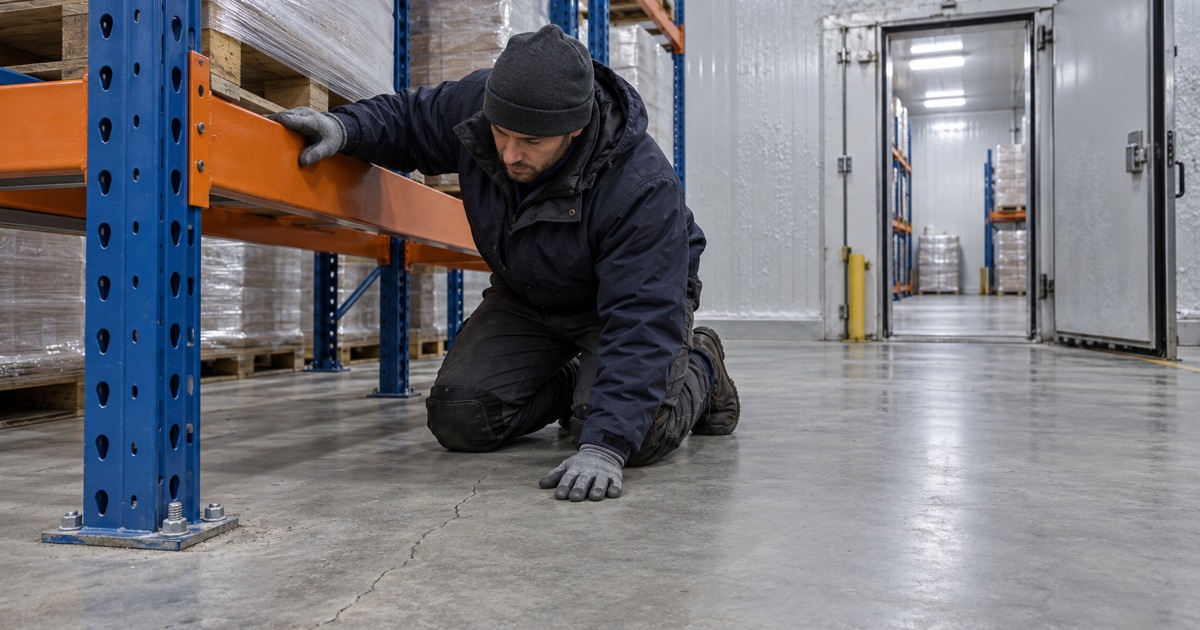
From inside the room, a heating failure rarely announces itself as a heating failure. It shows up as a floor problem: a crack pattern that was not there last year, a hump where a pallet jack starts to rock, or a rack that no longer sits plumb. Each of those can look like ordinary wear, and each is worth reading as a warning about what lies under the insulation.
Cracks and Level Changes Come First
A crack in a heated freezer slab is the symptom, not the disease. If the ground beneath is freezing and lifting, grinding out the crack, filling it and topcoating the room treats the one part of the problem a coating can reach. The heave keeps working from below, and the new floor cracks along the same lines.
So we say it directly in every cold-store proposal: a coating adds no insulation, cannot hold back frost heave and does not repair a slab that is moving. A resin topcoat over a heaving slab cracks with it. Those limits go at the top of the warranty exclusions we walk through before the job is sold, next to moisture.
A Level Survey Before Grinding
Before any diamond grinder touches a freezer floor, we want a level survey of the room. A set of elevations taken across the slab, compared against the drawings or an earlier survey if the operator has one, shows whether the floor has moved and where. A rise that the survey finds and the drawings do not explain calls for whoever maintains the heating system before it calls for a coating crew.
When the Slab Needs More Than a Coating
We map every crack, spall and patch of old coating before we price a cold-store floor, and the map goes into the proposal. If the survey and the heating records together say the slab is moving, our advice is to have the heating contractor deal with the cause first, and sometimes to repair or replace sections of the slab before anything is coated. Saying that can cost us a job in the short run, and it saves the owner from paying for a floor twice.
Heating Records, Drilling and Cold-Cure Coatings
The first documents we ask a Franklin Park cold-store operator for are the heating system records: what kind of system sits under the room, whether it runs on main and reserve circuits, its thermostat settings, and its alarm log. We also ask who maintains it, because that contractor will usually know more about the slab’s recent behavior than anyone on the floor. If no records exist, we treat the floor as unknown and plan accordingly.
No Deep Drilling Without the Layout
In a freezer, the depth of every cut matters. The wear slab sits on insulation, and below that may lie a vapor retarder and the heating runs, so a core drilled for a new drain or an anchor set too deep for new racking can puncture the layers that keep the room working. We do not drill or core deep into a freezer floor until the insulation, vapor retarder and heating layout are known from drawings or the system’s installer.
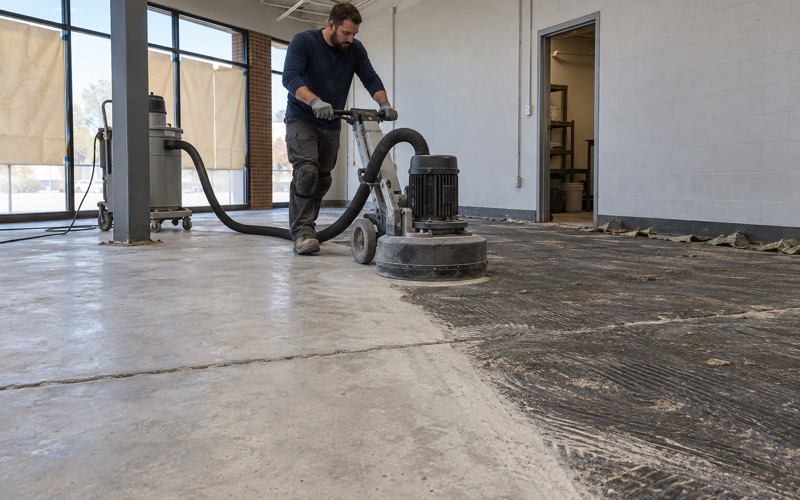
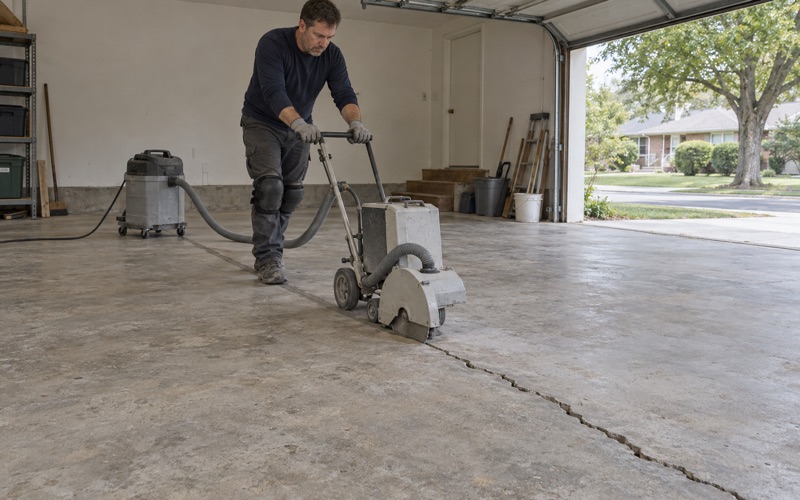
Surface preparation stays shallow on purpose. We open the wear surface with a diamond grinder and capture the dust at the machine with a vacuum, taking only the ICRI surface profile the product data sheet calls for.
Moisture Testing and Scheduling
A moisture test is written into our scope before the price is final, on a freezer slab as on any other. An ASTM F2170 in-situ relative humidity probe means drilling into the concrete, so in a freezer the hole depth is set from the wear slab’s known thickness, never guessed. Where that thickness is unknown, we choose a surface method such as the ASTM D4263 plastic sheet test and record its limits in the proposal.
Cold-store rooms rarely close for long, so we phase the work around the operation: one room at a time where the layout allows, with overnight and weekend windows when product has to keep moving. The operator decides how long a room can stay out of service, and the coating system follows that decision rather than the other way around.
Cold-Cure Coatings Rated for the Room
A standard epoxy is formulated to cure at room temperature, and a freezer that cannot be warmed up for days is no place for one. Cold-cure coating systems exist for this work, and the right one is rated for the temperature the room will actually hold while it cures and in service. Where an operator can shut down and warm a room, the choice widens; where the room must stay near minus 20 degrees, the product list gets short.
Slip resistance in a freezer is specified by the broadcast and topcoat, typically a quartz aggregate broadcast locked in by the finish coat, rather than promised in a sentence. The texture is chosen with the operator’s cleaning routine in mind, since a profile too coarse to clean holds debris.
Whatever the product, our cure schedule follows the slab’s temperature and the dew point spread at its surface, not the calendar. A freezer slab coming out of service can sweat as warm air meets it, and moisture on the surface is a coating failure waiting to happen.
The proposal that follows names the product line, the number of coats and the finished thickness, so the floor can be checked against it. Permit questions go to the Village of Franklin Park Building Department at 9500 Belmont Avenue before a start date is set.
- 20+ Years Coating Concrete
- Moisture Tested Before Pricing
- Free Written Estimates