Lombard Epoxy Flooring brings more than 20 years of concrete coating work to epoxy-flooring in Hickory Hills, and on a commercial job the first question is often not color or texture. It is how the finished floor behaves when a fire in the next room sends radiant heat down a hallway. That question has a test method, a pass number and a document that answers it.
This page is about that document. It covers the code the city now enforces, what the floor-finish section asks of corridors and stair enclosures, how carpet, vinyl and resin each fit, and the data sheet worth having on hand before a permit review. It is written for anyone who manages a school, a church hall, an office or a store, and for the architects and facility staff who work with them.
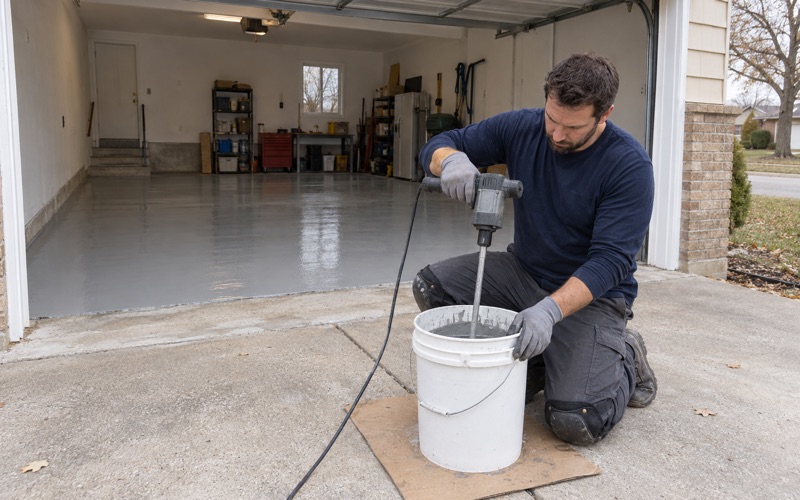
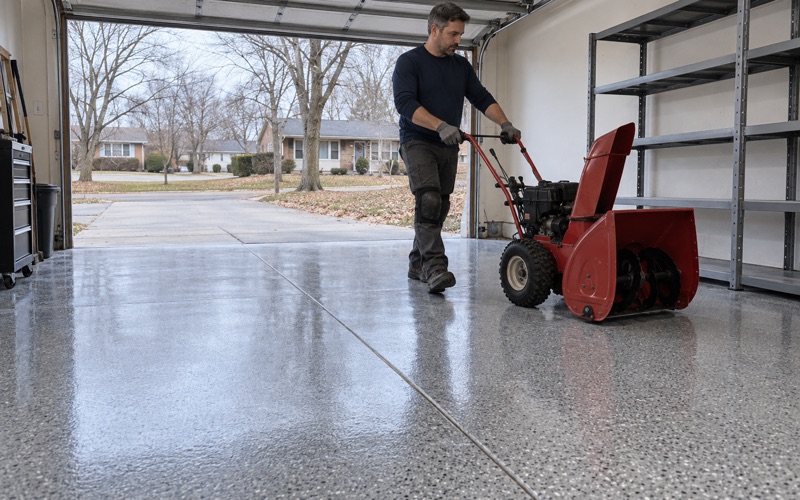
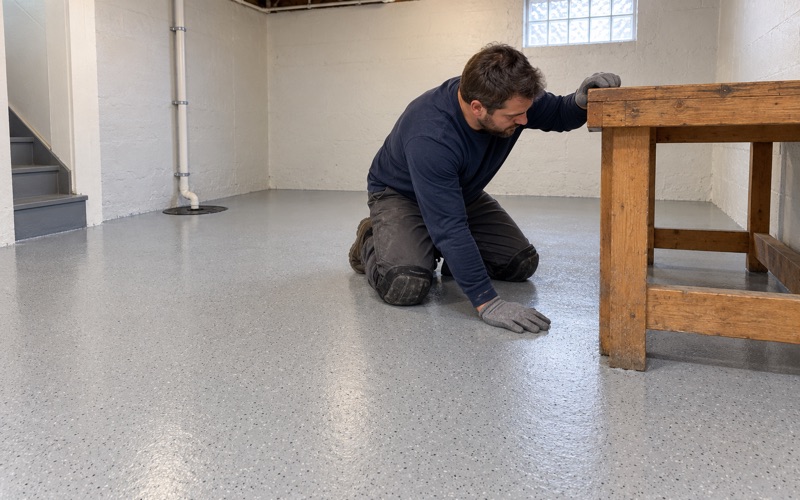
Garage and basement owners will find the same working habits here, just without the fire class. We open the concrete mechanically, test it for moisture before the price is final, and put the product line, coat count and finished thickness in the proposal so the result can be checked against it.
Hickory Hills Moves to the 2024 Building Code
What the April 2026 ordinance did
At its April 23, 2026 meeting, the Hickory Hills City Council approved Ordinance #26-06, adopting the 2024 International Building Code and the 2024 International Residential Code along with related codes. The city’s earlier hazard-mitigation record had listed an IBC entry dated January 2014, so the 2024 edition is now the one in force for commercial building work. We have not read whether the city adopted it with local amendments, which is one more reason the Building Department at 8652 W. 95th Street is the place to confirm how a given floor will be reviewed.
For a coating contractor, a new code edition matters less for its headline changes than for the sections that quietly reach the floor. Section 804, Interior Floor Finish, is one of them, and it can reach the surface we install just as it reaches carpet. The 2021 text reads the same, so the wording is not new to the 2024 edition, but the adoption puts it squarely in front of anyone remodeling a corridor here.
Which floors Section 804 reaches
The corridor rule in 804.4.2 is broader than the word suggests. It covers enclosures for stairways and ramps, exit passageways, corridors, and rooms or spaces not separated from a corridor by partitions running from the floor to the underside of the ceiling. An open lobby that flows into a hallway can fall inside it, while a classroom behind a full-height wall does not.
A separate paragraph, 804.4.1, applies in every occupancy and asks floor covering materials to pass the DOC FF-1 pill test or ASTM D2859. That one is aimed at textile coverings. The radiant-flux class is the stricter test, and it is the one that decides what goes down in a corridor.
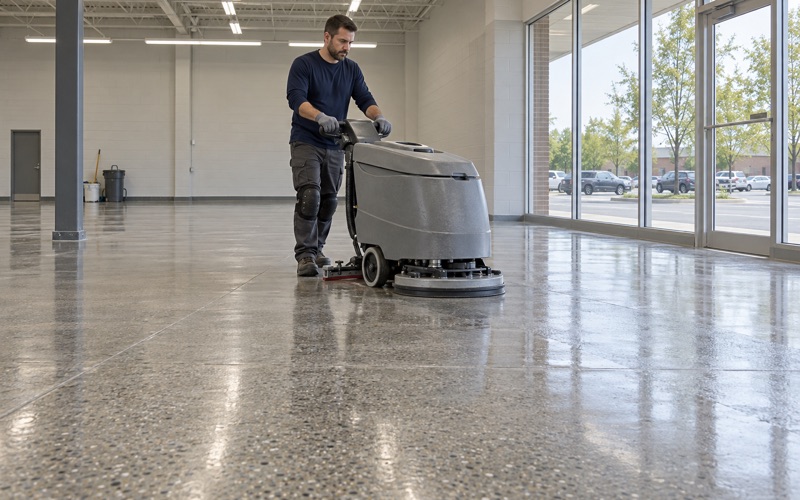
For a building owner, the practical upshot is that a corridor refinish is not only a finish choice. Replacing worn carpet in an exit corridor with a coating, or coating over an old terrazzo hall, changes what the reviewer sees, and the class question comes with the new surface. We raise it at the walkthrough so it is settled before work is scheduled.
Looking for epoxy-flooring closer to Lemont? See Epoxy-Flooring in Lemont.
Section 804: Class I, Class II and the Sprinkler Exception
What critical radiant flux measures
Critical radiant flux is the amount of radiant heat a floor needs before a flame will keep spreading across it. ASTM E648 measures it by exposing a floor sample to a graded heat source and finding the point where the flame goes out, and the result is reported in watts per square centimeter. A higher number means more heat is needed to carry a flame along the floor, which is exactly what a hallway used as an exit should demand.
Section 804.2 sets two classes. Class I is 0.45 watts/cm2 or greater, and Class II is 0.22 watts/cm2 or greater, so a Class I floor also satisfies a Class II requirement. NFPA 253 is accepted as an alternate test method for the same classes.
Which buildings need which class
Under 804.4.2, corridor and stair-enclosure floors must reach at least Class I in Groups I-1, I-2 and I-3, the institutional occupancies such as residential care, hospitals and detention. Groups A, B, E, H, I-4, M, R-1, R-2 and S need at least Class II. In plain terms, that list takes in schools (E), assembly spaces such as church halls (A), offices (B), stores (M), hotels and apartment buildings (R-1, R-2) and storage buildings (S).
Note that the class attaches to the occupancy and the location in the building, not to the material alone. The same epoxy system can sit outside the radiant-flux rule in a storage room behind a full-height wall and inside it a few steps away in the corridor.
When sprinklers change the answer
The exception turns on whether the building is sprinklered throughout under Section 903.3.1.1 or 903.3.1.2. In that case Class II is permitted where Class I would otherwise apply, and where Class II is required, a material that passes the DOC FF-1 pill test or ASTM D2859 is enough. A sprinkler head in one hallway does not qualify; the system has to cover the whole building.
That is why the first two questions we ask on a corridor job are the occupancy group and the sprinkler coverage. The architect of record or the owner’s code consultant usually has both, and the city’s Building Department is where they get settled.
Carpet, Traditional Floors and Where Resin Fits
Carpet carries its result
Carpet and other fiber floor coverings get no exception under Section 804. They have to show their class, and commercial carpet sold for corridor use typically lists its ASTM E648 result on the specification sheet. A building official reviewing a carpeted school hallway checks that number against the class the occupancy requires.
The traditional-type exception
Section 804.1 sets aside floor finishes and coverings of a traditional type, such as wood, vinyl, linoleum or terrazzo, along with resilient floor coverings that are not composed of fibers. Those materials are exempt from 804.2 through 804.4.2, so a vinyl tile corridor or a terrazzo hallway is not asked for a radiant-flux class at all. The list gives examples; seamless resin systems are not among them.
Why resin is the building official’s call
A troweled or self-leveling epoxy floor is not a fiber, and on a slab it can look and behave much like terrazzo or a resilient sheet. Whether it is read as a traditional-type finish, though, is a judgment the building official makes, not one a coating contractor or a manufacturer gets to make for them. A reviewer could reasonably go either way, so it pays to arrive with the class in hand.
We do not describe our floors as fire-rated or code-approved, because a rating belongs to a tested product and its build-up, not to an installer. What we can do is choose a system whose maker has published an ASTM E648 result and install it as that result describes. That gives the official something to check whichever way the exception is read.
A school and parish on 86th Avenue
St. Patricia School at 9000 S. 86th Avenue has offered Pre-K through 8th grade since 1960, and the parish church and school were dedicated together in 1961. A campus of that kind typically combines two of the occupancies on Section 804’s Class II list: a school (Group E) and assembly space (Group A), with corridors, stairs and a Parish Center gym. We have not seen its hallways, its sprinkler coverage or any plans, and the parish is not a client; it simply shows how the rule lands on a real Hickory Hills building.
For a building like it, the code math is short. If the building is sprinklered throughout, a corridor floor covering can drop to the pill-test level; if it is not, the corridor floor needs Class II. The open question is only whether the official treats the chosen floor as traditional-type or asks for its class.
The ASTM E648 Sheet to Hand the Building Official
What a good data sheet shows
The document that settles the question is the manufacturer’s product data sheet or test report showing the ASTM E648 classification for the exact system being installed. One trade example: a Sika Northern Gulf data sheet for the Sikafloor MultiDur ES-24 system, a smooth pigmented epoxy with a primer and a Sikafloor-263 SL wearing coat, lists its critical radiant flux classification as Class I under ASTM E648, referring to the test of the Sikafloor-263 SL. That is a rating for that product and that build-up, nothing broader.
The limits matter as much as the class. A rating does not carry over to a different product line, to a similarly named product sold in another market, or to a build-up with a different primer, topcoat or broadcast, and it says nothing about who installed it. So the sheet we provide names the same products and build-up the proposal lists.
Matching the installed floor to the sheet
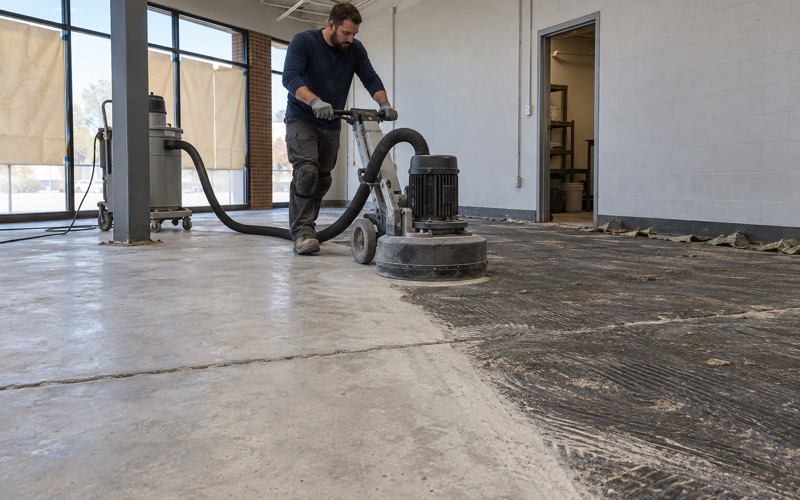
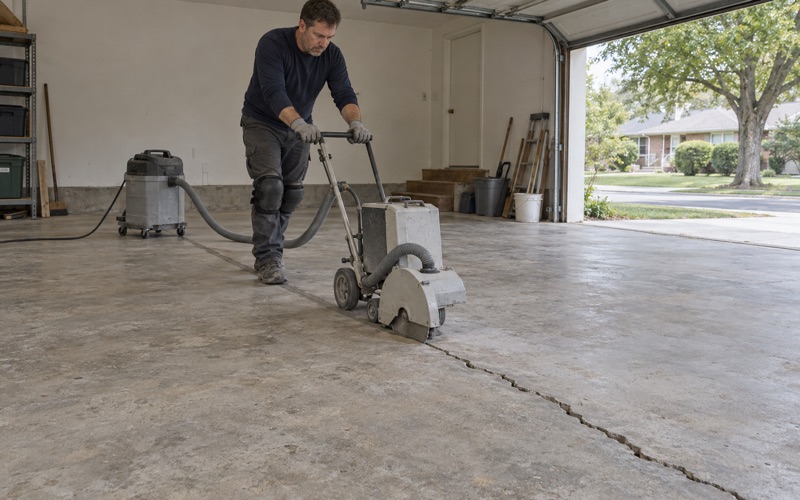
A corridor floor only matches its test report if it is built the way the report describes. We open the slab with a diamond grinder or shot blaster to a measured ICRI concrete surface profile rather than acid etching it, test for moisture vapor with ASTM F1869 calcium chloride kits or ASTM F2170 relative humidity probes, and map cracks and spalls before anything is priced. If the slab needs repair first, the proposal says so.
Hickory Hills adds a reason to take moisture seriously in older buildings. Over half its housing dates from 1960 to 1979, before under-slab vapor retarders were routine, and the city names blocks where storm sewer capacity falls short and structures flood. A coating does not stop seepage or hydrostatic pressure, and moisture is the first exclusion we explain in any warranty discussion.
Scheduling corridor work around a building in use
A corridor is usually the hardest part of a school or church to close for a week. We phase the work around operating hours, using overnight and weekend windows when a hallway has to stay open, and set cure times by slab temperature and dew point rather than the calendar. A slip-resistant texture, where the corridor needs one, is specified by the broadcast and topcoat, and both are part of the build-up the data sheet has to describe.
Grinding dust is captured at the machine with a vacuum, which matters more in an occupied building than in an empty one. When the floor is finished, the owner has the proposal, the data sheet and the product list in one place, ready for the next inspection or the next remodel.
- 20+ Years Coating Concrete
- Moisture Tested Before Pricing
- Free Written Estimates