Lombard Epoxy Flooring has spent more than 20 years on epoxy flooring in Hinsdale and the surrounding suburbs, and some of the most careful jobs we price are small ones: a treatment room in a practice that has been seeing patients for generations. The resin is rarely the hard part there. The hard part is knowing what an old floor may be holding before anyone puts a grinder on it.
Every commercial floor we take on starts the same way. Cracks, spalls and any earlier coating are mapped before a number is written, the slab is opened mechanically rather than etched with acid, and the proposal names the product line, the coat count and the finished thickness so the result can be checked against the paper. In an older clinical room, that mapping step carries one extra question that has nothing to do with concrete strength.
This page walks through that question for older dental operatories: why elemental mercury was ever on those floors, where it tends to settle, who checks for it, and what sort of floor goes down once the room reads clean. The vapor survey and any hazardous-waste handling belong to qualified specialists the practice brings in. Our work begins after theirs is finished.
A Dental Practice on South Garfield Since 1954
Family dentistry in Downtown Hinsdale
Hinsdale Dental, at 101 S. Garfield St., presents itself as trusted family dentistry in Hinsdale since 1954, and a business directory describes it as located in downtown Hinsdale for over 60 years. Its home page lists four general dentists. That is about the extent of what the practice publishes about itself. The address geocodes inside the village, in the Downers Grove Township part of DuPage County.
The page does not say whether 1954 refers to the current address, and it describes no office history or renovation. So we draw no conclusion about the building, its rooms or its floors. Hinsdale Dental is not our customer, nothing is known to be wrong with any of its rooms, and we use it here only because a practice with that kind of history illustrates a question every long-running office faces sooner or later.
What a 1954 start date spans
What the date does mark is a span of practice. A dental office that has been open since 1954 reaches back to the years when amalgam fillings were mixed in the operatory from bottled elemental mercury, well before premeasured capsules took over. Whether any particular room today ever held that mercury is a separate question, and one nobody can answer by looking at the floor.
That is the reason the date matters to a flooring contractor. A floor in a room that predates capsules is a floor whose past use is unknown, and an unknown past is something to settle before surface prep, not during it.
Looking for epoxy-flooring closer to Bensenville? See Epoxy-Flooring Services in Bensenville.
When Fillings Were Mixed From Bottled Mercury
What a 1971 survey found on operatory floors
In 1971, Comproni, Cuzacq and Smith published a survey of mercury contamination in dental offices in the Journal of the Massachusetts Dental Society. In 32 percent of the sites they measured, mercury vapor concentrations on the floors of the main operatories were above the threshold limit value, and 22 percent of offices had levels above the allowable limit. Most reception-room readings were far lower.
One finding in that paper is the one we think about most. The authors noted that the absence of wall-to-wall carpeting did not prevent a high mercury concentration on floors or in the air. A hard floor was not automatically a clean one, because droplets of a dense liquid metal find their way into whatever gaps a floor has.
Capsules replaced in-office mixing
The practice changed over time. The Maine Department of Environmental Protection, working with the Maine Dental Association, published The Environmental Guide for Dentistry, revised in 2002, which tells dentists to discontinue formulating amalgam with elemental mercury and use amalgam capsules instead, to minimize the chance of an accidental spill. It is a Maine guide rather than an Illinois rule, but the reasoning carries anywhere. Capsules can be spilled too, and the guide counts those among the historical spills worth flagging, so the switch lowered the risk without erasing it.
The same guide has a section on office renovations, and that section is why this page exists. It tells dentists to alert renovators to the possibility of historical mercury spills, and it notes that equipment is available to detect mercury vapor and locate spills. In other words, the people writing guidance for dentists anticipated exactly the moment a floor crew walks into an old operatory.
Where Old Spills Hide, and the Order of Work
Floor cracks, carpet and base moldings
The Maine guide lists where historical mercury may be found: in carpets, in floor cracks, behind moldings, and in other areas where elemental mercury was used or where capsules were spilled. On a working operatory floor, the places worth asking about are the joints and hairline cracks in the slab, the seams of old resilient tile or sheet goods, the gap under a base molding, and the floor around chair bases and cabinet toe kicks.
None of those places are visible once a floor is finished. A room can look spotless and still have a history sitting just below the surface, which is why a visual inspection tells us nothing useful about this particular risk.
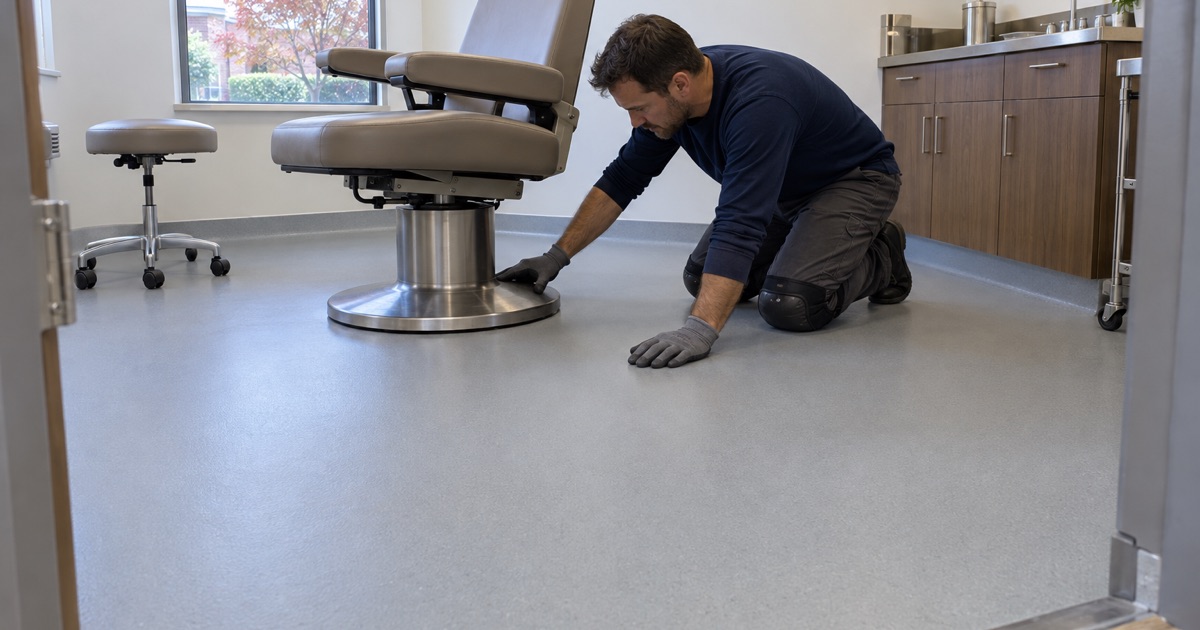
Chair bases deserve their own mention. A dental chair is bolted down and rarely moved, so the floor under and around its base is often the oldest, least-disturbed surface in the room. When a remodel replaces the chair, that patch of floor is exposed for the first time in years, and it is one of the spots a survey crew will want to read before our grinder ever reaches it.
Low points such as sink traps
The guide also notes that mercury from past practices often settles at low points such as sink traps and sumps. A floor project in an operatory often means pulling cabinets, disconnecting sinks or moving a chair, and several of those steps open a low point that has been closed for years. That is plumbing and hazardous-waste territory, not ours, and it belongs on the practice’s list before our crew is scheduled.
Survey first, then grind
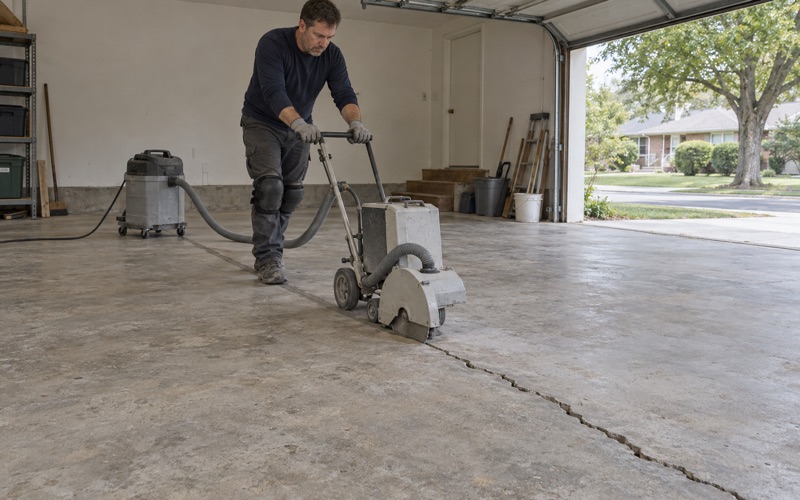
Grinding, shot blasting or pulling old tile with heat can disturb whatever sits in a crack and put it into the air of the room. So on an older operatory or sterilization room, we ask the practice to arrange a mercury vapor survey by a qualified firm before we mobilize. If beads are found, they are handled as hazardous waste by the right contractor, and surface prep waits until the room reads clean.
Before we mobilize, we ask the practice for the survey result in writing and keep a copy with the job file. It tells our crew which rooms are cleared and which are still waiting, and it gives the practice a dated record that the order was followed. If a room has not been cleared, it stays off our schedule, whatever the rest of the project looks like.
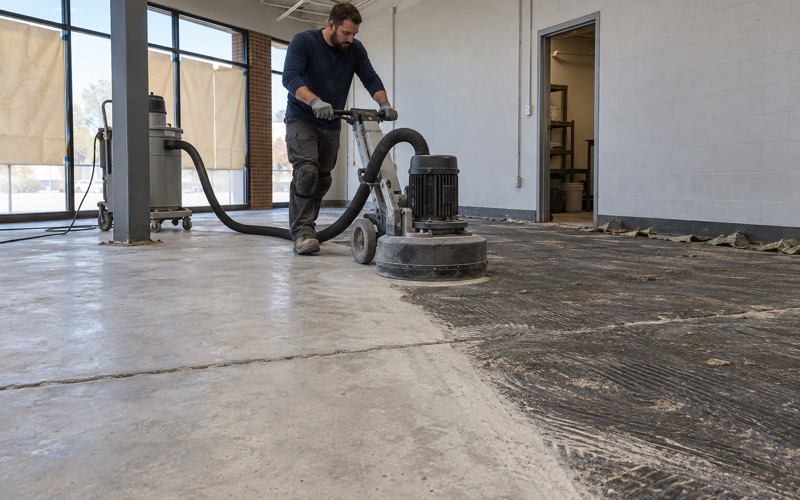
Only then does our part start. Grinding dust is pulled straight into a vacuum at the machine rather than swept or rinsed toward a sink or floor drain, and the grinder brings the slab to an ICRI concrete surface profile the primer can grip. If the slab under an old operatory floor is too far gone for a thin coating, we say so in writing before the price is final.
We want to be plain about what a coating does not do. A resin floor does not encapsulate, neutralize or remediate mercury, and we never offer one as a fix for a room that has not been cleared. The order is survey, cleanup by others, then grinding and coating, and we hold to it even when the schedule is tight.
A Seamless Floor That Leaves a Future Spill Nowhere to Go
A seamless coved operatory floor
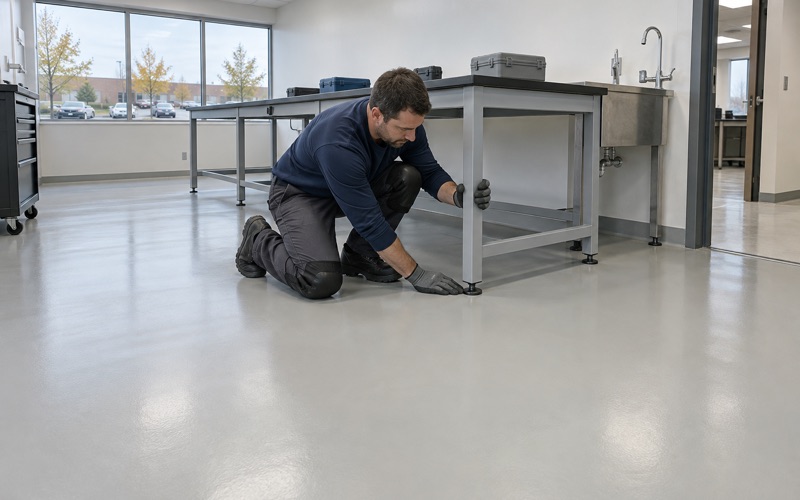
Once a room is clear, the floor we recommend for an operatory is continuous: a 100% solids epoxy body coat with an integral cove run up the wall, so there is no seam between floor and base and no molding gap for anything to slip behind. Capsules replaced bottled mercury, but spills of any kind still happen in a treatment room, and a floor with no cracks, grout lines or tile joints simply gives them nowhere to go.
Where the room needs grip at the chair or the sink, slip resistance is specified by the broadcast and topcoat we name in the proposal, usually a fine quartz aggregate under a polyaspartic or urethane topcoat. We pick the topcoat against the cleaning and disinfecting products the practice actually uses, so the finish holds its gloss and color under daily wipe-downs.
Moisture, cure and coating limits
A moisture test is part of the written scope on every slab, using ASTM F2170 in-situ relative humidity probes or ASTM F1869 calcium chloride testing, because moisture is the first thing a coating warranty excludes and we explain those exclusions before the job is sold. Where readings run high, a moisture-mitigation primer goes down first or the schedule waits.
Cure schedules follow slab temperature and the dew point spread at the surface rather than the calendar, and products are chosen inside the Illinois VOC limits for floor coatings under 35 Ill. Adm. Code Part 223. In an occupied medical building, low odor and a predictable return-to-service time matter as much as hardness.
Working around a practice that cannot close
An operatory floor is usually done one room at a time, over a weekend or a block of evenings, so the practice keeps seeing patients in the rest of the office. We phase grinding, coating and cure around those windows and confirm each one with the office manager before we arrive. Each room gets its full cure before chairs and cabinets go back, so nothing is bolted into a coating that is still soft, and the doorway transition is finished flush so carts roll across without a lip.
Permits run through Village of Hinsdale Community Development, where most residential and commercial projects take a combination permit, and we check whether the work needs one before anything is scheduled. For a practice planning a remodel, the conversation starts with the room’s history and the survey, and the floor comes after that.
- 20+ Years Coating Concrete
- Moisture Tested Before Pricing
- Free Written Estimates