Lombard Epoxy Flooring installs industrial epoxy flooring in Lombard, IL, serving surrounding cities including Northlake, Westchester, Wood Dale, Hinsdale and Bensenville. With more than 20 years of grinding, shot blasting and coating concrete, we build industrial floors for warehouses, distribution centers, manufacturing plants, shops and maintenance garages, where a floor has to carry forklifts, pallet loads and chemicals every shift.
An industrial floor is judged by how long it stays bonded and intact under real traffic. A thin coat over an unprepared slab can look fine at handover and wear through in the first busy season, while a properly profiled slab with a high-build system, repaired joints and the right topcoat keeps working for years. Most of the difference is in the preparation and the thickness.
Our industrial proposals spell out the system, coat count and finished thickness by area, along with the moisture result, joint and crack repairs, striping layout and phasing plan. Plant managers can check the work against that scope, and the floor can be maintained against it later.
Preparing an Industrial Slab
Shot Blasting and Grinding
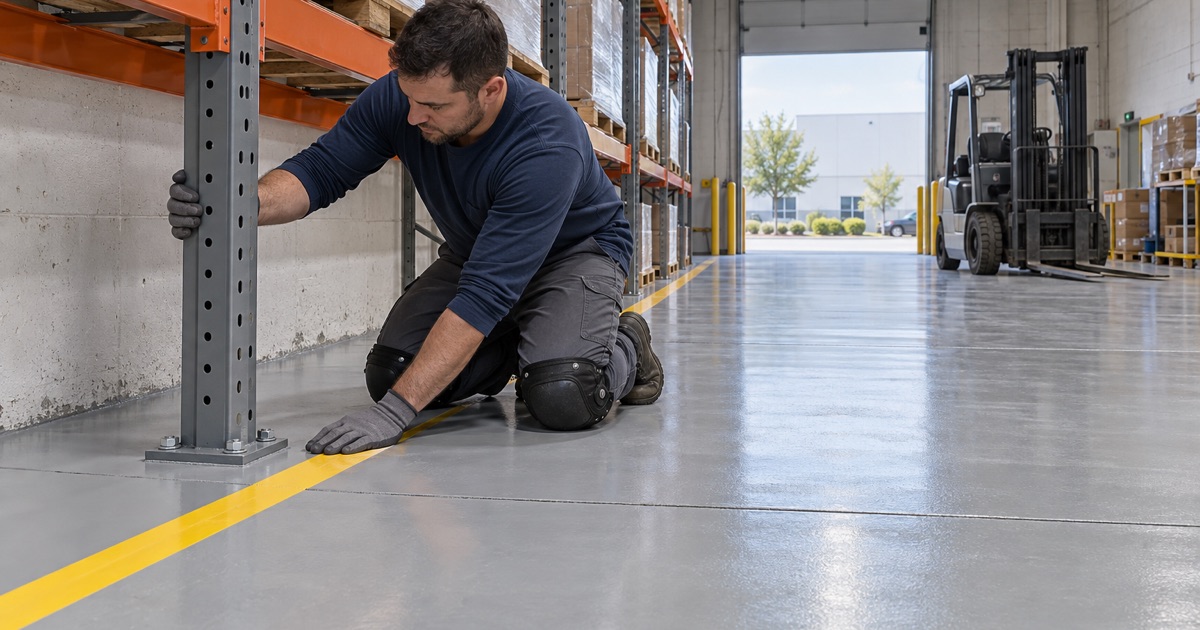
Large industrial floors are usually shot blasted, which profiles the concrete quickly and recovers the steel shot and dust in the same machine. Edges, corners and areas around racking and equipment are finished with diamond grinders. The profile is set to what the coating system requires, often deeper for thick systems than for thin ones.
Shot blasting also removes the oil, rubber and curing compounds that build up on a working floor over the years. Heavily contaminated areas around machines and fueling or maintenance bays may need degreasing and extra grinding before they will accept a primer.
Joints and Cracks
Joints are where industrial floors fail first. Hard forklift and pallet-jack wheels hammer every open joint edge until it spalls, and the coating chips with it. We rebuild damaged joint edges with repair mortar and fill joints with a semi-rigid filler flush with the floor, which supports the edges and lets wheels roll across smoothly. Cracks are repaired and ground flush.
Not every joint should be filled solid. Expansion and isolation joints need to move, and we detail those with flexible sealants rather than locking them up, so the slab can still do what the joints were designed for.
Moisture Testing
Industrial slabs on grade are tested for moisture before pricing. High readings call for a moisture-mitigation primer, priced as its own line. Coating a damp slab without one risks blistering and delamination across large areas that are costly to repair and disruptive to production.
Industrial Floor Systems
High-Build Epoxy
A 100% solids epoxy applied in multiple coats creates a thick, hard surface for warehouse aisles, assembly areas and storage. It seals the concrete against dusting, resists many oils and chemicals, and brightens the space by reflecting light. Thickness is matched to the traffic, with heavier builds in forklift lanes.
Epoxy Mortar and Slurry Systems
Where floors take heavy impact, dragging pallets or steel wheels, a trowel-applied epoxy mortar or broadcast slurry system builds much greater thickness and toughness. These systems can also level out worn or uneven concrete while they protect it.
Mortar systems are common at loading docks, in front of dock levelers, under workbenches where parts are dropped, and along lanes where carts with hard wheels run all day. They take longer to install than a roll-on coating, so we often use them only in the heaviest zones and a high-build epoxy everywhere else.
Chemical-Resistant Linings
Areas with battery charging, acids, solvents or strong cleaners may need novolac epoxy or other chemical-resistant systems. We ask for the list of chemicals the floor will see, including cleaning products and spill risks, and choose a system rated for them.
Where a spill area needs curbs, sumps or engineered containment, the coating protects the concrete inside that design rather than replacing it. We coat up and over curbs with continuous coves so liquid cannot reach the slab at the edges, while the containment volume and layout stay with the facility’s engineer.
Urethane Cement for Heat and Washdown
Food processing, wash bays and areas with hot water or steam cleaning are better served by urethane cement, which handles thermal shock and moisture far better than standard epoxy. It also tolerates more moisture in the slab during installation, which can make it a practical choice on older plant floors that test damp.
Safety, Striping and Layout
Aisle Lines and Pedestrian Walkways
Aisle lines, pedestrian walkways, crosswalks and equipment zones can be laid out with your safety team and coated into the floor system. Sealed under the topcoat, they last far longer than tape or paint on bare concrete. Color coding and layout follow the plant’s own scheme.
Because the markings are part of the coating, they stay crisp under scrubbers and forklift traffic, and they do not leave the lifted tape edges that collect dirt and become trip points. If the layout changes later, new lines can be added over the existing topcoat.
Slip Resistance by Area
Texture is specified by area. Ramps, docks, wash areas and wet processes get more aggressive aggregate, while aisles get a finer texture that still sweeps and scrubs easily. The broadcast and topcoat used for each area are named in the proposal.
Scheduling and Compliance
Working Around Production
We phase industrial work around shutdowns, weekends and off shifts, coating one zone while the rest of the plant keeps running. Fast-curing products shorten downtime per zone, and each section is closed off until it is ready for traffic.
Dust Control and VOC Limits
Shot blasters and grinders run with dust collection, and work zones are isolated. Products are selected within the Illinois VOC limits for floor and industrial maintenance coatings, which apply to us as the contractor applying them, and DuPage County falls within the Chicago ozone nonattainment area. High-solids and 100% solids systems keep solvent content low, which also helps air quality for the crews still working elsewhere in the building.
- 20+ Years Coating Concrete
- Moisture Tested Before Pricing
- Free Written Estimates