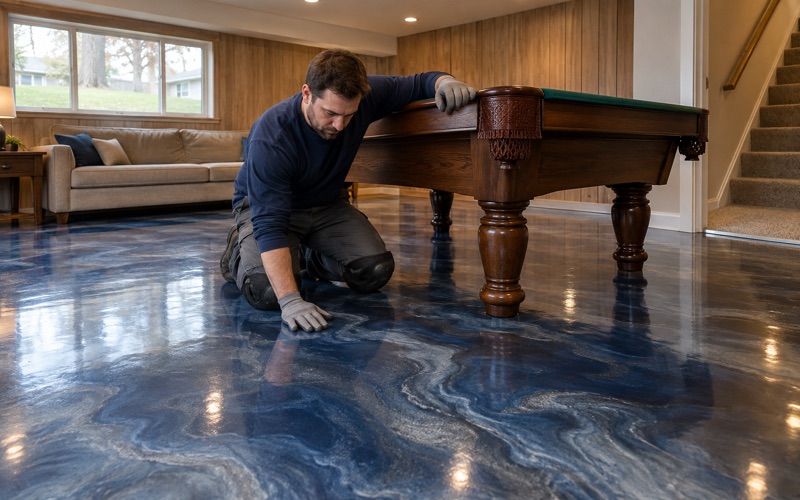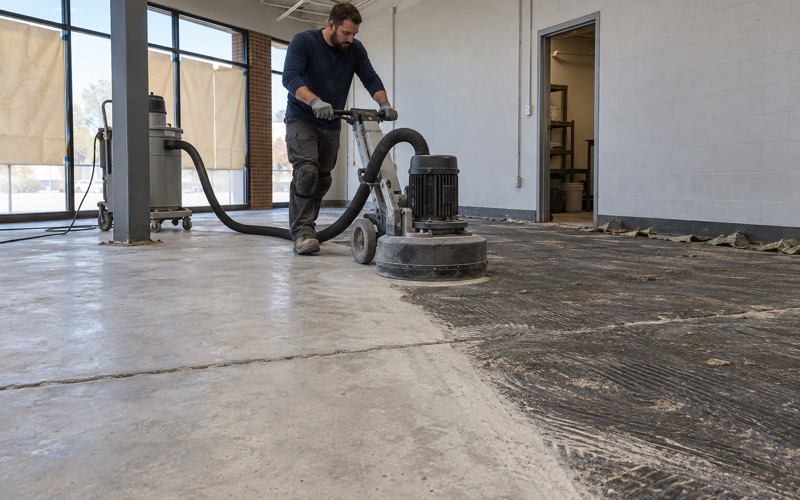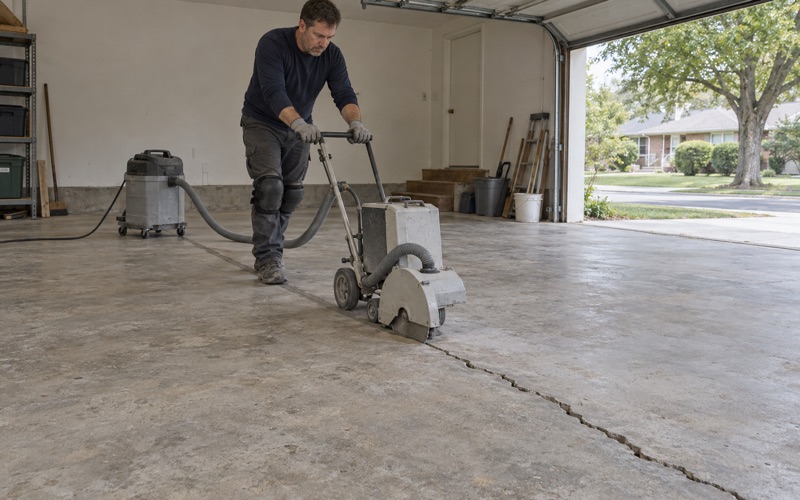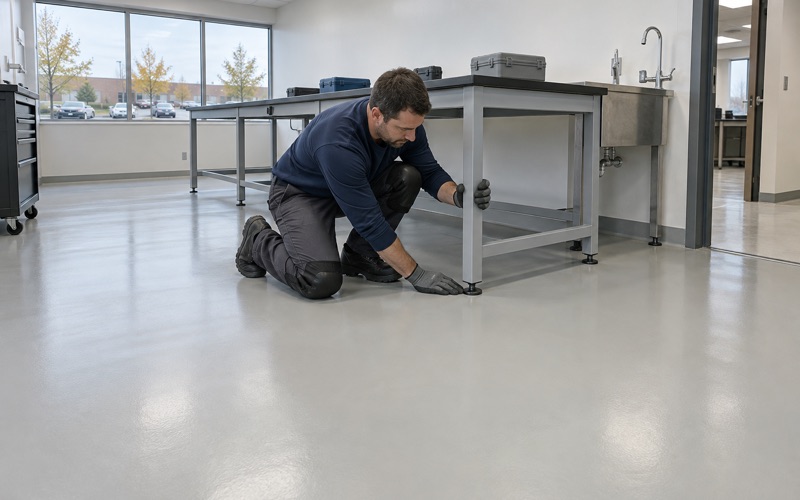
Lombard Epoxy Flooring brings more than 20 years of epoxy-flooring work to Justice, and on this page we focus on one kind of floor: the print room, where the spill that matters is a paste that never sets on its own. Most shop floors fail against a fluid that runs, soaks in or eats at the surface. Screen printing ink behaves differently, and the floor has to be built around that difference.
We start the way we start every job, with a diamond grinder or a shot blaster rather than an acid etch, so the coating has a real profile to hold. A moisture test goes into the written scope before the price is final, and the proposal names the product line, the coat count and the finished thickness. That gives a shop owner something concrete to check the finished floor against.
What follows explains why ink that stays wet changes the choice of finish, color and cleanup chemistry. It also covers what we can and cannot tell from outside a business we have never worked for. The same thinking applies to a home garage or basement studio where someone prints shirts on a small press.
A Screen Printer on Archer Road, and Why Its Ink Never Dries
The village business list, updated in July 2025, carries a screen printing entry at 7750 S. Archer Road, an address that geocodes inside Justice. Trademark filings by the operator include THE PLUG POWERED BY AVANCE for silk-screen printing inks. Whether that address prints on site, what ink it runs and what its floor looks like are things we have not seen, and the business has no relationship with us.
It still makes a useful starting point, because screen printing in a garment shop usually means plastisol, and plastisol is a floor problem unlike almost anything else a coating sees. The village’s own hazard plan says Justice grew along Archer Avenue and now holds over 200 small businesses with no major industries, so a print room here is more likely a storefront or a bay than a plant floor.
A Paste, Not a Liquid
One maker’s safety data sheet for a white plastisol, Triangle Ink’s SDS 1707, describes the product as a white paste built on PVC resin and a plasticizer. Its percent volatile is listed as not applicable, which means there is no solvent or water in it waiting to evaporate. Leave a drip on the floor overnight and it is still a drip in the morning.
Cured by Heat, Never by Air
Plastisol cures in a dryer, not on a shelf. Printer guides put the cure at 320 degrees for at least one minute, with the ink itself reaching that temperature. A shop floor never gets near that, so ink that lands there never dries; it sits as a soft film until someone removes it or walks through it.
That is also why we never describe plastisol as attacking a coating. Nothing on the data sheet says it harms a floor. The trouble is simpler and more persistent: it stays wet, and wet ink travels.
Looking for epoxy-flooring closer to Bridgeview? See Epoxy-Flooring Services in Bridgeview.
Footprints, Carts and Garments: How Wet Ink Moves Through a Shop
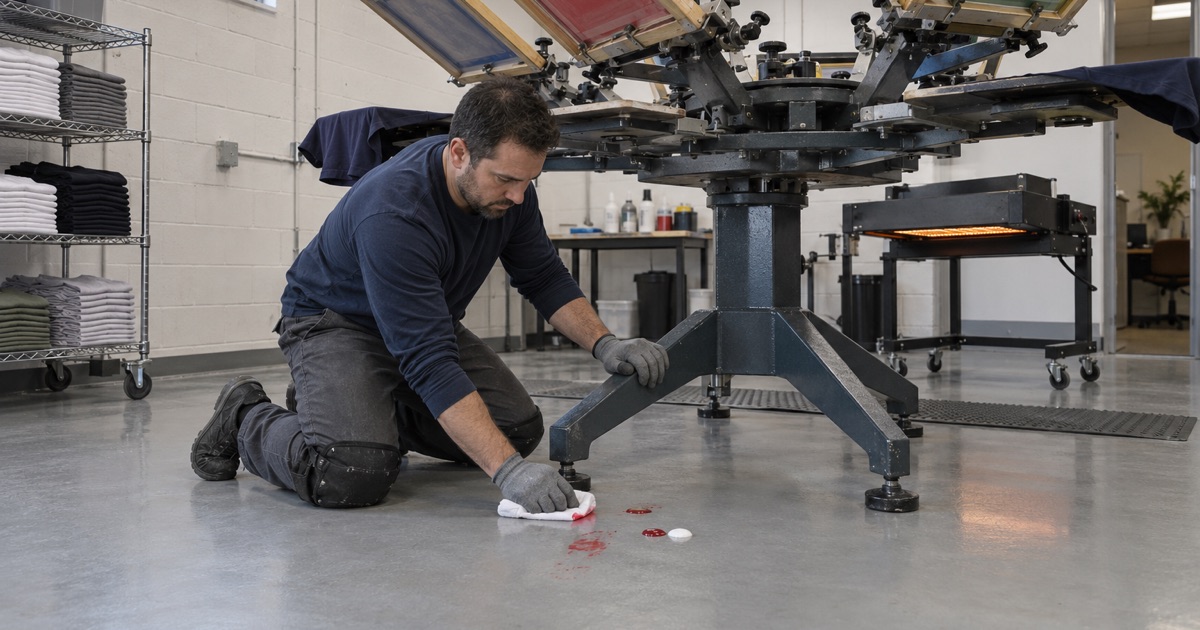
A drip under a press head, a smear off a squeegee or a blob that falls from the lip of an ink bucket does not stay where it lands for long. Shoe soles pick it up, cart wheels roll it into lines, and a dropped shirt or a stack set down for a moment can come up printed on the wrong side. In a garment shop the floor problem ends up on the product.
Why a Mop Makes It Worse
The same data sheet lists the ink as insoluble in water. Push a wet mop through a plastisol spill and the paste is not lifted; it is spread thinner over a wider area, and the mop head carries it to the next stretch of floor. A water-based routine that suits an ordinary floor does nothing useful here.
Press Mats That Get Swapped, Not Washed
The practical answer at the press is a mat that catches drips and is swapped out when it is loaded, rather than mopped in place. A clean mat goes down, the inked one goes to wherever the shop cleans or discards it, and the coated floor around the station stays clear. We plan the mat footprint with the owner before coating, so the floor’s edges and seams do not fall where mats get dragged.
The rest of the room is handled the same way as any spill-prone workspace: ink picked up at once with a scraper and a rag, carts kept on a defined path, and finished goods off the floor. A coating cannot stop ink from being tracked, but the right one makes it quick to see and quick to lift.
Edges, Corners and Under the Press
Ink that gets under a press base, into a cove or along a wall line is the ink that stays longest. We keep the coating continuous up to fixed equipment and walls where the layout allows, without open seams or a gap at the edge, so there is no crack for paste to work into. Where a press or dryer cannot be moved for the work, we say so in the scope and finish around it rather than leaving a ragged line.
Mineral Spirits, Press Washes and What the Coating Must Tolerate
The ink maker’s own cleanup instruction is short: wash up promptly with mineral spirits. That means the floor in a print room is going to see mineral spirits on a rag, regularly, and often right next to the press where the ink fell. A coating for that room has to take repeated solvent wiping without softening, dulling or losing its surface.
Mineral Spirits Are the Easier Case
One resin maker’s chemical-resistance chart rates white spirit, another name for mineral spirits, as having no deleterious action on each of its resin types. We treat that as supporting evidence, not a guarantee, and check the specific product line we propose against its own data. On that evidence, mineral spirits wiping is usually the routine part of the specification.
Ketone Press Washes Are a Different Question
Some shops do not stop at mineral spirits. Screen washes and press washes built on ketones are a different chemistry, and a chart rating for white spirit says nothing about them. Before we name a topcoat, we ask for the data sheet of the wash the shop actually uses and check the coating against that, not against a generic solvent.
Where the wash is aggressive, that may move the choice toward a different topcoat, or toward keeping the strongest washes at a sink or a bench rather than on the floor. Either way, the decision is written into the scope before work starts, so nothing about the chemistry is assumed on the day.
Coating an Occupied Small Shop
A print room in a small storefront usually cannot close for long, so we phase the work around the shop’s own hours where we can, with overnight or weekend windows when the press cannot stop. Grinding dust is captured at the machine with a vacuum, which matters in a room full of screens, emulsion and blank garments.
We also choose products inside the Illinois VOC limits for floor coatings, which bind whoever applies them. Cure times follow slab temperature and dew point, not the calendar, so the press goes back into service when the floor is ready rather than on a promised date.
A Smooth, Wipeable Print-Room Floor in a Color That Shows Ink
Many garage and shop floors get a broadcast texture for traction, and that is often the right call. A print room runs the other way. Ink pressed into a deep texture is hard to scrape out, and every ridge holds a little of it, so the floor here is built smooth and seamless enough to scrape with a blade and finish with a rag.
Smooth Does Not Mean Slick
A smooth floor still needs to be safe to stand on at the press. Where a shop wants some grip without giving up scrapability, we specify a fine quartz aggregate broadcast held in the topcoat rather than a coarse one, and we name the broadcast and topcoat in writing instead of promising slip resistance as a slogan. The trade-off is discussed with the owner before the scope is signed.
Color and Gloss That Work Against Ink
Color is a working decision in a print room. A dark or busy flake floor hides a drip until it has been tracked across the room, while a plain, light or mid-tone solid color shows a fresh spot of ink right away. We steer a print room away from heavy vinyl flake for that reason, since flake reads as pattern and ink disappears into it. The best choice contrasts with the colors the shop prints most.
A dense, glossy topcoat gives ink less to grip than a porous or worn surface does, which is what lets a blade lift it cleanly. Gloss also shows where a wipe has left a smear behind. That finish is only as good as the bond under it, so cracks, spalls and old coatings are mapped first, and we say plainly when a slab needs repair before it should be coated.
Permits and Who Signs Off in Justice
Concrete work is a listed permit item with the Village of Justice Building Department on 82nd Place, and the village requires each contractor on a permit to be registered and bonded before the permit issues. A coating over a sound slab and a slab repair or replacement are different jobs, so we confirm with the department which one a project is before it is scheduled.
Illinois does not license flooring or coatings contractors at the state level, so the village’s own rules are the ones that apply here. In a leased storefront, whether the floor gets coated at all is usually the landlord’s or property manager’s call, not only the tenant’s.
If you run a print shop, a garment decorator or any room where plastisol hits the floor, start by telling us what ink you print with, what wash you clean screens with and where the presses sit. From that we can write a scope you can check the finished floor against, including the moisture test result. A warranty conversation comes before the sale, and moisture is the first exclusion we name.
- 20+ Years Coating Concrete
- Moisture Tested Before Pricing
- Free Written Estimates