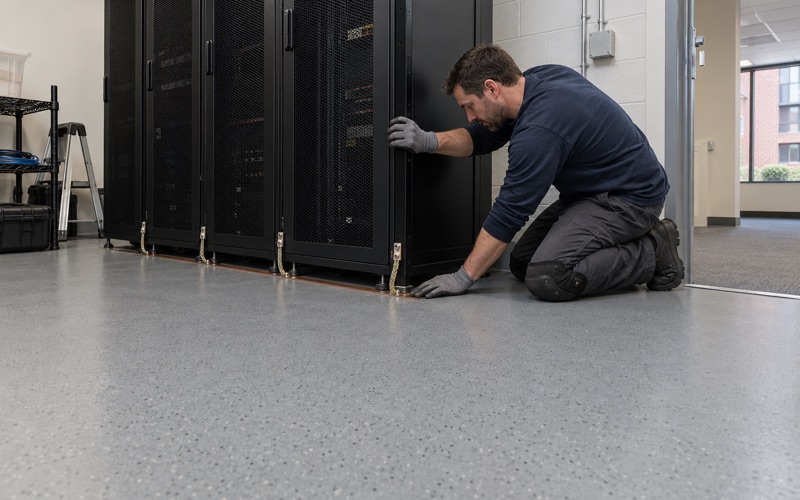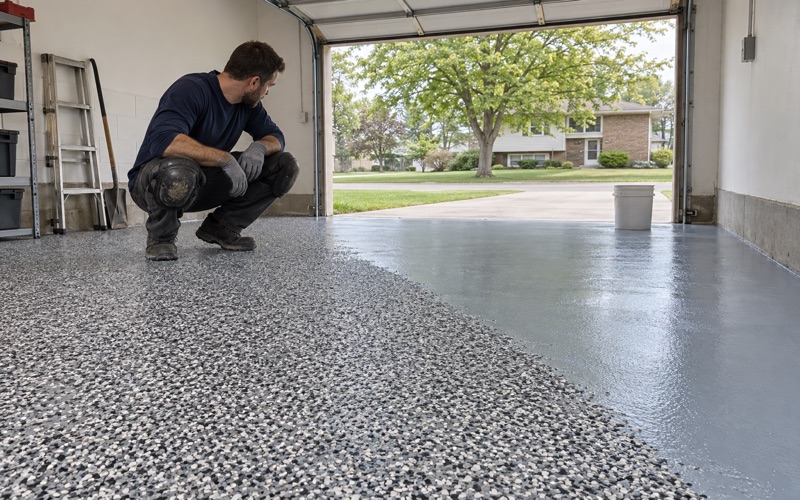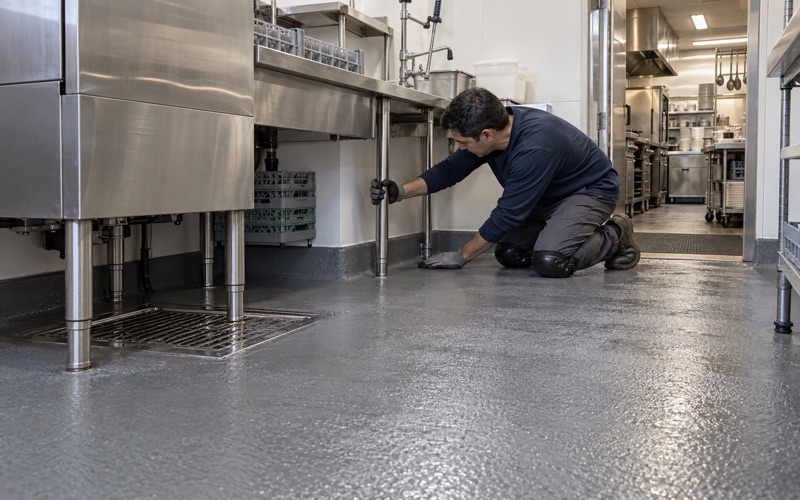
Lombard Epoxy Flooring has spent more than 20 years on epoxy-flooring in La Grange and across the western suburbs, and the question we ask first on any job is what the room is for. A garage that sees tires and rock salt needs a different system than a basement with an old slab, and a treatment room in a medical practice needs a different conversation than either one. The finish that suits one space can be the wrong call in the next.
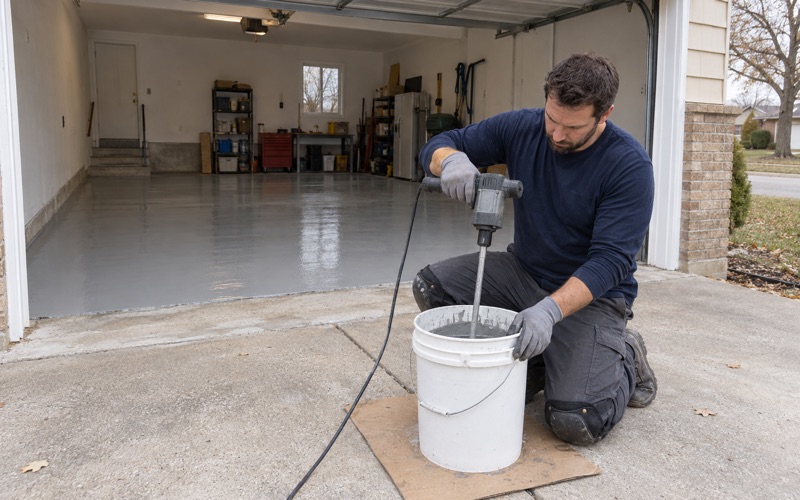
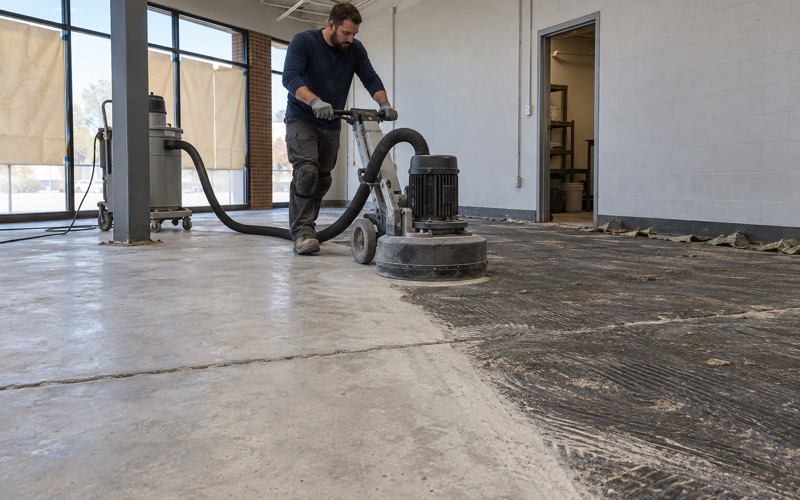
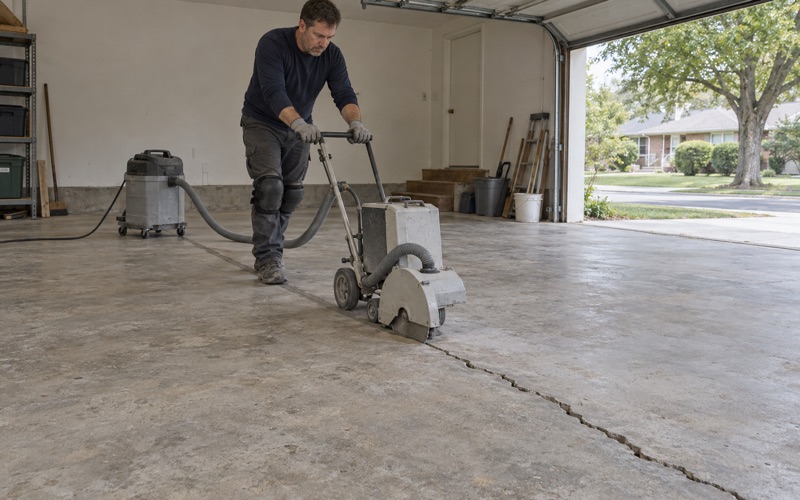
Every slab we work on is opened mechanically, with a diamond grinder or a shot blaster rather than an acid etch, so the coating bonds to a real profile. Before a price is final, the written scope includes a moisture test, and the proposal names the product line, the number of coats and the finished thickness so you can hold the floor up against the quote. Cracks, spalls and old coatings are mapped at the first visit, and if a slab should be repaired or replaced before anyone coats it, we tell you that plainly.
This page covers one decision that rarely comes up on a garage job: how much shine a floor should carry in a room where a medical laser is used. It is a narrow question, but it has a real answer under Illinois rules, and it shows why we treat sheen as a specification rather than a style choice.
A Medical Spa Across From the La Grange Road Metra Station
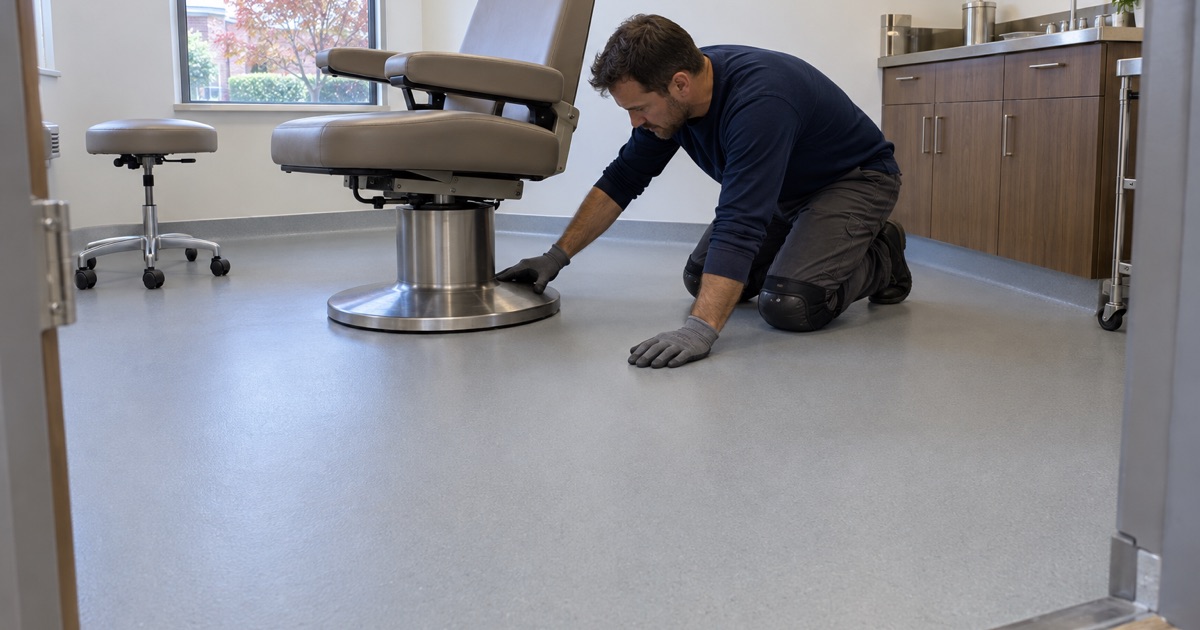
Express Med Spa La Grange sits at 320 W. Burlington Avenue, across from the La Grange Road Metra station, and describes itself as downtown La Grange’s nurse-practitioner-led medical spa. Its published service list includes laser hair removal and IPL photofacials alongside microneedling, chemical peels and injectables. The building geocodes inside the Village of La Grange, in Lyons Township, Cook County.
We have not been inside it. The spa does not publish its laser models, its room layout or its floor finish, and it is not a customer of ours. We use it here because a downtown practice offering laser hair removal is exactly the kind of tenant that raises the question this page is about, and because anyone fitting out a similar room in a La Grange storefront will face it too.
Why the Floor Is Part of the Room Review
A laser treatment room is not judged only by the device. Every surface the beam could strike after it leaves the handpiece, or after it bounces off something, matters to the people who run the room. Walls, counters, instrument trays, mirrors and the floor all belong to that picture, and the floor is the largest horizontal surface in it.
Hair-removal lasers commonly run in the near infrared, a wavelength the eye cannot see, so a stray reflection gives no visible warning. That makes a coating plan for a laser room a different job from the waiting area, even when both rooms sit in the same suite.
Village Permits and a Storefront Floor
The Village of La Grange issues its own building permits. Its permit guidance says replacing existing flooring needs no permit, but the page does not mention floor coatings, and finishing a basement room or altering a garage does need one. For a commercial interior we confirm the path with the village’s Community Development office before the job is scheduled rather than assuming the flooring line covers it.
A treatment suite is also a working business. We phase clinic and storefront floors around operating hours, using overnight and weekend windows when a room cannot close, so coating the laser room does not mean shutting the whole practice for a week.
Looking for epoxy-flooring closer to Brookfield? See Brookfield Epoxy-Flooring.
What Illinois’ Laser Rule Says About Reflective Surfaces
Illinois regulates lasers under 32 Ill. Adm. Code Part 315, the Standards for Protection Against Laser Radiation adopted under the Laser System Act of 1997. Section 315.100 sets out administrative and procedural controls, and two of them bear directly on a treatment room’s surfaces.
The Controlled Area
Under 315.100(a)(5), a controlled area must be established wherever exposure to laser radiation above the maximum permissible exposure, or MPE, is possible. Entry is allowed only with permission of the laser safety officer or a trained designated representative. That one sentence tells a flooring contractor who is in charge of the room, and it is not us. In practice that means floor work in a laser room is scheduled with the practice, done while the device is not in use, and finished with a product the officer has already reviewed.
Unenclosed Beam Paths
Section 315.100(a)(6) deals with unenclosed beam paths. It calls for an evaluation of the expected beam path and the potential hazards from reflective surfaces, and it states that all reflective surfaces shall be excluded from the beam path at all points where the laser radiation exceeds the MPE.
Medical uses carry their own section, 315.130, which covers calibration, a delivered-dose measurement within plus or minus 20 percent, and a guarded footswitch. Neither section names a floor finish. Nothing in the rule says a laser room must have a matte floor, and we would never tell a client otherwise.
What That Means for a Floor
The rule works by evaluation, not by a material list. Whoever runs the room looks at where the beam goes and what it could reflect from, and the floor is one of those surfaces. A floor is not laser protection, and no coating makes a room safe for laser work. What a coating can do is avoid adding a mirror to the room.
Specular Versus Diffuse Reflection, and the Topcoat That Follows
Laser safety manuals draw a simple line between two kinds of reflection. A smooth, polished surface generally gives a specular reflection, where the beam leaves in one tight direction much like light off a mirror. A rough surface gives a diffuse reflection, scattering the energy across many directions instead of sending it back as a beam.
Diffusely Reflective Room Surfaces
Design criteria for Class 4 laser labs at the University of Pittsburgh, based on its laser safety program and ANSI Z136.1, state that all surfaces in the room shall be diffusely reflective. Those criteria were written for research lasers, not clinics, and the health care standard, ANSI Z136.3, is a separate document we have not relied on here. Still, the principle matches the Illinois rule: keep reflective surfaces out of the beam path.
One caution from laser safety guidance overseas is worth repeating. Many surfaces that look dull to the eye can still reflect specularly in the infrared, so a finish that seems flat under room lights is not proven diffuse at the wavelength a hair-removal laser uses. That is one more reason the decision belongs to the person who evaluates the beam path.
Satin or Matte, Never a Mirror Metallic
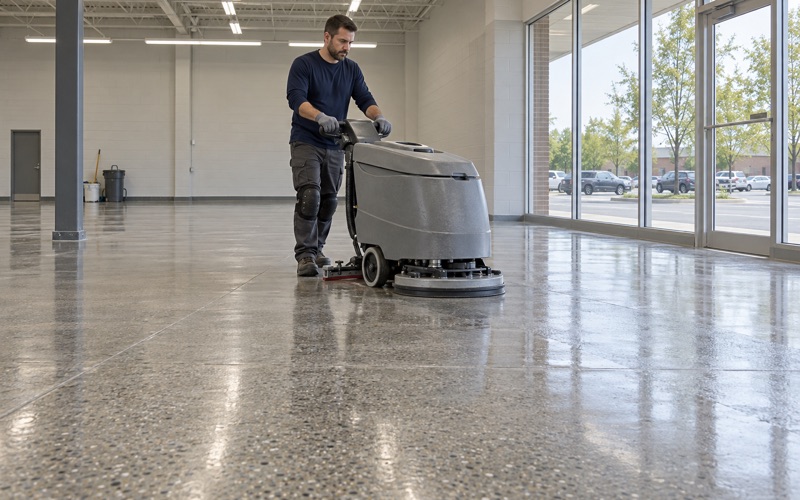
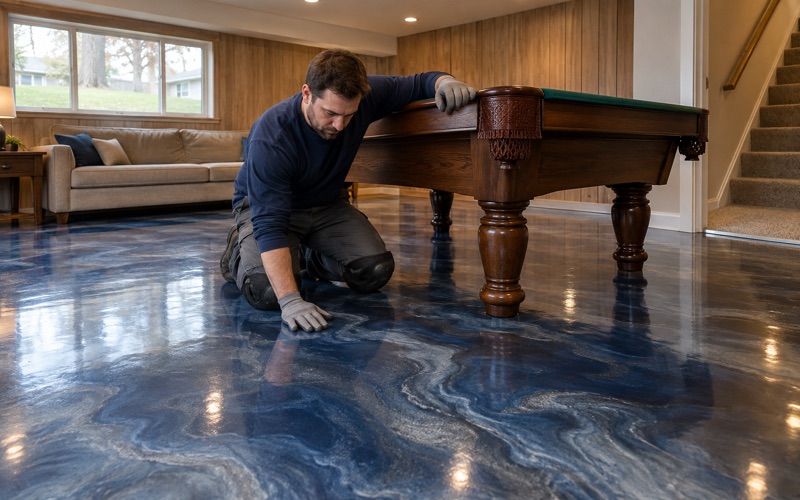
A high-gloss clear coat or a glossy metallic epoxy is exactly the smooth, polished kind of surface that reflects specularly. Metallic systems are built to look like liquid metal, and that depth comes from a glassy top layer. In a laser treatment room, the honest specification is a satin or matte topcoat, with no mirror-gloss metallic anywhere in the controlled area.
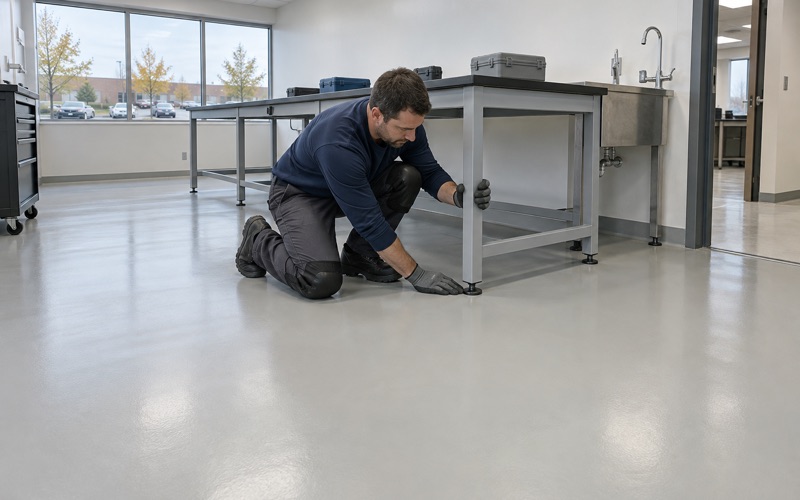
Underneath, the system can be whatever the room’s use calls for, such as a 100% solids epoxy body coat with a lower-sheen polyaspartic or urethane topcoat over it. The sheen is set by the topcoat product itself, so it is written into the proposal by name and can be checked before it goes down.
The Laser Safety Officer’s Call
We do not sign off on laser rooms, and we do not certify any room for laser use. The laser safety officer, or the trained designated representative who controls entry, decides what is acceptable in the controlled area. Our part is to bring a sample of the proposed topcoat at the finished sheen, so that person can evaluate the actual surface rather than a brochure photo.
If the officer wants a flatter finish, a different texture or a change at the treatment chair, that request shapes the scope. A slip-resistant texture, where one is wanted, is specified by the broadcast and topcoat we use, so it is part of the same conversation rather than an afterthought.
Gloss at Home: Where a High-Shine Floor Is Fine
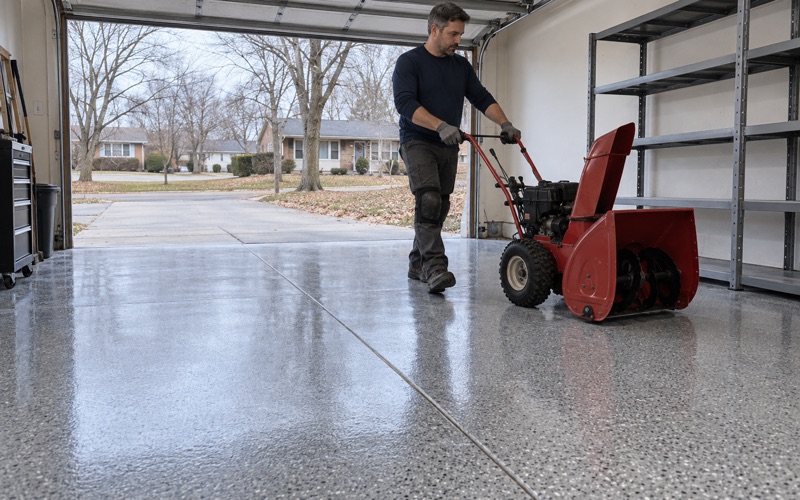
None of this reasoning applies to an ordinary garage or basement. There is no laser in a two-car garage, and a glossy metallic or a high-shine flake floor is a perfectly reasonable choice there. In La Grange the residential buyer is usually the owner: owner-occupancy runs 81.5 percent and only 121 detached houses are rented, so the household choosing the finish is the one that lives with it.
Older Slabs Get a Moisture Test First
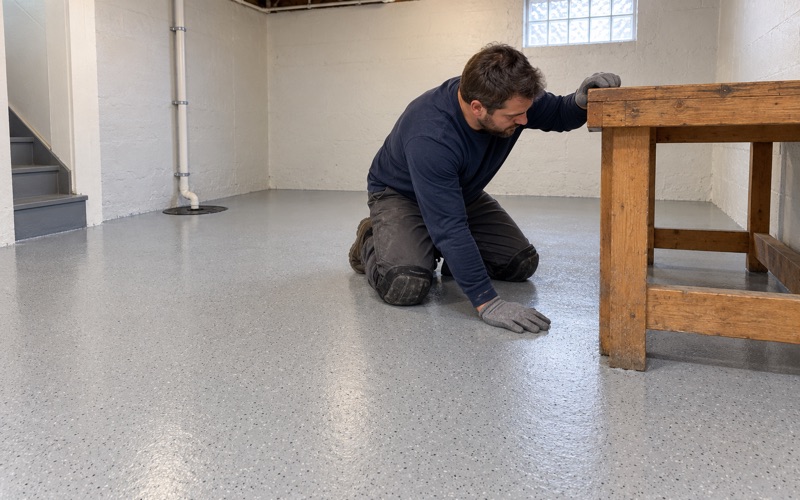
What matters more at home is the slab under the shine. More than a third of La Grange’s housing, 2,237 units, was built in 1939 or earlier, and nearly two-thirds predates 1960. Every one of those slabs predates ASTM E1745, the standard that defines a modern under-slab vapor retarder, so we test before we coat rather than assume the floor is dry.
Depending on the slab, that can mean an ASTM F2170 in-situ relative humidity probe, an ASTM F1869 calcium chloride test, or a plastic sheet check under ASTM D4263 as a first read. A high result points to a moisture-mitigation primer or a different plan entirely, and moisture vapor transmission is the first exclusion we explain in any coating warranty.
Garage Floors Through an Illinois Winter
A garage system here has to hold up to the brine and rock salt that ride in on tires every winter, and the topcoat is chosen for that before anyone talks about sheen. Cure schedules follow slab temperature and the dew point spread at the surface, not the calendar. If an unheated garage is too cold in deep winter, we tell you to wait for spring rather than lay a coating that will not cure properly.
Grinding dust is captured at the machine with a vacuum rather than rinsed toward a floor drain or a storm inlet, and products are picked inside the Illinois VOC limits for floor coatings. For a home job over the state threshold, you get a written contract and the Home Repair: Know Your Consumer Rights pamphlet before any grinding starts.
So the shine question has two answers in La Grange. In a laser room, the finish is satin or matte and the laser safety officer makes the call; in your garage or basement, gloss is yours to choose once the slab has passed its tests.
- 20+ Years Coating Concrete
- Moisture Tested Before Pricing
- Free Written Estimates