Lombard Epoxy Flooring offers epoxy flooring in Lemont backed by more than 20 years in the trade, and the most useful thing we can tell a homeowner here starts with the chemical built to undo a coating. A floor coating is a cured film of resin bonded to concrete. Paint stripper is a liquid engineered to soften and lift exactly that kind of film, which is why the two belong in the same conversation.
That chemical shows up in two places on a Lemont job. One is the auto body trade, where stripping old finish off a panel is routine work and where a federal rule already treats it as its own operation. The other is the garage of a homeowner who wants an old, failing coating gone and assumes a can from the store will do it.
Both lead to the same answer, and it shapes how we quote. A finished floor has to be kept away from stripper, and an old coating comes off with a diamond grinder or a shot blaster, which is also how we open every slab before anything new goes down. We never rely on an acid etch for that step.
A 1935 Body Shop on New Avenue and the Rule It Paints Under
Kallemeyn Collision Center sits at 16039 New Ave, an address that geocodes inside the village of Lemont. The shop’s own site says it was founded in 1935 and calls itself Chicago’s second-oldest auto body shop. We have no connection to the shop, and nothing on this page describes its floors or its methods beyond what it publishes.
The Lemont area is home to Argonne National Laboratory and other heavy industrial sites, and the village itself sits on a hillside along the south banks of the Des Plaines River. A body shop with roots in 1935 fits that working character, and its trade is a clear example of floors that share a room with the one chemical designed to remove coatings.
What the shop says about itself
The certifications it lists are BMW, Jaguar, Land Rover through the Authorized Aluminum Repair Network, Mercedes-Benz and Tesla, and it describes itself as one of the only Tesla factory certified body shops in Chicago. The equipment it names includes Celette frame benches and aluminum tooling. On the paint side, it advertises water-based paints and precision color-matching technology.
Those details matter here only as identity: a long-running refinish shop doing auto body repair, frame straightening, and paint and refinishing on New Avenue. What the shop does not publish is how many booths it runs, whether it strips parts chemically at all, or what finish its floors carry.
Where the 6H refinishing rule draws its lines
Body shops refinish under the federal area-source rule for paint stripping and miscellaneous surface coating, 40 CFR part 63 subpart HHHHHH, known in the trade as the 6H rule. Its paint-stripping section, 40 CFR 63.11173(a), requires operations to implement management practices to minimize the evaporative emissions of methylene chloride. The practices it lists are evaluating whether stripping is needed, considering alternatives, reducing exposure to air, optimizing application conditions, and storing and disposing of the material properly.
Above one ton of methylene chloride a year, the rule adds a written minimization plan and a posted placard. Notice what is missing: the section names no floor. The rule treats chemical stripping as its own operation with its own handling, and that is the cue we take for the floor underneath it.
Looking for epoxy-flooring closer to Palos Hills? See Epoxy-Flooring Services in Palos Hills.
Paint Stripper Is Built to Remove Coatings, Floors Included
Most shop chemicals reach a floor by accident and harm it, if at all, as a side effect. Paint stripper is different, because it is the one product in a refinish shop formulated to dissolve the kind of cured film a floor coating is. A drip of it on a garage or shop floor is not a stain to wipe later; it is the chemical doing its job on the wrong surface.
No floor coating is immune
Customers sometimes ask which of our systems will shrug off paint stripper, and the honest answer is none of them. A thick 100% solids epoxy or a polyaspartic topcoat is a tougher film than a thin roll-on kit, but a remover left to sit will still soften resin, because that is what it was made for. The protection is in how the stripping is done, not in the floor.
Stripping on a tray, a sheet or a table
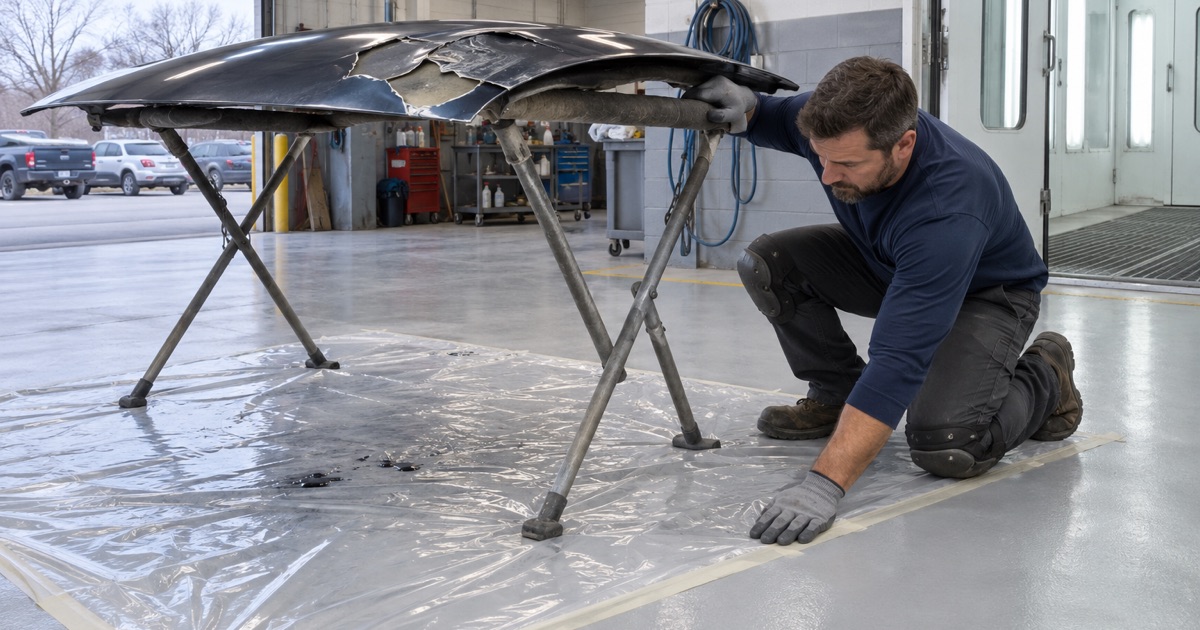
In a refinish shop, the practical answer is to keep stripping off the finished floor entirely. Parts are stripped on a tray, a sacrificial sheet, or a dedicated stripping table, so the chemistry lands on a surface meant to take it. It also keeps the work in one known spot, which is the point of treating stripping as its own operation.
When a drip does reach the floor, it is lifted at once with an absorbent and the spot is cleaned, rather than left to work while the job continues. A coating that has been softened in one place is a weak spot that traffic, rolling jacks and dropped tools will find. We would rather tell a shop owner that than sell a thicker system on the promise that it will not matter.
What we put in the proposal for a shop floor
For a commercial floor where stripping happens, our proposal names the product line, the number of coats and the finished thickness, so the floor can be checked against the quote. We also mark where the stripping station will stand and recommend that it sit on its own tray or table rather than on the coating. A slip-resistant texture, if the space needs one, is specified by the broadcast and topcoat we use, not promised as a slogan.
Why Methylene-Chloride Strippers Left Store Shelves in 2019
The homeowner’s version of the stripper question has a federal answer. Under 40 CFR 751.105, a rule issued under the Toxic Substances Control Act, after November 22, 2019 methylene chloride for consumer paint and coating removal may not be manufactured, processed or distributed for that use. Distributing it, or products containing it, to retailers for paint and coating removal is prohibited, and retailers are prohibited from distributing those products.
What the retail rule does and does not reach
That is a distribution ban aimed at the consumer market, and we describe it as exactly that. The section does not itself address commercial use, and we make no claim here about what a body shop may use. For a homeowner, the practical result is simpler: a methylene-chloride remover is no longer something a retailer may sell for paint and coating removal.
Why a can was never the right tool for a floor
Even before 2019, pouring stripper across a garage slab was a poor way to remove an old coating. The softened resin has to be scraped up as a sticky sludge, often in more than one pass, and the result still has no measured profile for a new coating to grip. A remover sold for furniture or trim is aimed at thin films on small surfaces, not at a two-car slab.
Removing an Old Garage Coating: Grinding, Not a Can of Stripper
Lemont’s housing is young enough that the garage floor market here is mostly slabs poured from the 1990s through the 2010s. Census figures put 63.0 percent of the village’s housing as built since 1990, and 99.3 percent of owner-occupied homes are single-family. When one of those slabs already carries a peeling coating, the first job is getting it off cleanly.
Mapping the old coating before quoting
We start by mapping cracks, spalls and every area where the old coating has lifted, flaked or stayed bonded. That map decides the removal method and the repair list, and it is where we say so if a slab needs repair or replacement before it should be coated at all. Where an old coating is still bonded in places, we still take it down to bare concrete, because a new system is only as good as what it sits on.
Before the price is final, a moisture test goes into the written scope. Depending on the slab, that can mean an ASTM F2170 in-situ relative humidity probe or ASTM F1869 calcium chloride testing, and a quick ASTM D4263 plastic sheet test is a screen rather than a substitute. Moisture is also the first exclusion we name when we explain what a coating warranty leaves out.
Diamond grinding or shot blasting, with the dust captured
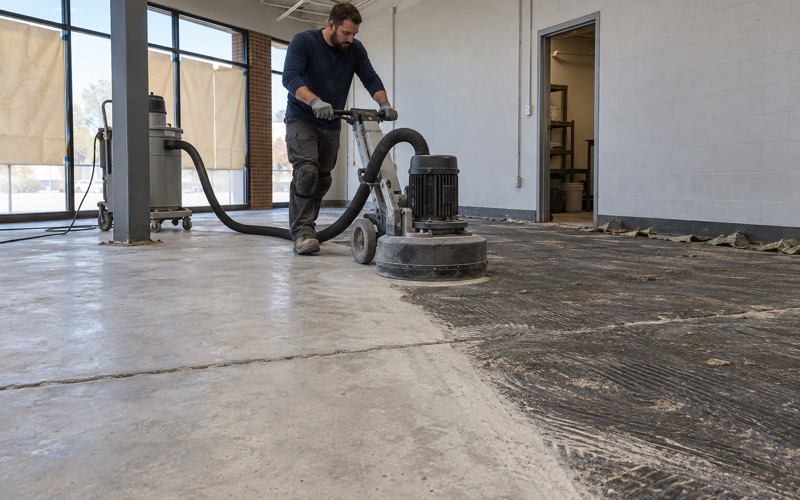
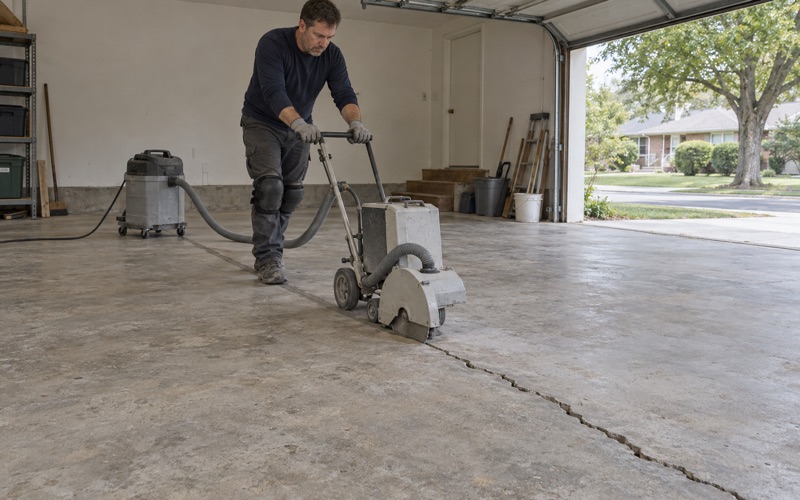
The old film comes off mechanically. Diamond grinding handles edges, corners and the area around a drain, and shot blasting covers open floor quickly where the space allows it; either one leaves a real profile for a fresh primer to grip, which an acid etch does not. It is the same step we use to open a bare slab, so removing an old coating adds passes rather than a different process.
Grinding dust is captured at the machine with a vacuum rather than rinsed toward a floor drain, a sump or a storm inlet. That matters more when the dust carries ground-up resin from an old coating, not just concrete. Nothing about the removal involves pouring a chemical across the floor and washing it out the garage door.
The new system, the season and the village
Once the slab is open and repaired, we choose a garage system built to stand up to the brine and rock salt that ride in on tires all winter, often a 100% solids epoxy base with a vinyl flake or quartz aggregate broadcast and a polyaspartic topcoat. Products are picked inside the Illinois VOC limits for floor and industrial coatings, which bind whoever applies them. The cure schedule follows slab temperature and the dew point spread at the surface, and an unheated garage in deep winter is told to wait.
On the paperwork side, a home job over the state threshold gets a written contract and the Illinois Home Repair: Know Your Consumer Rights pamphlet before any grinding starts. Lemont’s contractor registration terms were not published where we could read them, so we ask the Village of Lemont Building Department before the job is scheduled. The village spans Cook, DuPage and Will counties, but the building questions for a garage inside its limits go to the village either way.
If you are weighing a store-bought remover against professional removal, the comparison is not close for a floor. We would rather quote the grinding, show you the moisture reading and the profile, and let the new coating start on concrete we have actually seen.
- 20+ Years Coating Concrete
- Moisture Tested Before Pricing
- Free Written Estimates