Lombard Epoxy Flooring brings more than 20 years of concrete preparation and resin work to epoxy flooring in Lincolnwood, and this page starts in a restaurant kitchen. A cooking line takes grease, heat and mop water every shift. Once in a while it takes something stranger, and the floor decides whether that spill stays where a crew can collect it or soaks into the slab.
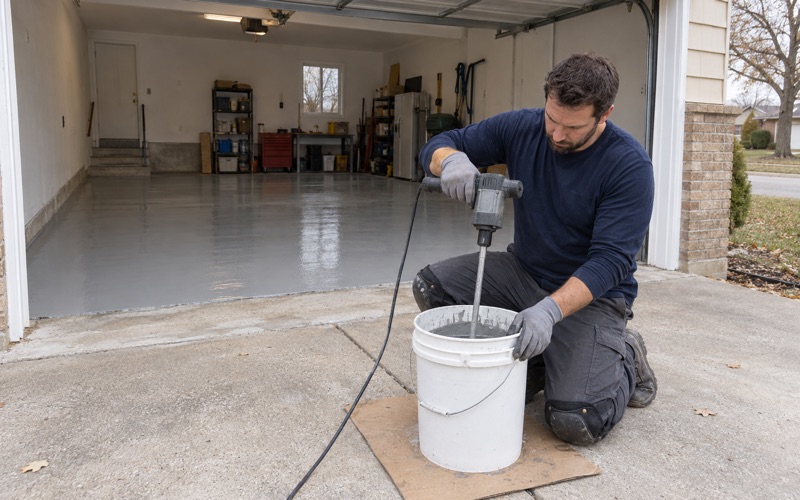
We open the concrete with a diamond grinder or a shot blaster rather than an acid etch, map cracks, spalls and old coatings before pricing, and test for moisture as a written line of the scope. The proposal names the product line, the coat count and the finished thickness, so an owner or a kitchen manager can hold the finished floor up against the quote.
One thing we do not do: we have no part in hood or fire-suppression work. We do not install, inspect or service those systems. What we build is the surface underneath them, and the rest of this page is about why that surface matters when one of them goes off.
A Lincoln Avenue Supper Club and the Line Under Its Hood
L. Woods Tap & Pine Lodge sits at 7110 N. Lincoln Avenue, inside the village and Niles Township. It is a Lettuce Entertain You restaurant built on the nostalgia of a Northwoods supper club: baby back ribs, a barbecue brisket burger, a Wisconsin Fish Fry and Wisconsin Old Fashioneds at the bar. It serves lunch and dinner every day of the week.
We have not been in that kitchen, and we have not read what protects its hood. We use it here because it is the kind of menu that keeps a cooking line busy from late morning to night, and a line like that is exactly where a hood suppression system earns its place.
What a wet-chemical system leaves behind
Many restaurant hoods are protected by wet-chemical systems. When one discharges, nozzles above the appliances release a liquid agent onto the cooking line, and whatever the equipment does not hold ends up on the floor. That strip of floor in front of and beneath the line is the discharge footprint, and it is usually the hardest-worked floor in the building.
One common agent is the liquid used in Ansul’s R-102 restaurant system, sold as ANSULEX LPH. Its 2023 safety data sheet lists potassium acetate at 30 to 40 percent by weight, with the balance non-hazardous ingredients. It is a light green liquid with a vinegar odor, a pH of 7.7 to 8.7 and a relative density of 1.33, and it is soluble in water.
It does not stay where it falls
Because it is a water-soluble liquid, the agent behaves on a floor much as mop water does: it runs toward low spots and pools there instead of staying where it fell. Mixed with grease and food soil from the line, it finds every joint and gap the surface offers. On a floor with open grout lines, the grout is where it goes first.
Quarry tile and grout are still a common kitchen floor, and grout that has worn below the tile face holds liquid in a grid of shallow channels. Porous or unsealed tile can take some in as well. None of that is a fault in the suppression system; it is simply what the floor does with a liquid it cannot shed.
Looking for epoxy-flooring closer to Worth? See Worth Epoxy-Flooring.
Do Not Flush It: Reading the Agent’s Safety Data Sheet
Section 6 of the ANSULEX LPH safety data sheet covers accidental release, and its instructions are short. It says to prevent further leakage or spillage if it is safe to do so. It says not to flush the agent into surface water or the sanitary sewer system. It says to pick it up and transfer it to properly labeled containers, then clean contaminated objects and areas thoroughly while observing environmental regulations.
The same sheet classifies the liquid as not hazardous under GHS, so the instruction is not about a dramatic danger. It is about where the material is allowed to end up. Hosing the line down and moving on is the instinct after a long night, and the data sheet asks for the opposite.
Pickup only works on a surface that holds the spill
Containerizing a spill means squeegeeing, scooping or absorbing it off the floor. That works when the liquid is sitting on top of a continuous surface. It works poorly when part of it has gone into grout joints, cracked tile and the open pores of worn concrete, because what is in the floor cannot be lifted into a container.
That residue then has to be worked out with repeated wet cleaning, long after the visible spill is gone. A seamless resin floor changes the problem. With no joints to fill and a closed surface, the agent and the soil it carries stay where a crew can collect them.
After the cleanup crew leaves
Once the agent is up, the sheet still asks for the area to be cleaned thoroughly. On a sealed resin floor that is an ordinary scrub, with no stained grout lines left holding residue from the discharge. We also explain how the topcoat will wear under daily traffic and what a recoat involves, so the surface that does this work is kept intact.
Who looks at the kitchen
In Lincolnwood, the village contracts with SAFEbuilt for health inspections of food establishments, up to three times a year depending on risk category. Fire inspection comes from the Lincolnwood Fire Department, which is staffed largely under contract by Paramedic Services of Illinois. Neither of those is our role, and questions about the system after a discharge belong with whoever services it.
A Kitchen Floor Built to Hold a Discharge for Pickup
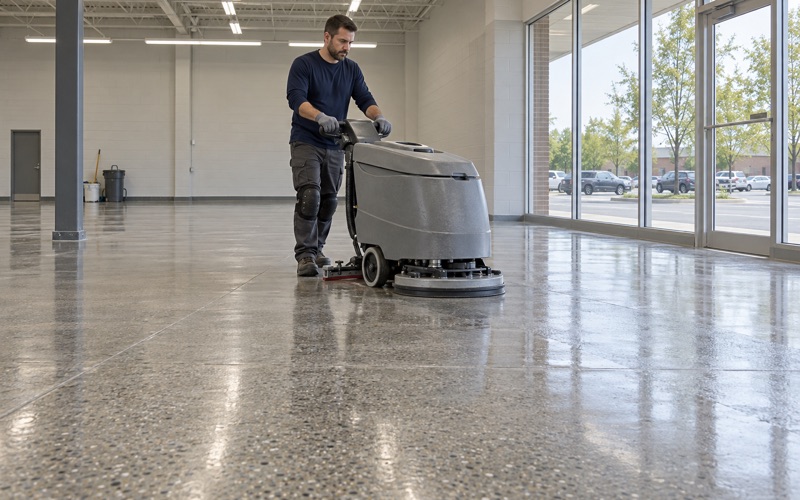
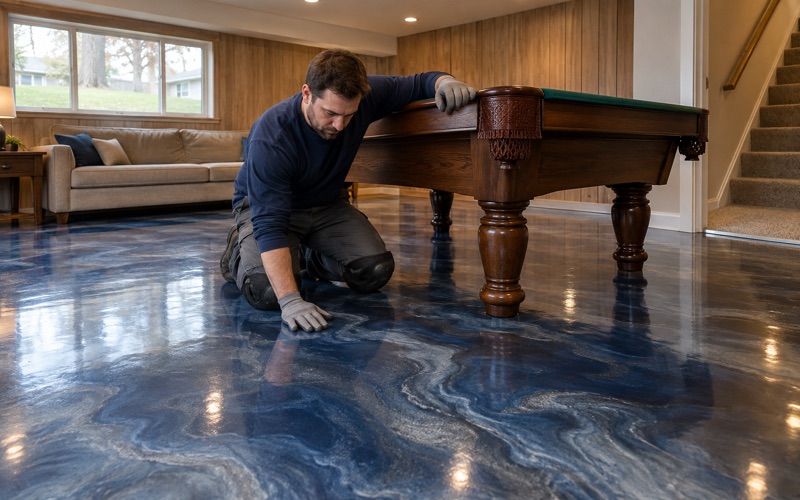
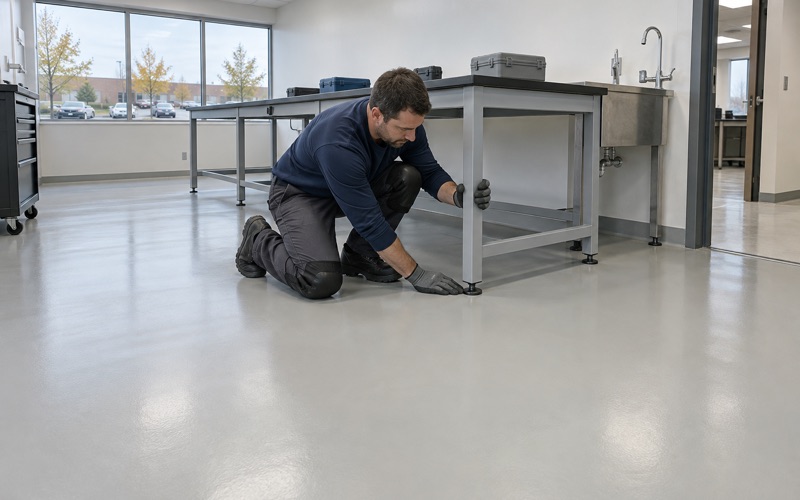
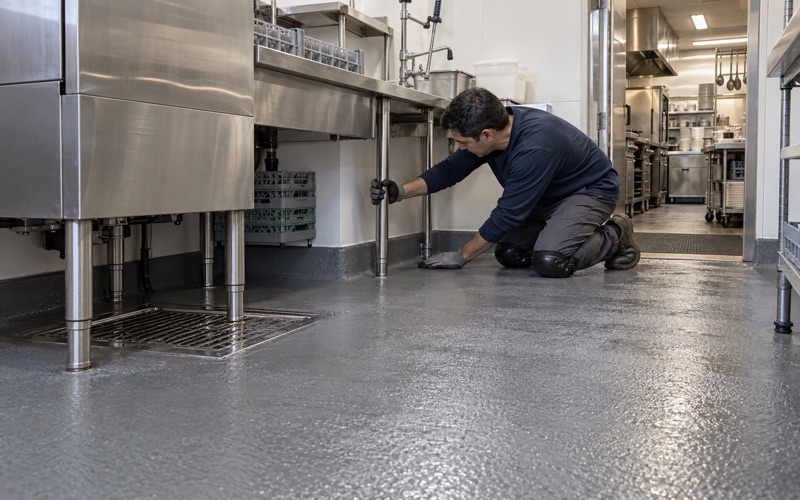
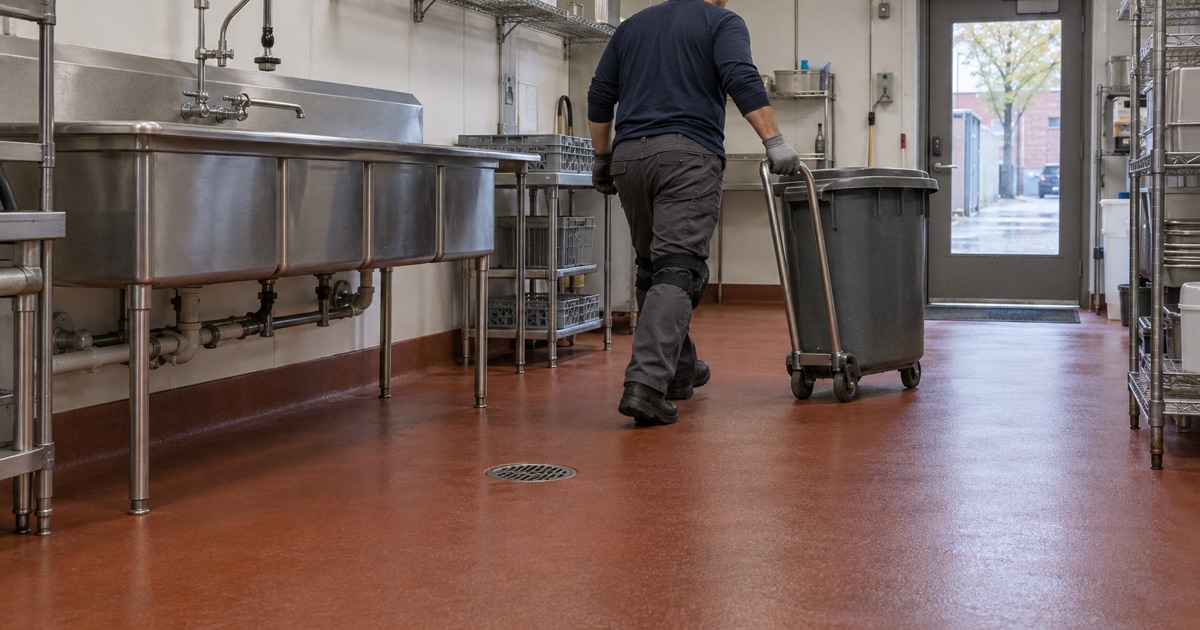
The floor we put down for a cooking line is a sealed, seamless resin system carried up the wall as an integral cove. Depending on traffic and the cleaning routine, that can be a urethane cement or a 100% solids epoxy, finished with a topcoat chosen for the room. The cove matters as much as the field: where floors are cleaned by methods other than water flushing, FDA Food Code 6-201.13 calls for floor and wall junctures coved and closed to no larger than 1 mm. A closed cove leaves a spill nowhere to hide at the base of the wall.
We also keep the coating’s job honest. A resin floor does not change what the suppression system does or how it is maintained, and it has nothing to do with the hood itself. Its work starts after a discharge, when the liquid reaches the floor and someone has to get it back off.
Getting the slab ready under the line
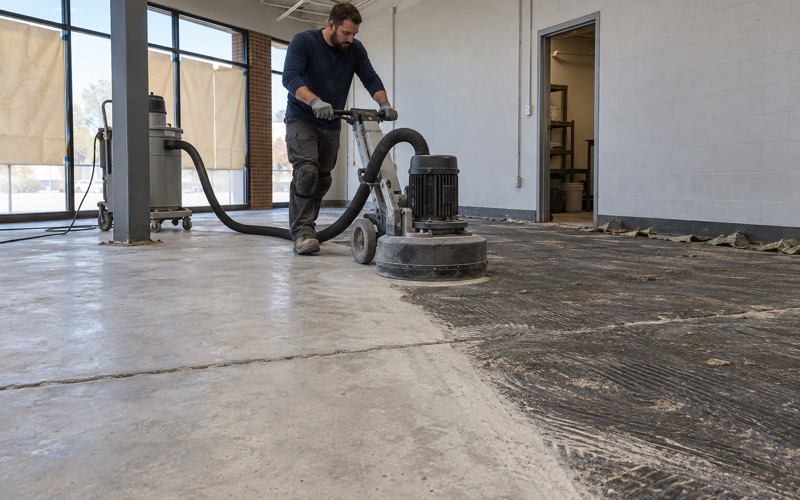
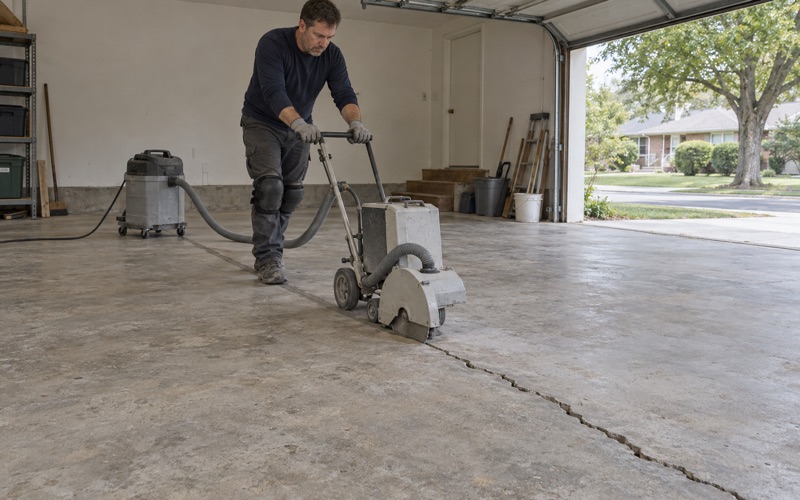
Kitchen slabs carry years of grease, and an old tile floor leaves thinset and grout behind when it comes up. We take the slab down to sound concrete with diamond grinding or shot blasting to a measured ICRI concrete surface profile, so the resin bonds to concrete rather than to residue. Dust is captured at the machine by vacuum, which matters in a building that has to reopen for service.
Moisture comes next. We run in-situ relative humidity probes to ASTM F2170 or a calcium chloride test to ASTM F1869, and where the readings call for it, a moisture-mitigation primer goes down before the body coat. If the slab is too far gone to coat, we say so and price the repair or replacement first.
Working around service hours
A kitchen that serves lunch and dinner seven days a week rarely has a long closure to spare. We phase the work in sections around service and inside the village’s permitted construction hours, and we set cure times by slab temperature and dew point rather than by the clock. The finished texture comes from the broadcast aggregate and topcoat we specify, and the proposal names both.
Garage and Basement Spills That Belong in a Container
The same logic runs through a house. A garage or basement collects its own liquids, from motor oil and antifreeze to paint and cleaning products, and the right way to handle a spill of each is whatever its own label or safety data sheet says. Whatever that is, it is easier on a sealed floor that keeps the spill on the surface, where an absorbent and a container can take it up.
Garage floors and winter salt
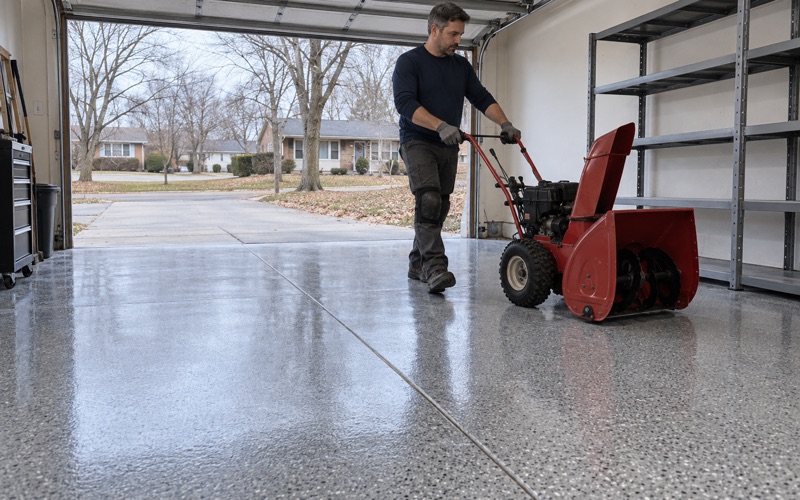
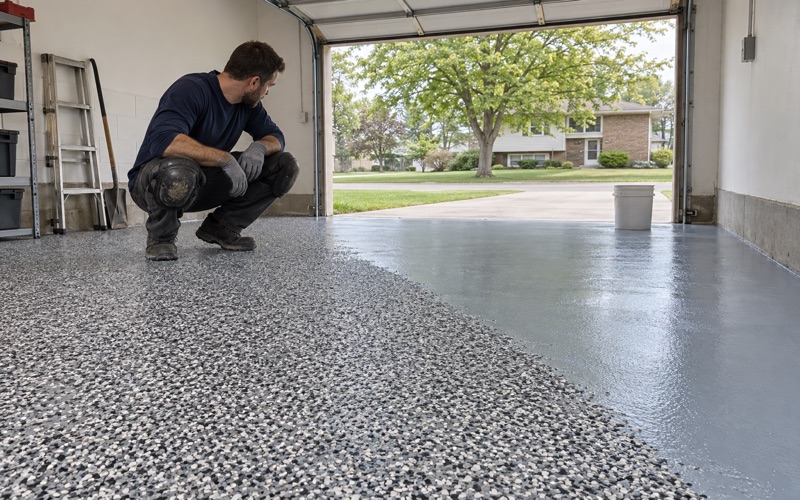
In an attached garage, the steady load is winter. Brine and rock salt ride in on tires all season, and bare concrete soaks them up alongside the drips from the car. We choose garage systems for that exposure, typically a 100% solids epoxy base with a vinyl flake or quartz aggregate broadcast under a polyaspartic or polyurea topcoat that resists hot tire pickup.
An unheated garage in deep winter is often too cold to cure a coating properly, and we will tell you to wait rather than coat a slab that cannot reach its schedule. If the garage slab itself has to be replaced, that is a village Flatwork permit with its own construction standard of 5 inches of compacted CA-6 gravel under 5 inches of concrete.
Basements in a 1950s housing stock
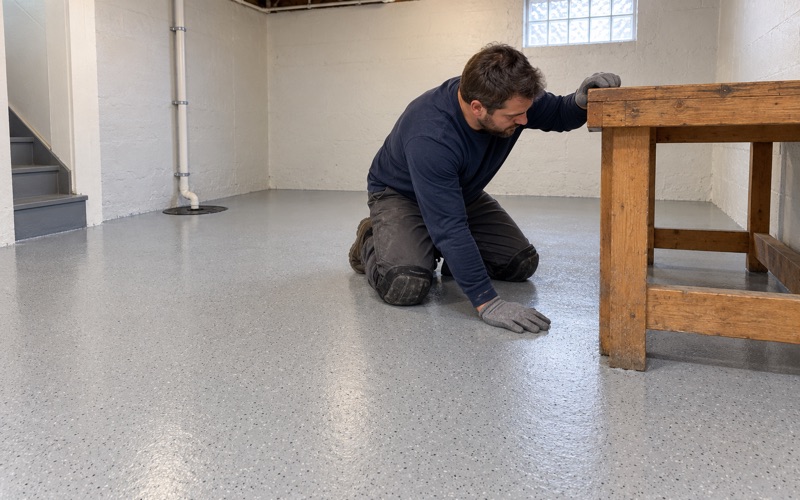
Lincolnwood is a Cook County village of 13,463 people at the 2020 census, and its houses lean old. Of 4,955 housing units, 1,967 were built in the 1950s, about 39.7 percent, and roughly half date from 1940 to 1959. Slabs from that era generally predate under-slab vapor retarder practice and have often carried decades of paint or sealer.
That makes preparation and moisture testing the job itself, not an add-on. We read a basement for past water before anything else, because a coating does not stop seepage, a sewer backup or a sump that cannot keep up. Moisture is also the first exclusion we name when we walk through what a coating warranty does and does not cover.
Home jobs above the Illinois threshold get a written contract and the Home Repair: Know Your Consumer Rights pamphlet before any grinding starts. We also never sell a floor coating as radon reduction, since in Illinois that is licensed mitigation work and not something a coating does.
Whether the floor sits under a cooking line on Lincoln Avenue or under a car in a garage behind a 1950s house, the request is the same: a surface that keeps a spill on top until someone picks it up. Products are chosen inside the Illinois VOC limits for floor and industrial coatings, which bind whoever applies them, and the written scope says exactly what goes down.
- 20+ Years Coating Concrete
- Moisture Tested Before Pricing
- Free Written Estimates