Lombard Epoxy Flooring brings more than 20 years in the trade to epoxy-flooring in Lyons, and on a shop floor where oil is stored in bulk, the coating has a job beyond looks. Under a rack of lubricant tanks, the floor can become one surface of a federally regulated containment. That changes what the coating is for, how every edge of it is detailed and what anyone can honestly say it does.
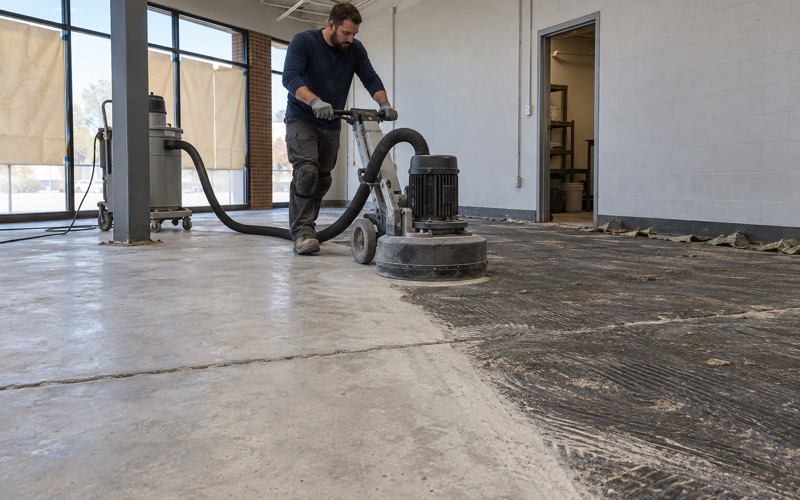
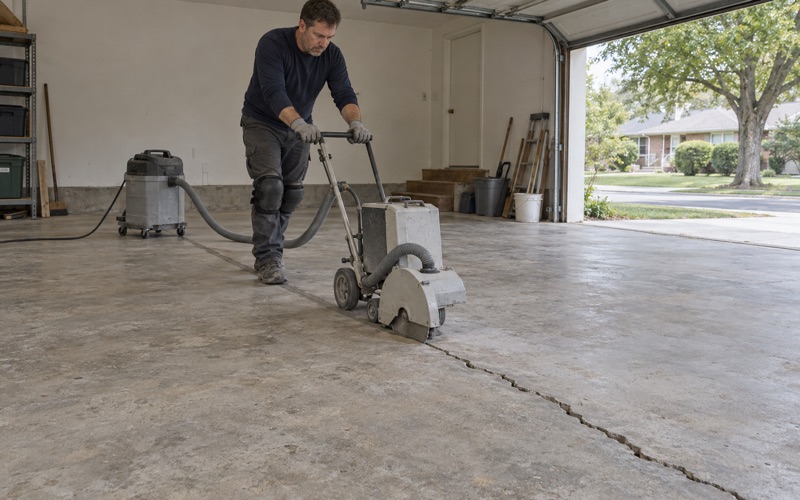
We start the way we start every job: the slab is mapped for cracks, spalls and old coatings, a moisture test goes into the written scope before the price is final, and the surface is opened with a diamond grinder or a shot blaster rather than an acid etch. On a containment floor those steps are not polish. A joint left open or a coating that lets go at the curb is exactly where stored oil would find its way out.
This page covers when federal oil-storage rules reach a shop floor, what a coating can and cannot contribute to a diked area, and how we would scope a curbed lube room so the floor, the curb and every opening in it are handled as one piece. The same questions apply to a fleet garage that keeps oil on hand, not only to a large truck shop.
A Truck Shop on 45th Street and the 1,320-Gallon Line
What runs out of 8445 45th Street
Lyons is a Cook County village of 10,817 people at the 2020 census and the home of the Chicago Portage National Historic Site, but the floors this page is about sit on its industrial side. Rush Truck Centers runs its Chicago light- and medium-duty location at 8445 45th Street, the address a 2009 Ford dealer directory gave Freeway Ford Truck Sales, under the same phone number. Service and parts are open 7:00 a.m. to 6:00 p.m. on weekdays, and mobile service runs until midnight. The listed work includes Xpress PM preventive maintenance, Xpress Check and DOT inspections, and the brand it carries is Ford.
We have no relationship with that shop and have not seen its floors, its lube setup or how it stores oil; none of that is published. We use it here because a preventive-maintenance operation of that kind is the textbook case. Oil changes and PM service on trucks run through motor oil, gear oil and hydraulic fluid, and shops that do that work commonly buy them in bulk, in drums of 55 gallons and up or in larger tanks.
When oil storage brings in EPA’s SPCC rule
The federal Spill Prevention, Control, and Countermeasure rule, 40 CFR 112, is where a stack of drums turns into a regulated floor. A facility is exempt when its completely buried capacity is 42,000 gallons or less and its aboveground oil storage capacity is 1,320 gallons or less, and only containers of 55 gallons or more count toward that total. Past 1,320 gallons aboveground, the rule applies, and bulk storage containers need a secondary means of containment.
The count is storage capacity, not the level in the containers on a given day. A tank that is half full counts at its full size, so a shop cannot get under the line by ordering less often. That is why we ask for a container list, with sizes, before we visit a curbed room.
That arithmetic can surprise an owner. Twenty-four full 55-gallon drums come to exactly 1,320 gallons, right at the line, and a single extra drum or one 275-gallon tote puts the shop over it. Whether a given shop is over the line, and what its plan has to contain, is the owner’s determination with the rule in hand, not ours.
Looking for epoxy-flooring closer to Norridge? See Epoxy-Flooring Services in Norridge.
The Curb Holds the Volume; the Floor Has to Hold the Oil
Section 112.8(c)(2) asks two separate things of a bulk storage installation. The dike, curb or pit must hold the entire capacity of the largest single container, plus enough freeboard for precipitation. And the rule adds that diked areas must be “sufficiently impervious to contain discharged oil.”
Volume is geometry, not coating
The first requirement is met by the height and footprint of the curb and the space inside it. A coating adds nothing to that number: a quarter-inch of resin across a lube room floor does not change how many gallons the curb holds, and painting an open floor with no curb around it does not create containment at all. If a curb is short of the largest tank plus freeboard, the fix is a taller or longer curb, which is concrete work and not something a coating can stand in for.
Where a coating can do real work
The second requirement is about the surface, and that is where a floor system can earn its place. Bare concrete is porous, and slab joints, shrinkage cracks and the seam where a curb meets the floor are paths out of the diked area. A properly built resin system can be the impervious surface inside that curb, provided the product resists the specific oils stored there and every seam is part of the same continuous film.
That is a narrower promise than a floor coating is often sold on, and we keep it narrow on purpose. The plan, its engineering review and the decision that a diked area is impervious enough belong to the facility owner. What we can put in writing is the product line, the number of coats, the finished thickness and the chemical resistance data for the oils on the shelf, so the owner and their engineer can check the floor against the proposal.
Rainwater inside the dike
Outdoor or partly covered containment collects rain, which is why the rule asks for freeboard. Section 112.8(c)(3) also bars draining uncontaminated rainwater from a diked area to a storm drain or open water, bypassing treatment, except under its listed inspection, sealed-valve and record conditions. For the floor, that means the containment is designed to hold water until someone inspects it, and the coating has to tolerate standing water as well as oil.
Coating a Lube Room as One Sealed System
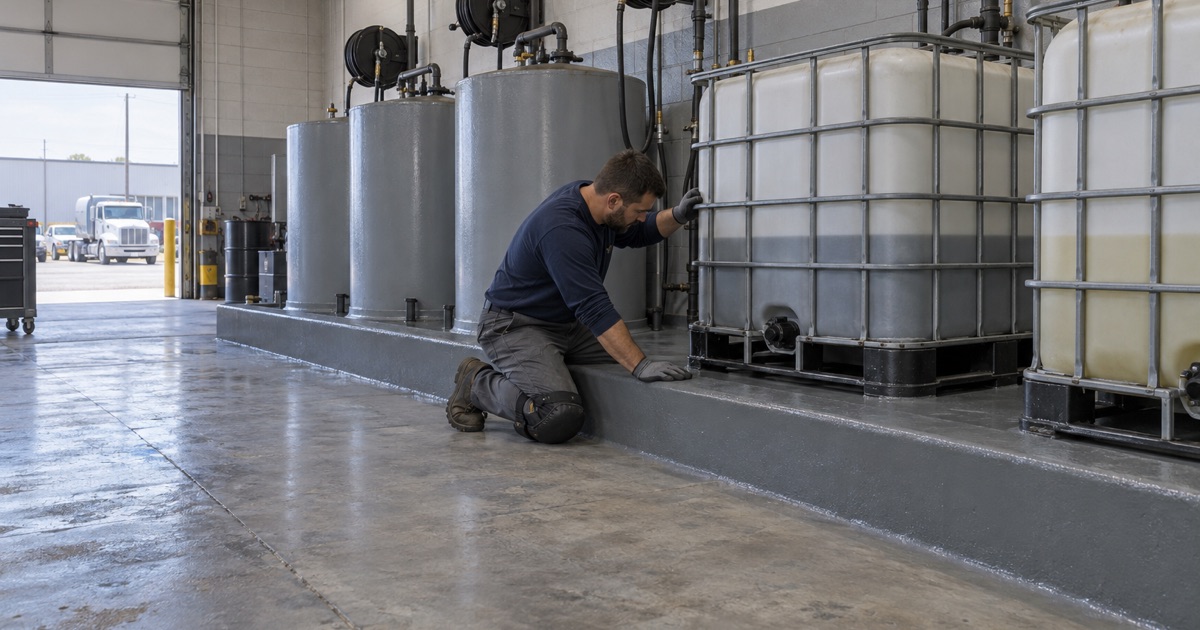
In a curbed lube room the coating is only as good as its weakest seam. We scope the job by walking every edge where oil could leave the diked area, then build the system around those edges rather than around the open field of the floor. Before any of it, tanks and drums have to come out of the room, and grinding dust is captured at the machine with a vacuum rather than washed across the floor.
The floor-to-curb joint
A curb poured after the slab leaves a cold joint at its base, and that line is the most likely path out of the containment. We grind the curb faces and the floor alike to a profile, rout and fill the joint, and carry the coating up the inside face of the curb as a cove, so floor and wall are one surface. The top and outside of the curb are coated as well, so the film has no exposed edge inside the containment.
Slab joints, cracks and penetrations
Control joints inside the curb are a trade-off. Filled solid with rigid epoxy, a joint that still moves can crack through the coating; left open, it is a hole in the containment. We treat each one on site, usually with a flexible joint filler such as polyurea under the coating, and we say in the proposal which joints get which detail. Mapped cracks are repaired before coating, and a slab too broken to seal is flagged for repair or replacement first.
Penetrations are the other leak path: anchor bolts for tank stands, pipe sleeves, conduit stubs and column bases. Each is cleaned, filled and lapped by the coating so the film wraps it rather than stopping short of it. We do not cut new openings through a curb, and a pipe that already runs through one is sealed and coated as part of the same system.
Choosing the product for the oils stored
Resistance data is product-specific, so we match the maker’s chart to the oils actually stored in the room. A 100% solids epoxy body coat with a chemical-resistant topcoat is a common starting point, with a quartz aggregate broadcast where people walk, because an oily film on a smooth topcoat is a slip hazard. Cure follows slab temperature and dew point, not the calendar, and the room stays out of service until the system has cured.
Keeping the surface impervious
An impervious floor on the day it cures is not the same as one five years later. Drum dollies, dropped tools and pallet jack wheels wear through topcoats, and a chip at the curb base reopens the path the coating closed. We specify a recoatable topcoat so worn areas can be abraded and recoated without stripping the room, and the owner’s own inspections are the place to catch damage early.
Drums and Totes in a Home Garage or Small Shop
The 1,320-gallon line sits far above what a household typically keeps, so a home garage with a few jugs of motor oil is not an SPCC question. It is still a floor question, and the same sealing logic applies at a smaller scale. We pick garage systems with the brine and rock salt that ride in on tires all winter in mind, and the slab is ground, moisture tested and mapped first, exactly as a shop floor would be.
Small shops near the line
Between a home garage and a truck shop sits the small operation: a one- or two-bay repair business or a contractor’s yard with a few drums on a pallet. For those, the honest first step is to add up every container of 55 gallons or more before talking about a floor. If the total is near 1,320 gallons, the owner should settle the SPCC question before we price anything, because a curb is concrete work that comes first. Below the line, a curbed corner or a spill pallet under the drums is still worth considering, and the floor around it is coated as one piece with the same joint and edge details.
The village issues its own contractor license application, and we check its current requirements before quoting work in Lyons. Old coatings are mapped and ground off rather than covered, and when moisture is the risk we say so before the job is sold, since moisture is the first exclusion we name in any warranty discussion. A home job over the state threshold gets a written contract and the Illinois consumer-rights pamphlet before grinding starts.
- 20+ Years Coating Concrete
- Moisture Tested Before Pricing
- Free Written Estimates