Lombard Epoxy Flooring has spent more than 20 years putting epoxy flooring in Palos Heights homes and commercial spaces through the same sequence: open the slab, test it, then choose a texture for the people who will actually use the floor. That last step is the one most often skipped. A grit chosen for a garage can get copied into a playroom or a therapy space, and the floor ends up gripping well while scraping the knees and hands of whoever spends time on it.
On this page we work through one question that rarely comes up in a quote: what should a resin floor feel like for someone on all fours? The answer changes the topcoat, the broadcast and where mats go, and it applies to a clinic room as much as to a basement where a toddler is learning to crawl. We write that texture into the proposal by product and broadcast, not as a promise.
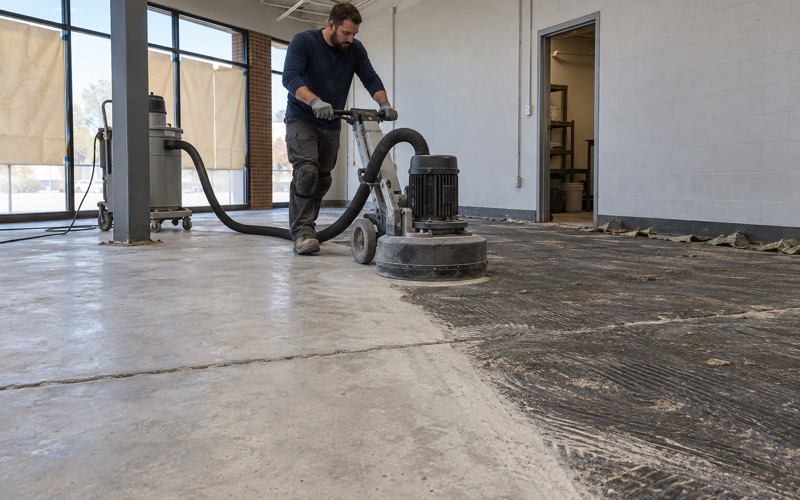
Every slab we coat is opened with a diamond grinder or a shot blaster rather than an acid etch, so the coating has a real profile to hold. A moisture test sits in the written scope before the price is final, and the proposal names the product line, the coat count and the finished thickness so the result can be checked against it.
Pediatric Therapy on South Harlem Avenue
Advocate Christ Hospital Outpatient Center at 12350 S. Harlem Avenue is one of Advocate Children’s Hospital’s outpatient pediatric therapy locations, listed by Advocate under the name Advocate Physical Therapy, Pediatrics, Palos Heights. Advocate describes its outpatient team as providing comprehensive physical, occupational, sensory and speech therapy services. The address sits inside the City of Palos Heights, in Palos Township.
We have not seen the rooms there, and we are not describing them. We point to the site because it makes a kind of floor user concrete for this city: children whose therapy puts them on the floor rather than above it. That user is the reason this page exists.
When the People on a Floor Are on Their Hands and Knees
In pediatric physical, occupational and sensory work, children commonly crawl, kneel, sit and lie on the floor as part of a session. Their knees, elbows and palms touch the surface, often for long stretches and with repeated sliding. A floor that feels fine under a shoe can feel very different under bare skin.
Most coating advice assumes the user is standing. Slip resistance gets framed as the only texture question, so the usual answer is more grit. When the user is crawling, the texture that stops a shoe from sliding becomes something to rub against, and the trade-off has to be stated out loud.
The First Question We Ask
Before we choose a broadcast, we ask who will be on the floor and which parts of their body will touch it. A room where people walk gets one answer, a room where people work at floor level gets another, and a room that does both may need two textures with a clear boundary. We would rather settle that in the walkthrough than after the topcoat cures.
Looking for epoxy-flooring closer to Northlake? See Epoxy-Flooring in Northlake.
Resilient, Nonabrasive and Slip-Resistant: The Federal Wording
The clearest written statement of what a floor should do for people who move along it with more than their feet comes from a federal rule. Under 42 CFR 483.470(f), an intermediate care facility for individuals with intellectual disabilities must have floors with a resilient, nonabrasive, and slip-resistant surface. Where a carpeted client area serves people who lie on the floor or move with parts of their bodies other than feet touching it, the carpet must be nonabrasive too.
That rule binds those facilities only. It does not apply to an outpatient clinic, a home or a playroom, and we do not present it as a requirement for any of them. We use it because it is the plainest description we know of the user in question, and because it names three properties together rather than one.
Three Properties That Pull Against Each Other
Resilient means some give under a knee or a hand. Nonabrasive means the surface does not scrape skin. Slip-resistant means it resists a slide, which on a coated floor usually comes from texture. A bare coated slab satisfies only part of that list.
A coated concrete slab is hard, not resilient, however good the coating. Adding aggressive grit raises slip resistance and costs nonabrasiveness. That is why, where people work on the floor, an honest specification pairs a resin floor with something soft on top rather than asking the coating to do all three jobs.
Sanitary and Easy to Move On
The same standard asks for exposed floor surfaces and coverings that promote mobility in areas clients use and promote maintenance of sanitary conditions. A seamless resin floor has no grout lines to collect soil, which is one of its genuine strengths in a care setting. Texture affects that too, because a heavy broadcast holds dirt that a fine finish releases to a mop.
How that standard is read in practice shows up in survey records. A CMS-2567 survey completed in May 2026 for an ICF/IID home in Hawaii marked the floors standard as not met because flooring tiles in the client’s room were cracked or lifting, and the deficiency was tied to clients’ mobility. A Hawaii home is not an Illinois clinic, but the record shows that a floor’s condition, not only its original specification, is what gets judged.
Why Garage Grit Is the Wrong Texture Where Children Crawl
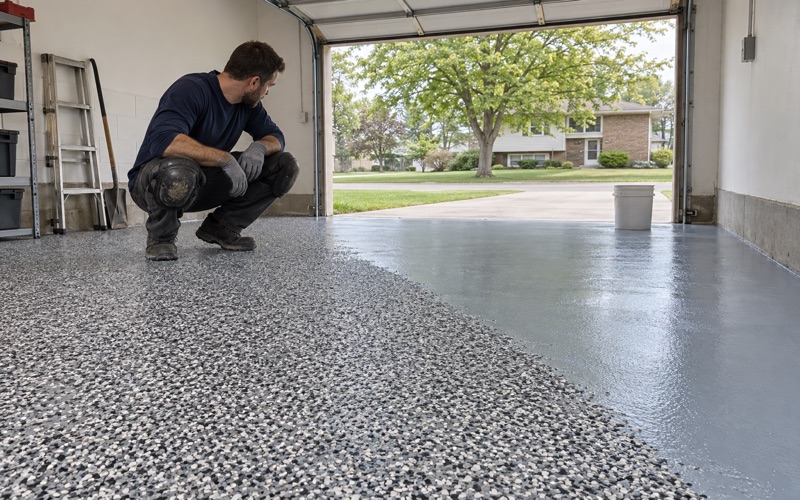
In a garage, an aluminum oxide broadcast in the topcoat is a common way to add grip, and garage-floor forum reports describe it as the most effective anti-slip additive for epoxy and polyaspartic floors. The same reports say it can leave a very abrasive surface that snags mops, brooms and skin, and that it wears down in high traffic. Those accounts are anecdotal rather than test results, but the mechanism is easy to picture: hard, sharp particles standing proud of the film, right where a knee lands.
Fine Grit and Glass Beads
Homeowners planning barefoot floors have reported choosing a very fine grit or spherical glass beads instead, accepting less grip when the floor is wet. At least one maker markets a fine aluminum oxide additive as barefoot friendly. A bead or fine-texture topcoat feels rounder and smoother under skin while still breaking up a glossy film.
Texture in a resin floor comes from what is broadcast into a coat or mixed into the topcoat, and from how much of it there is. A light, even pass of fine material reads very differently under a palm than a full broadcast of coarse grit, even with the same product underneath. That is why we name the additive and the coat it goes into, rather than writing non-slip on the quote.
That choice has a cost. A finer texture holds less on a wet floor, so we do not use it at an entry, beside a sink or where water is tracked in. In those spots the more aggressive texture stays, and the boundary between the two is drawn on the plan.
Mats Over the Coating, Not Instead of It
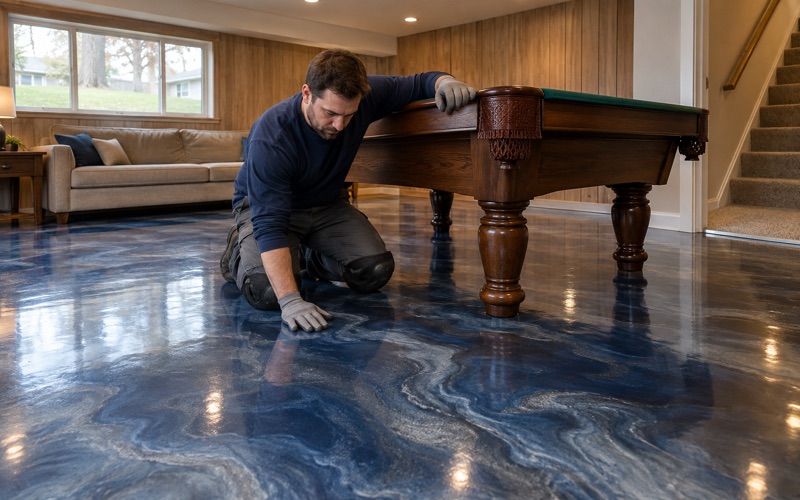
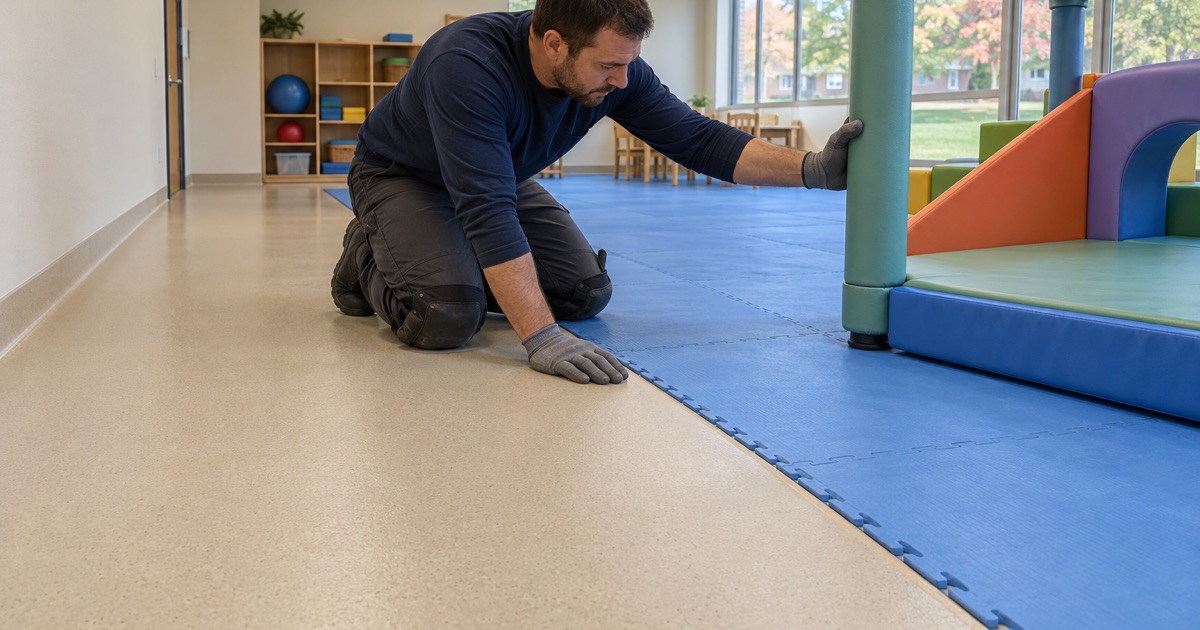
Where children do floor work, a resin system belongs as a fine-texture or bead-textured topcoat under therapy mats. The mats supply the give a slab cannot, and the coating underneath gives a seamless base that can be wiped down once the mats are lifted. We specify that texture by the broadcast and topcoat used, and we write down what it gives up.
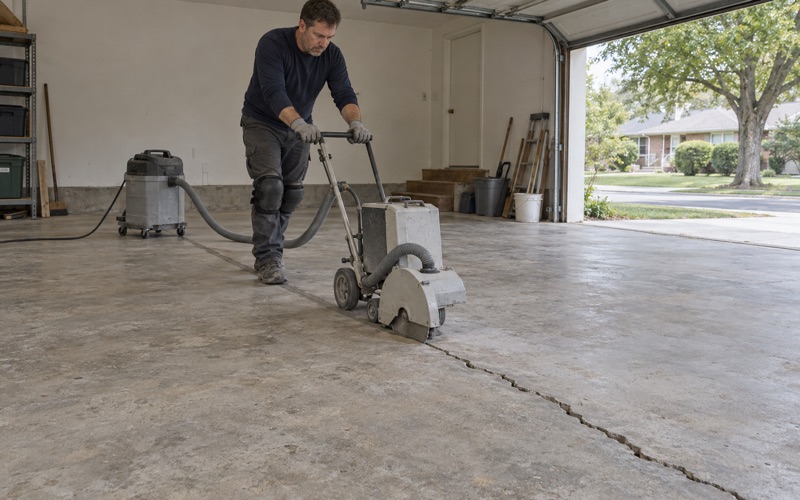
We also map cracks, spalls and old coatings before quoting. A crack that telegraphs through a thin topcoat becomes a ridge under a knee, and when a slab needs repair or replacement before it should be coated, we say so.
A Basement Playroom Floor for a Crawling Child
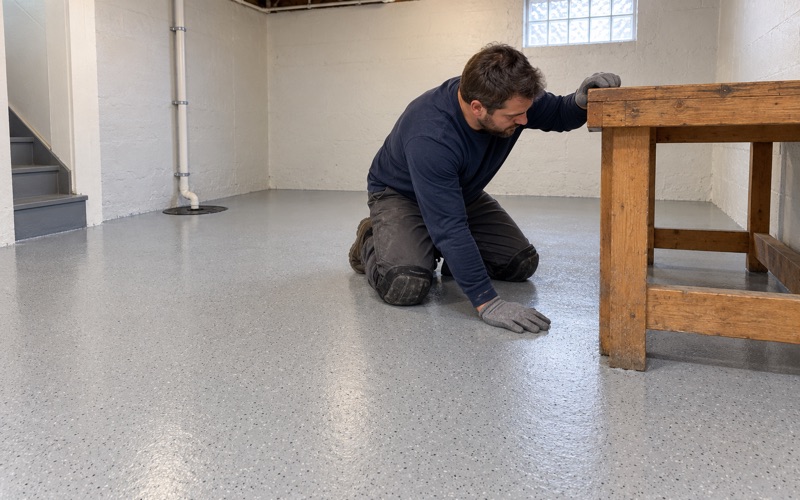
The same reasoning carries into a house. A coated basement playroom for a crawling child wants a fine texture and rugs, not a garage grit carried down the stairs. Palos Heights is largely owner-occupied, with 4,464 owner-occupied homes to 315 rented ones in the census tenure count, so most of these choices rest with a family rather than a landlord.
Read the Basement for Water First
Before texture comes up, we read the basement for past water. A coating does not stop seepage, a sewer backup or a sump that cannot keep up, and a playroom is the last room where a lifting floor should be discovered. We test with methods such as ASTM F2170 in-situ relative humidity probes or ASTM F1869 calcium chloride testing, and if the readings point to trouble, the system changes or the project waits.
Some slabs here are new. The city reports permits for teardown and replacement of existing houses and new construction on vacant lots, so a basement may be a recent pour rather than one from the 1960s or 1970s. Fresh concrete still gives off moisture as it dries, so a new slab is tested like an old one.
Texture, Rugs and a Practical Layout
In a playroom we specify a fine-texture or bead topcoat across the play area, with rugs or foam mats where a child spends the most time down low. The laundry corner, the foot of the stairs and the path to a walkout door can take a more aggressive texture if they get wet. We draw that layout on the proposal so the change in texture is a decision, not an accident.
Grinding dust is captured at the machine with a vacuum rather than rinsed toward a floor drain or sump. In a finished basement that matters, because the rest of the house shares the air.
Registration, Contracts and Cure Time
Palos Heights takes contractor registration in person or by mail only, refuses emailed registrations and has permits picked up in person, so we confirm with the City of Palos Heights Building Department whether a job needs a permit before it goes on the schedule. Home jobs over the state threshold get a written contract and the Illinois Home Repair: Know Your Consumer Rights pamphlet before grinding starts. Cure schedules follow slab temperature and dew point rather than the calendar, and a playroom stays off limits until the topcoat is ready for knees and hands, not only for shoes.
We also explain what a coating warranty leaves out before the job is sold, and moisture is the first exclusion we name. If you are planning a playroom, a therapy space or any room where people spend time at floor level, the walkthrough starts with who will be down there.
- 20+ Years Coating Concrete
- Moisture Tested Before Pricing
- Free Written Estimates