Lombard Epoxy Flooring brings more than 20 years of work to epoxy flooring in Palos Hills, and the cold-season jobs are where planning matters most. A garage or storage building that sees little heat in winter can still take a coating, but only once the heat that cures it has been chosen with care. On those jobs, the heater goes into the written plan alongside the primer and the topcoat.
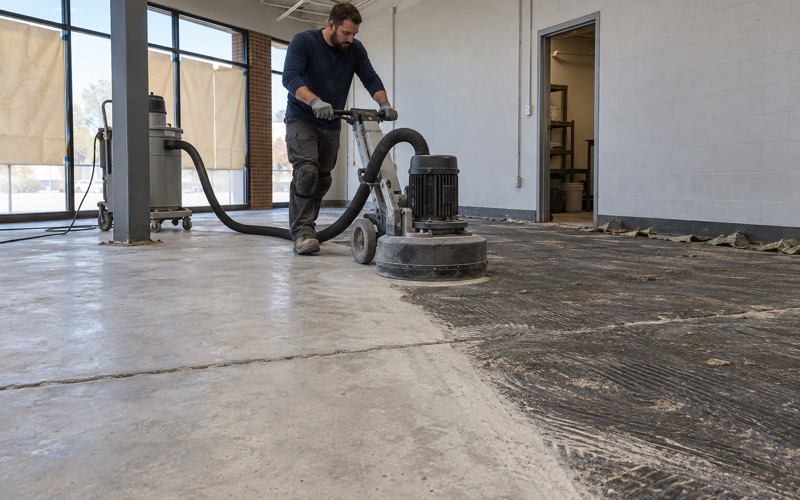
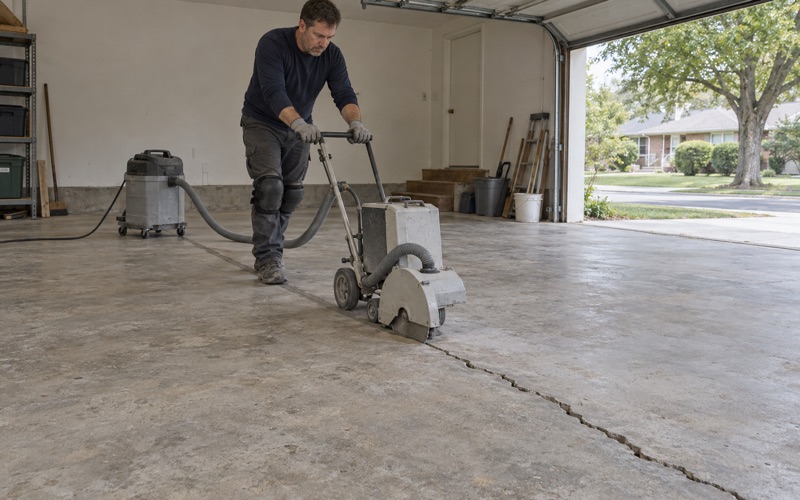
Our scope starts the same way on every slab. We open the concrete with a diamond grinder or a shot blaster rather than an acid etch, run a moisture test before the price is final, and map cracks, spalls and old coatings so the owner hears early when a slab needs repair first. The proposal then names the product line, the coat count and the finished thickness, which gives an owner something to check the finished floor against.
That last part matters more in cold months, because a finish that cured badly looks different from the one that was quoted. When a garage in deep winter cannot be warmed the right way, we tell the owner to wait.
A Police Garage Planned Beside the Former City Hall
The building at 8555 W 103rd St
The Palos Hills Police Department lists its home as 8555 W. 103rd Street, a building that housed Palos Hills City Hall before it became the police station. A 2010 Patch report said it had served as the station for the previous 35 years, with police once working from the basement. That same report covered a 9-0 council vote to replace a roof that one alderman said had never been replaced.
Motorcycles and ATVs need their own room
In the same report, Mayor Gerald Bennett said the city would construct a garage on the police station property, because the department needed a larger facility to store its motorcycles and ATVs. A $250,000 grant through a capital bill passed by the Illinois General Assembly was to pay for it. The department’s own motorcycle page says the bikes are used in patrol, traffic control and special events.
We have not read whether that garage was built, how it is heated or what its floor is, and the city is not our customer. We use the plan as an example because it names a kind of building that turns up in many forms. A structure put up to store vehicles rather than to house people is often heated little or not at all, and that changes how a coating job there runs in winter.
The same question in a home garage
In Palos Hills, 1,757 owner households live in buildings of three or more units, more than the renter households in such buildings, so a garage or storage floor here is often an association’s decision rather than one owner’s. A detached garage or a shared storage room can see as little heat in winter as a building made for vehicles.
Palos Hills also counts 945 owner-occupied single-family attached homes, which sit on shared or adjoining slabs where one unit’s floor job can touch a neighbor’s wall line. In those buildings, a heater’s exhaust or a long cure that blocks a shared drive affects more than one household, so we plan the schedule with the association where there is one. The heater question below applies to each of them.
Looking for epoxy-flooring closer to Prospect Heights? See Prospect Heights Epoxy-Flooring.
Cold-Season Coating Means Bringing Heat In
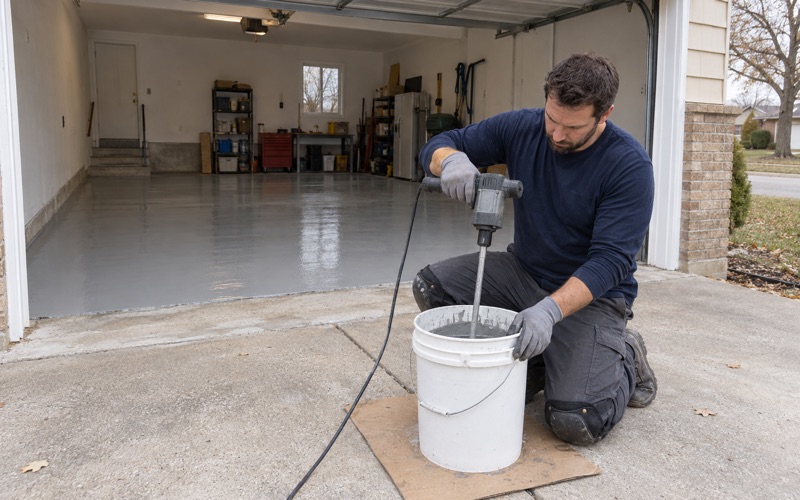
Epoxy cures by a chemical reaction, and that reaction slows as the slab and the air around it cool. In an unheated building through the cold months, the room has to be warmed before the first coat goes down and kept warm until the floor can take traffic. That makes the heat source a piece of equipment on the job, chosen as deliberately as the grinder.
Heat is written into the plan
Before we price a winter job in an unheated garage, we ask what heat the building has, what power is available at the panel, and how long the space can stay closed. The answers go into the proposal: the heater type, where it sits, how long it runs before the first coat, and how long it stays on afterward. If the building cannot be heated the right way, the honest answer is a spring date.
Timing matters as much as the heater. A garage that has to empty out for the work is planned around the days the vehicles can be parked elsewhere, and the heat schedule starts before the first day of grinding rather than the morning the resin is mixed.
Warm the slab, not just the air
A heater that warms the air for an hour does little for a slab that has been cold for weeks. We read slab temperature with a surface thermometer, because the concrete is what the coating touches and what sets the pace of the cure. So the heat goes on well ahead of mixing, long enough for the concrete itself to come up, and stays on through the cure. Heat that runs overnight at a steady setting does this better than a burst of high heat in the morning.
Prep still comes first
Heat does not replace surface preparation. We still grind or shot blast the slab, and the dust is caught at the machine by a vacuum rather than rinsed toward a floor drain or a sump. A vehicle garage also gets a system chosen to stand up to the brine and rock salt carried in on tires all winter.
Why a Fuel-Burning Heater Is the Wrong Heat
A common job-site heater runs on propane or kerosene, and it is cheap, portable and hot. It also burns its fuel in the same room as the fresh floor. Everything that flame produces goes into the air the epoxy cures in.
What the maker’s data sheet says
Sika’s data sheet for its MultiDur ES-24 floor system is direct about it. If heating is required, it says not to use gas, oil, paraffin or other fossil-fuel heaters, because they produce large quantities of carbon dioxide and water vapor that may adversely affect the finish. For heating, it calls for electric powered warm-air blower systems only.
That is one manufacturer’s instruction for one product, not a building code, and other makers word their guidance in their own way. We follow the data sheet of whatever product is on the proposal, and where a sheet is silent, we still keep combustion out of the room. Paraffin is the British name for kerosene, so the warning covers a heater many crews reach for.
Carbon dioxide and water vapor at the surface
A fresh epoxy film is most sensitive in its first hours, while the resin and hardener are still reacting at the surface. Many epoxy hardeners are amines, and amines react with carbon dioxide and moisture in the air to leave amine blush, a greasy or cloudy layer on top of the coat. Blush can dull a clear finish, leave white haze in a dark color, and keep the next coat from bonding until it is washed off.
A sealed garage with a fuel heater running for hours is close to the worst setting for that reaction. Opening the door to vent the fumes lets the warmth out, and keeping it shut traps the exhaust. Electric heat removes the trade-off.
Other ways combustion reaches the room
A fuel heater is not the only source. A gas water heater or furnace that shares the space, a vehicle started inside to move it, or a generator run in the doorway all put exhaust into the air over the floor. We ask about each one, and the plan keeps each one off or outside until the coating has cured.
The city’s own hazard planning notes that generators in multi-family buildings keep running during extreme cold events to keep heat and prevent pipe breaks. In a condominium building, we ask where any generator sits and exhausts before a floor goes down near it.
Electric Warm Air and the Cure Clock at 50 Degrees
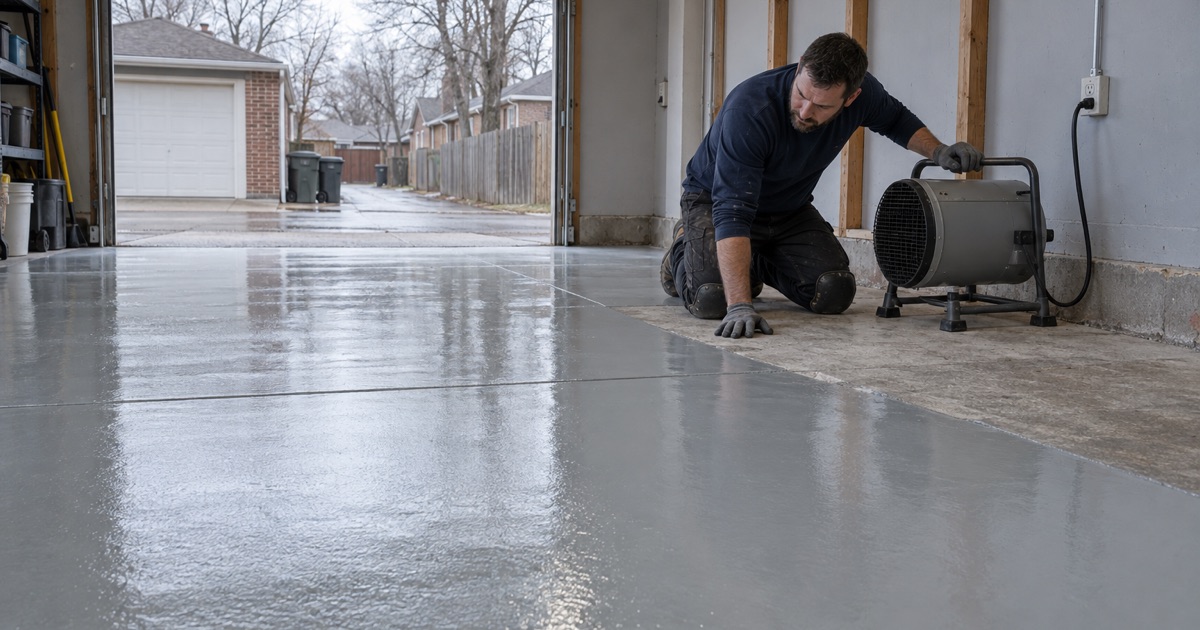
Electric warm-air heat warms the room without adding combustion gases or burning fuel inside the space. It does need power, and a large blower can need more than an ordinary garage outlet delivers, so we confirm the circuit before the job is booked. If a new circuit is needed, that is electrical work, which the city lists among the jobs that need a permit, and it is arranged before our crew arrives.
Placing the electric heat
Where the heater sits matters. A blower aimed straight at a fresh coat can skin the surface and push dust onto it, so we set heat to move air through the room rather than across the wet film, and we keep cords and units off the area being coated.
What the cure table says at 10 degrees C
The same Sika data sheet gives cure times at 10 degrees C, which is 50 degrees F. At that temperature it lists about 72 hours to foot traffic, about 6 days to light traffic and about 10 days to full cure. It also says the fresh floor must be protected from damp, condensation and water for at least 24 hours.
Those figures belong to one product and are not a reading of any Palos Hills job. They show why heat that lasts only through the first coat is not enough: at that temperature the floor is still curing more than a week after the last coat, so the heater stays on the same schedule.
When vehicles can roll back in
For a vehicle garage, foot traffic is not the date that matters. We give the owner a return date for vehicles that follows the product’s cure table at the slab temperature we measured, not the calendar day the job started. Where a different product or a later start would shorten that wait, the proposal lays out both options.
What we explain before the job is sold
A coating warranty has limits, and we go through them before anyone signs. Moisture coming up through the slab is the first exclusion we name, and we say plainly when a winter start carries more risk than waiting. For a home job over the state threshold, the owner gets a written contract and the Illinois consumer-rights pamphlet before any grinding starts.
On commercial property, the city’s permit page calls for registered contractors, and the City of Palos Hills Building Department at 708-598-3400 is the office for those questions. We confirm what applies to a given job before it is put on the schedule.
- 20+ Years Coating Concrete
- Moisture Tested Before Pricing
- Free Written Estimates