Lombard Epoxy Flooring installs polyaspartic floor coating systems in Lombard, IL, serving surrounding cities including Northlake, Westchester, Wood Dale, Hinsdale and Bensenville. Over more than 20 years of coating concrete in DuPage County, we have watched polyaspartics go from a specialty product to the topcoat we reach for most often on garage floors, because they handle sunlight, salt and abrasion better than epoxy alone.
Polyaspartic is a type of aliphatic polyurea. It cures quickly, stays clear instead of yellowing in sunlight, and forms a hard, chemical-resistant surface. Those traits make it a strong topcoat over epoxy, a fast single-system floor on its own, and a practical choice for jobs that have to be done and back in service quickly.
Speed is also its biggest risk. A fast-curing coating gives the installer very little working time, and it bonds only as well as the slab underneath was prepared. That is why our polyaspartic floors start with the same mechanical grinding and moisture testing as every other floor we put down, and why the proposal names the product line, coat count and thickness.
What Makes Polyaspartic Different
Fast Cure and Short Downtime
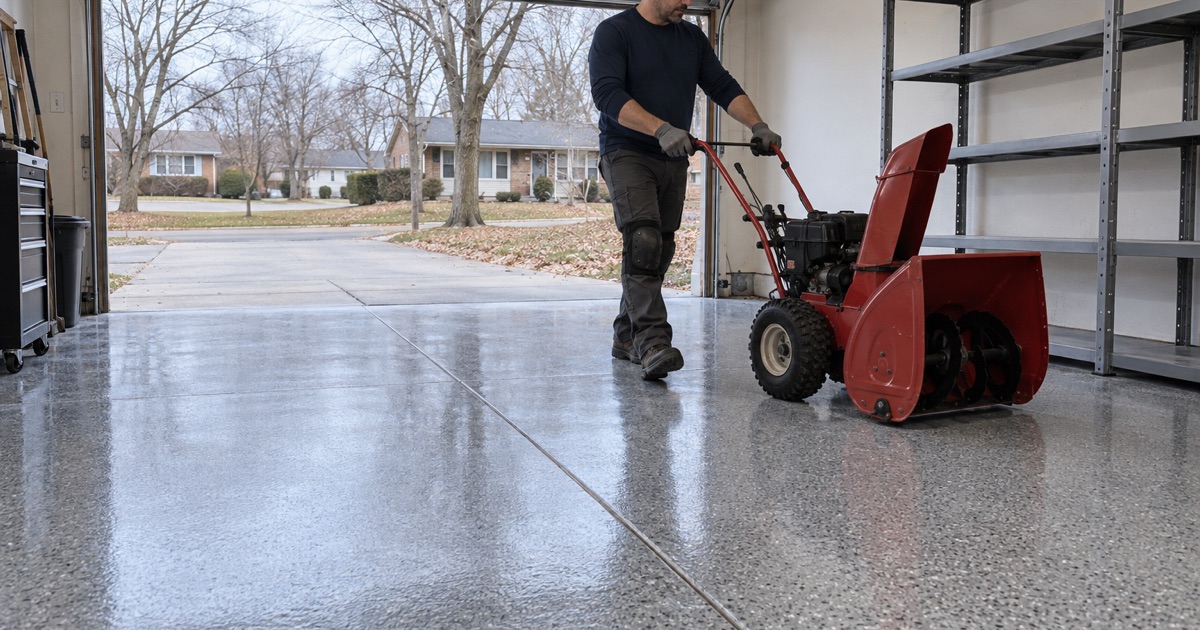
Polyaspartic coatings cure in hours rather than the day or more many epoxies need between coats. That lets us apply several layers in one day and get a garage or a small commercial space back in use sooner. For a business that cannot close, the short cure is often the deciding factor.
The tradeoff is a short pot life. Material is mixed in small batches and spread quickly, so a crew has to work in a planned sequence across the floor. Experience matters here, because a polyaspartic that starts to set before it is leveled leaves roller marks and thin spots that cannot be worked out later.
UV Stability and No Ambering
Standard epoxies amber, or yellow, when they are exposed to ultraviolet light. Aliphatic polyaspartics hold their color and clarity, which keeps a flake or metallic floor looking the same years later. That matters in a garage where the door is open all summer, in a sunroom or porch, and in any commercial space with big windows.
Abrasion and Chemical Resistance
A polyaspartic topcoat is very hard and resists scratches from tires, dropped tools and grit far better than many epoxy topcoats. It also stands up to gasoline, oil, antifreeze, road salt brine and most household chemicals. In a Lombard garage, the salt that rides in on the car all winter sits on a sealed surface rather than soaking into the concrete.
The hardness also makes the floor easier to keep clean. Grit, salt residue and tire marks come off with a squeegee and a neutral cleaner, and the finish does not dull as quickly as a softer topcoat that has been scuffed by years of sand and gravel tracked in from the driveway.
Lower Temperature Curing
Many polyaspartics can cure at lower temperatures than standard epoxies. That stretches the season for unheated garages, although the slab itself still has to stay within the product’s range and well above the dew point while the coating cures. We measure the slab and the dew point spread on the day rather than trusting the forecast.
Polyaspartic Systems We Install
Epoxy Base With Polyaspartic Topcoat
On most garage floors we use a 100% solids epoxy base for thickness and adhesion, broadcast vinyl flake into it, and finish with a clear polyaspartic topcoat. The epoxy does the bonding and build, and the polyaspartic takes the wear and sunlight. It is a balanced system that handles Lombard winters well.
The epoxy base also gives a little more time to work the flake broadcast evenly, which helps on a large two- or three-car garage. Once the base has cured, the loose flake is scraped and vacuumed off, and the polyaspartic topcoat locks the remaining chips in place and smooths the texture to the level you chose.
Full Polyaspartic One-Day Floors
Where the slab is dry and needs little repair, a full polyaspartic system with a flake broadcast can often be installed in a single day. The primer, the broadcast coat and the topcoat are all polyaspartic, and the floor can usually take foot traffic the same evening. We confirm the slab qualifies before promising a one-day schedule.
A one-day floor still gets the full preparation. The grinding, crack repair and vacuuming happen first thing in the morning, the coats follow in sequence through the day, and the floor is left to cure overnight. Cars typically come back after the cure window the manufacturer sets for the product, which we give you in writing before the crew leaves.
Clear Polyaspartic Over Polished or Metallic Floors
A clear polyaspartic can protect a polished concrete floor or a metallic epoxy floor that will see heavy traffic. It adds stain and abrasion resistance and keeps the finish from yellowing. The sheen can be set to gloss, satin or matte depending on how much reflection you want.
Polyaspartic on Commercial Floors
In offices, clinics, stores and back-of-house areas, a polyaspartic system lets us coat in sections overnight and return the floor to service in the morning. Its chemical resistance suits areas that are mopped often with disinfectants, and the low odor of many products helps in occupied buildings.
Commercial products are also chosen with the Illinois VOC limits for floor and industrial maintenance coatings in mind, since those limits apply to the contractor applying the coating as well as the company selling it. Many polyaspartics are high-solids products that sit comfortably inside them, which also helps keep odor down during an overnight install.
Preparation Still Decides the Result
Grinding, Not Etching
Polyaspartic has very low viscosity and wets into the concrete well, but it still needs an open, clean surface to bond to. We grind every slab with diamond tooling, or shot blast large floors, to the profile the manufacturer requires. An acid etch does not remove sealers, oil or weak concrete, and a fast-curing coating over any of those will let go.
Moisture Testing and Primers
Polyaspartics are sensitive to moisture rising through a slab, which can cause bubbles, pinholes and adhesion loss. We test with the ASTM D4263 plastic sheet method and calcium chloride or relative humidity testing where needed. If the readings are high, a moisture-mitigation epoxy primer goes down under the polyaspartic and is priced as its own line.
Repairing Cracks and Old Coatings
Cracks, spalls and failing coatings are mapped and fixed before the first coat. Fast-cure crack fillers let us repair and grind flush on the same day, and old paint or epoxy is removed down to sound concrete. A polyaspartic laid over a loose old coating is only as strong as that coating.
We also look at the edges of the slab, the area around the floor drain and the strip in front of the garage door, which is where salt damage and old patches tend to collect. Those spots are ground and filled with extra care, because a fast-curing coating will show every low spot and rough patch that was left under it.
Is Polyaspartic Right for Your Floor
Good Fits
Polyaspartic works well for garages that see sunlight and salt, for owners who want the floor back quickly, for commercial spaces that can only close overnight, and as a protective topcoat over decorative floors. It is also a strong choice where scratching from tools and gravel is the main concern.
When Another System Is Better
Very wet slabs need a moisture-mitigation epoxy first, and commercial kitchens with hot water and steam cleaning are usually better served by urethane cement. Very large floors with complex layouts may suit a slower epoxy system that gives more working time. We recommend the system that fits the floor rather than the one that sounds fastest.
- 20+ Years Coating Concrete
- Moisture Tested Before Pricing
- Free Written Estimates