Lombard Epoxy Flooring has spent more than 20 years on epoxy-flooring in River Forest and the surrounding suburbs, and the work we quote most carefully is the floor a building’s other systems depend on. A corridor, a classroom wing or a cafeteria is rarely just a floor question. What hangs on the wall above it, what drips onto it and what the fire code says about both all shape the right surface.
Our scope starts the same way on a school slab as on a garage slab. We open the concrete with a diamond grinder or a shot blaster rather than an acid etch, map cracks, spalls and old coatings before we price anything, and put a moisture test into the written scope. The proposal then names the product line, the number of coats and the finished thickness, so a facilities manager can hold the finished floor against the paper.
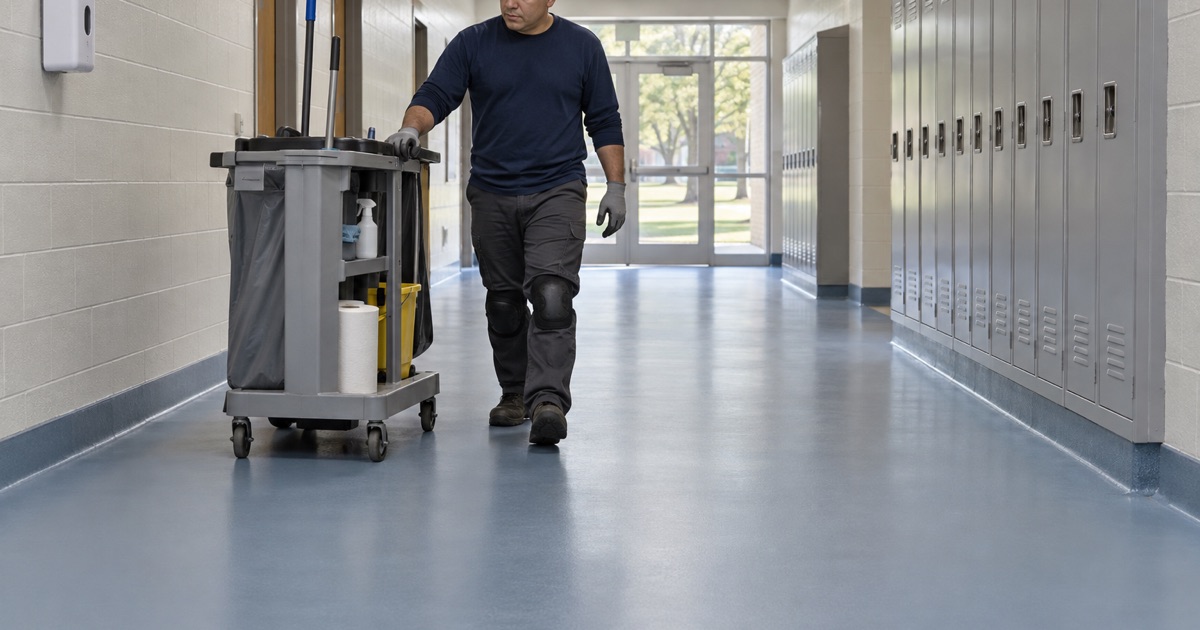
This page follows one of those questions through a single kind of space: the school corridor lined with hand-sanitizer dispensers. It covers what the model fire code says about those dispensers over carpet, what lands on the floor beneath them, and how we choose a topcoat for that strip.
Trinity High School’s Corridor Upgrades and the Dispenser Question
What the published project covers
Trinity High School sits at 7574 Division Street in River Forest, an all-girls school affiliated with the Sinsinawa Dominican Sisters. JNKA Architects’ project page describes a two-story Leadership Center addition with a new student entrance, administrative offices, an elevator reaching every level and a new interior connection between the school and its athletic facility. The same page lists upgrades to the existing classrooms, cafeteria, corridors and bathrooms.
The page does not describe floor finishes, and we have not seen the school’s corridors. Trinity is not our customer. We use the project because it names the kind of space this page is about, a corridor being upgraded in a working school, and because corridor walls are where hand-sanitizer dispensers usually hang.
A school renovation also brings a scheduling problem. A corridor in daily use can rarely close for a week, so we phase floor work around operating hours, with overnight and weekend windows where a hallway has to reopen by morning. The proposal says which window each stretch of corridor gets.
Why a dispenser is a fire-code item
Alcohol-based hand rub is a fire-code product, not just a cleaning supply. The 2018 International Fire Code defines these products as containing ethanol or isopropanol at up to 95 percent by volume, which is why Section 5705.5 treats a wall dispenser as something to be placed, spaced and capped rather than simply mounted wherever it is convenient.
The text we work from is the 2018 code as quoted by the Kansas Office of the State Fire Marshal. Which edition River Forest has adopted is a question for the village and the River Forest Fire Department at 400 Park Avenue, and we do not treat the model text as local law. What it does show is how closely the code ties the dispenser to the floor below it.
Looking for epoxy-flooring closer to Forest Park? See Forest Park Epoxy-Flooring.
Over Carpet Only Where the Building Is Sprinklered
The carpet condition
Section 5705.5 allows dispensers in occupancies with carpeted floors only in smoke compartments or fire areas equipped throughout with an approved automatic sprinkler system. The word that matters is throughout. A corridor served by a partial system is a different case from a compartment that is sprinklered end to end, and that coverage is a fact about the building, not something a flooring contractor decides.
The same carpet condition appears in NFPA 101 health care text, which permits dispensers directly over carpeted surfaces only in sprinklered smoke compartments. Oklahoma went further and required a guard or shield so product does not dispense onto the floor, citing concern over hand-rub buildup on carpet whether or not the building is sprinklered.
We read that as a sign of where the concern sits. The gel does not stay in the dispenser, and carpet holds what falls on it. When a renovation is already replacing corridor flooring, a hard, sealed corridor floor takes the carpet question off the table, though the code official, not the floor contractor, reads how the rule applies to the building as a whole.
Spacing and clearances down to the floor
The same section sets dispensers at least 48 inches apart horizontally. None may be installed above, below or closer than 1 inch to an electrical receptacle, switch, appliance, device or other ignition source. The wall space between the dispenser and the floor, or an intervening countertop, has to stay free of those ignition sources too.
The code also caps quantity: 68 ounces per dispenser in rooms separated from the corridor and 41 ounces per dispenser in corridors. A corridor dispenser is the smaller of the two, but corridor traffic, not capacity, decides how much gel reaches the floor beneath it.
For floor work this matters in a practical way. Corridor renovations often move outlets, add floor boxes and relocate wall devices, and a resin floor run up the wall as a cove base changes where the wall stops and the floor begins. We ask for the dispenser locations and the electrical layout before the floor is laid out, so cove height, joints and any floor boxes are planned around the strip the code already keeps clear.
The Strip of Floor Under a Dispenser
What lands there every day
A wall dispenser drips. Some gel misses the hand, some falls from a wet palm on the way out, and a pump that sticks leaves a puddle at the wall base. Over a school year the same few square feet under each dispenser take more ethanol or isopropanol gel than any other part of the corridor.
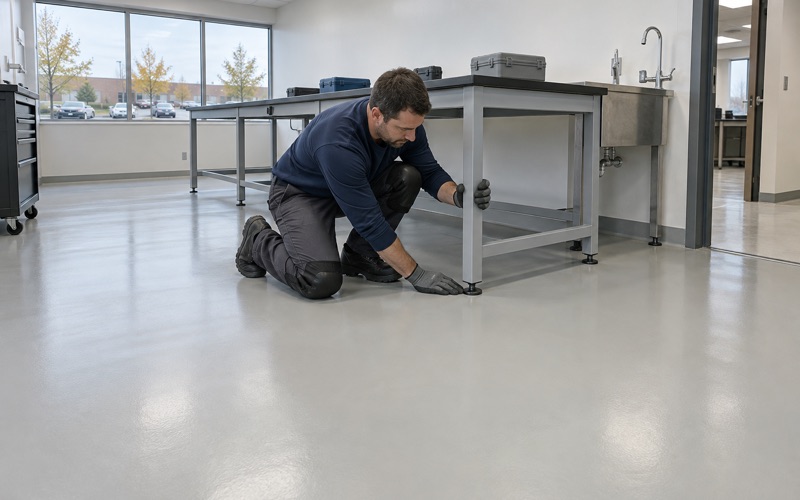
On carpet that gel soaks into the pile and the backing. On a hard floor it stays on the surface, where the daily mop reaches it, and the alcohol evaporates instead of sitting in a fiber layer against the wall. That is the whole case for a sealed corridor floor under dispensers: the drips are caught where they can be cleaned.
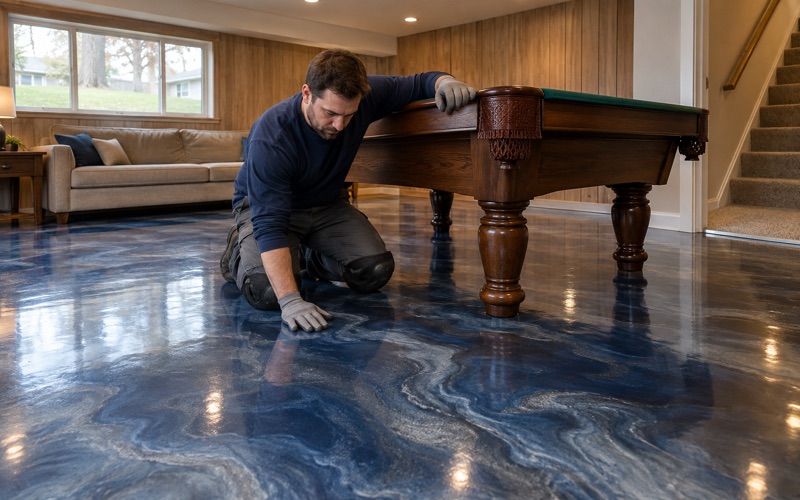
A seamless resin floor with an integral cove carries that further, because the joint between floor and wall, where a puddle collects, has no seam to open. A slip-resistant texture belongs in the same conversation, and we specify it by the broadcast and the topcoat, not as a slogan, since a fine quartz aggregate broadcast in a corridor has to grip a wet shoe and still mop clean.
Getting the corridor slab ready
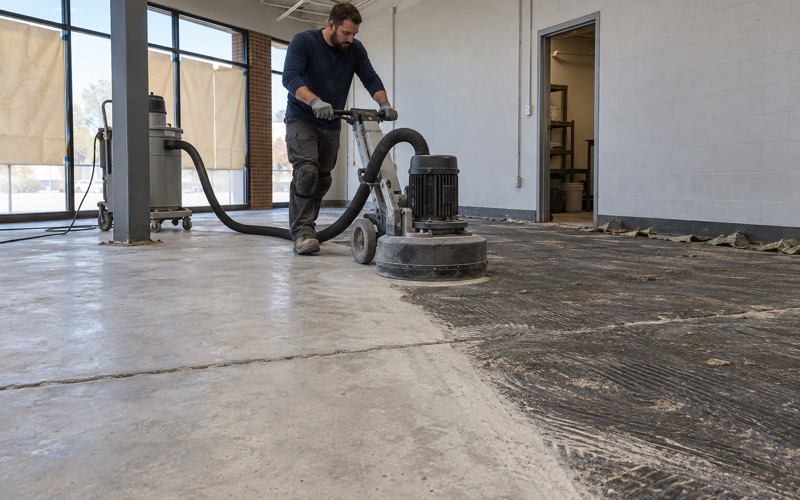
None of that works on a slab that is not prepared for it. We grind or shot blast to an ICRI concrete surface profile that matches the system, and capture the dust at the machine with a vacuum so it does not drift down an occupied hallway or toward a floor drain. Old adhesive from carpet tile or vinyl comes off in the same step.
Moisture comes next. A slab that held carpet for years may never have been tested, so we run ASTM F2170 in-situ relative humidity probes or ASTM F1869 calcium chloride tests before the price is final, and a high reading means a moisture-mitigation primer goes into the scope rather than a warranty claim later. Moisture is the first exclusion we name on any coating warranty, and we explain it before the job is sold.
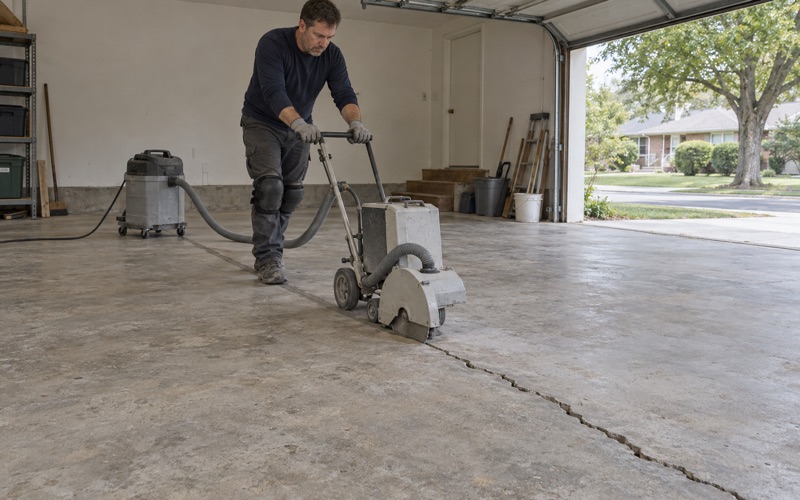
Joints get the same attention. Control joints in the corridor slab are carried up through the coating rather than bridged, and a moving crack is treated as a joint, so the strip under a dispenser does not crack open along a line the slab was always going to move on.
Choosing a Topcoat That Tolerates Alcohol Drips
The data sheet decides, not the label
Resin floors are not one material, and their resistance to alcohol is not one number. A 100% solids epoxy, a urethane cement and a polyaspartic or polyurea topcoat are each formulated differently, and two products sold under the same generic name can behave differently under repeated ethanol or isopropanol contact. We do not assume a coating tolerates sanitizer; we read it on the topcoat’s data sheet.
What we look for on that sheet is how the rating is framed. A resistance table can split exposure into short-term splashes rinsed off the same day and long-term exposure to repeated splashes on one spot, and a dispenser strip is the second kind. Ratings can also depend on temperature, concentration and what happens as a liquid evaporates, so gel left to dry on the floor is a different test from gel mopped up wet.
When the sheet is silent on alcohol, or rates it only for brief contact, we choose a different topcoat or put the question to the manufacturer before we commit. The product that answers it is the one written into the proposal, and a school can check the delivered containers against it.
Curing, VOCs and an occupied building
A topcoat that rates well on paper still has to cure properly. We watch the dew point spread at the slab surface, because condensation on a curing coat can cause amine blush on epoxy, and we hold traffic off until the cure the data sheet calls for is reached. Products are picked inside the Illinois VOC limits for floor and industrial coatings, which bind whoever applies them, a point that matters in a building that reopens in the morning.
At home in River Forest
The same reasoning carries into homes. In River Forest, 68.8 percent of the housing predates 1960, so the slab we are asked to coat is usually an older basement or garage floor. The village reports about 6-10 renovations a year in its moderate and very high-end housing, and a floor coating there is often one trade inside a larger job, scheduled after the dusty work and before the finish carpentry.
Whether the corridor belongs to a school, a clinic or an office, the first visit is the same: we read the slab, ask where the dispensers and devices sit, and write down the topcoat and the moisture plan before anyone grinds. That written plan is what we price, and what the finished floor is checked against.
- 20+ Years Coating Concrete
- Moisture Tested Before Pricing
- Free Written Estimates