Lombard Epoxy Flooring brings more than 20 years of slab preparation and resin work to epoxy flooring in River Grove, where some floors carry a job beyond looking clean. In a drycleaning plant, the floor around a cleaning machine is part of how a spill is held, and the coating on it has to be specified that way. That is the work this page is about, along with the garages, basements and storefronts that need something simpler.
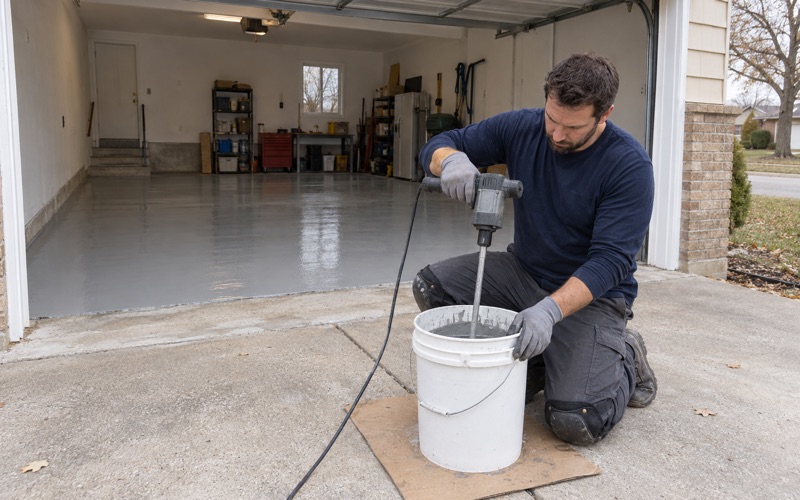
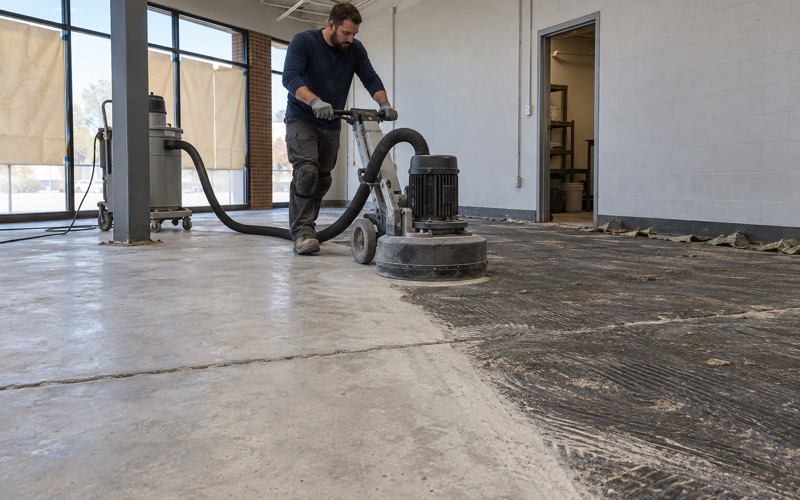
Every slab we coat is opened with a diamond grinder or a shot blaster rather than an acid etch, which gives the resin a measurable surface profile to bond to. Before a price is final, a moisture test goes into the written scope, and our proposal names the product line, the coat count and the finished thickness. You can hold the finished floor up against the quote line by line.
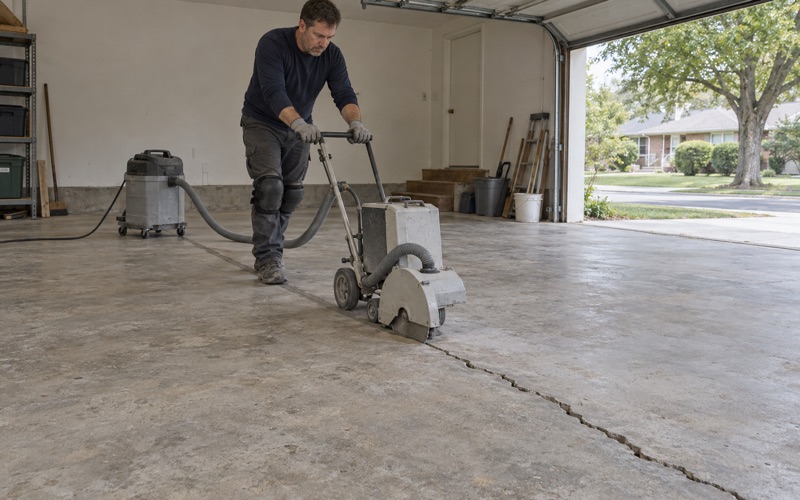
We also map cracks, spalls and old coatings first, and we say plainly when a slab needs repair or replacement before anything goes on it. A coating over a failing slab only hides the failure for a while.
A Grand Avenue Cleaner and the Rule Under Its Floor
A drycleaning-plant record on Grand Avenue
River Grove is a village in Leyden Township, Cook County, and part of the Chicago metropolitan area. EPA’s ECHO database lists 8360 W. Grand Avenue as a drycleaning plant under SIC code 7216, recorded under the name Neat Cleaners. The storefront at that address now trades as Anet Cleaners, and the address geocodes inside the village. The same list carries a second drycleaning-plant record, Magic Touch Cleaners at 3111 Thatcher Avenue.
What that record does not tell us matters just as much. We have not seen whether a cleaning machine runs on site there, which solvent it would use, or what the floor looks like, and we have no connection to the business. The ECHO listing is useful because it shows the building type exists on Grand Avenue, which makes the state’s floor rule a practical question here rather than a hypothetical one.
What Illinois asks around each machine
The Illinois rule that sets eligibility for Drycleaner Environmental Response Trust Fund insurance, 35 Ill. Adm. Code 1501.410, draws its terms from 415 ILCS 135/45(d). It calls for a containment structure around each drycleaning machine, item of equipment, drycleaning area and portable waste container, one “capable of containing leaks, spills, or releases of drycleaning solvent.” That structure must hold at least 100 percent of the solvent in the largest tank or vessel, with capacity levels also set for equipment and portable waste containers.
Capacity is the dike’s job, set by its curb height and footprint, and it is something the plant and its own advisers work out. A coating contractor does not size containment, and we do not suggest a resin floor adds volume to a dike. Where we come in is the next line of the rule, which is about the floor itself.
Looking for epoxy-flooring closer to Burr Ridge? See Epoxy-Flooring in Burr Ridge.
Sealed or Otherwise Impervious: The Coating as Part of the Dike
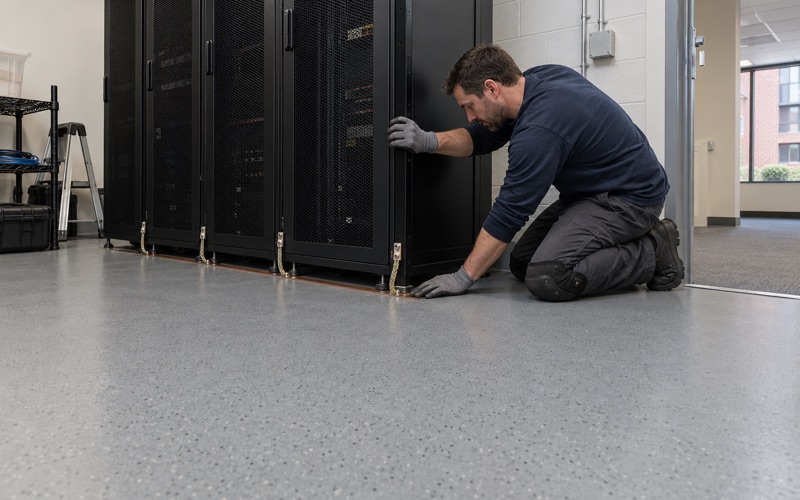
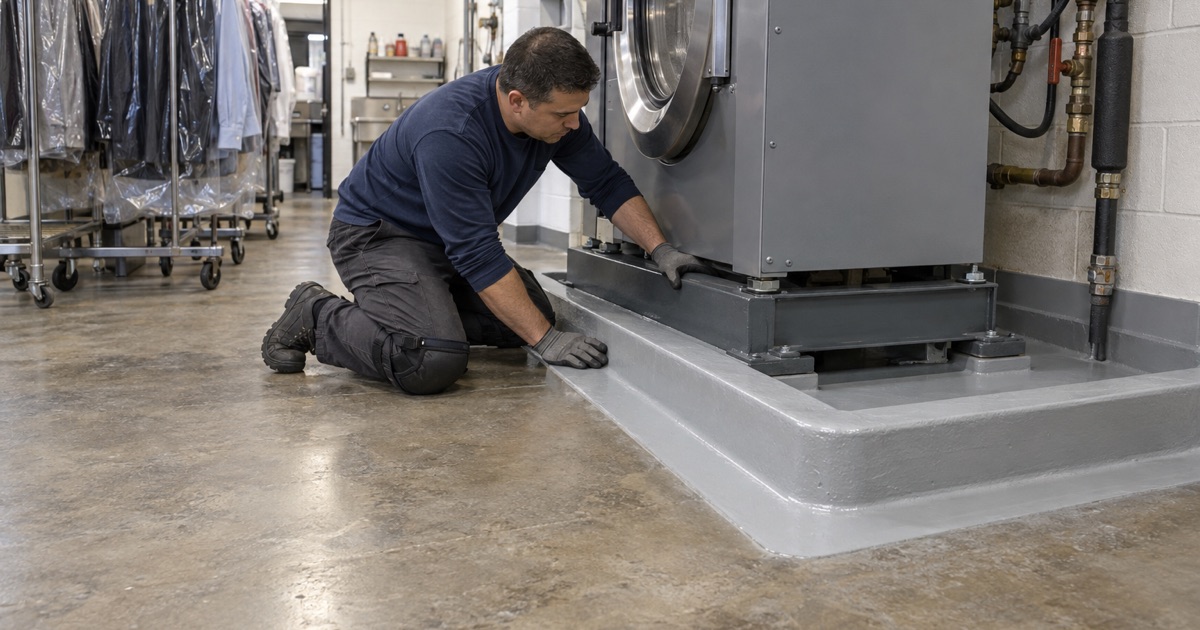
Under 1501.410(a)(4)(D), the portions of diked floor where drycleaning solvent may leak, spill or otherwise be released must be “sealed or otherwise impervious.” That phrase is the reason a floor coating can belong in a plant’s containment rather than sitting beside it. The curb holds the volume, and the surface inside it decides whether a spill stays on top long enough to be cleaned up.
Why bare concrete is the weak point
Concrete looks solid, but it is porous, and chlorinated solvents do not treat it as a barrier. Environmental due-diligence guidance on drycleaning sites says perchloroethylene and trichloroethylene easily permeate and migrate through concrete or asphalt, and can reach soil and groundwater. One Maine site assessment read staining on a cleaner’s slab as a sign of perc released from leaking machinery or spills.
So a dike built on bare concrete holds a spill in plan and still lets it go downward. A sealed floor is meant to keep a release on the surface, inside the curb, where it can be recovered. That is a narrower promise than it sounds, and we keep it narrow on purpose.
One continuous surface, up the curb
A coating that stops at the base of the curb leaves a seam exactly where solvent pools. In a plant we treat the dike and the floor inside it as one surface: the resin runs continuously across the slab, into the corner and up the face and top of the curb, with no joint left open between them. Existing cracks are routed and filled before the system goes down, because a crack carried through the coating is a path straight into the slab.
The prep that gives that continuity a chance is the same prep we do everywhere: diamond grinding or shot blasting to the ICRI concrete surface profile the product calls for, with grinding dust pulled into a vacuum at the machine instead of washed toward a drain. Stained concrete inside a dike is something we point out to the owner before quoting, rather than grind past quietly.
Repairs on the machine’s schedule
A sealed floor only stays sealed if someone looks at it. Machine service is the natural time, because the area around the unit is open and a technician is already on the floor. We suggest an inspection of the dike coating at each service, with chips, scrapes from moved equipment and any lifted edge at the curb repaired before the area goes back into use.
Cleanup inside the dike matters as well. A release is recovered from the coated surface, not mopped toward a floor drain, and the topcoat has to take that cleanup repeatedly without softening or losing its seal at the curb.
Matching the Coating to the Plant’s Own Solvent
There is no single drycleaner floor product, because there is no single drycleaning solvent. Perchloroethylene is the traditional one, hydrocarbon solvents are another family, and there are others. A resin that shrugs off one can soften, swell or stain under another, so the solvent is the first fact we ask for, not the last.
Reading the maker’s data for that solvent
Selection works from the coating manufacturer’s chemical-resistance data for the plant’s actual solvent, along with the spotting chemicals used at the board. We look at how the system is rated for splash versus longer contact, because a leak inside a dike may sit until someone finds it. A 100% solids epoxy base with a chemical-resistant topcoat is a typical starting point, but the data sheet makes the decision, and that data is a selection step under the state rule, not a substitute for it.
If a plant changes solvents later, the floor question opens again. A coating chosen for perc is not automatically right for a hydrocarbon machine, and the reverse is also true, so a solvent change is a good moment to have the dike surface checked against the new chemistry.
Moisture, temperature and cure
A solvent-resistant coating still fails if the slab under it pushes moisture. We test before the price is final, using ASTM F2170 in-situ relative humidity probes or ASTM F1869 calcium chloride tests depending on the slab, and a moisture-mitigation primer goes into the scope when the readings call for one. Cure follows slab temperature and the dew point spread at the surface, not the calendar.
Commercial work is phased around operating hours, so a plant that cannot close on a weekday can plan the dike coating for a weekend or overnight window. Products are picked inside the Illinois VOC limits for floor and industrial coatings, which bind whoever applies them, and the cure time before machines and solvent return is written into the schedule.
Drop-Off Counters, Laundry Rooms and What a Coating Is Not
A drop-off store is a different floor
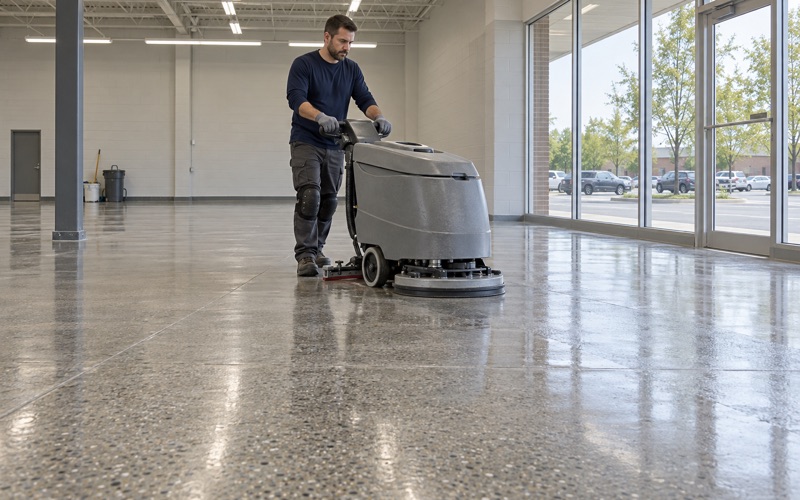
Not every cleaner’s storefront runs a machine. A drop-off store that sends garments to an off-site plant has none of the dike requirements above, and its floor is a retail floor: foot traffic, rolling racks, and a counter where customers stand. For a space like that we would look at a durable vinyl flake or quartz broadcast system, with slip resistance specified by the broadcast and topcoat rather than promised as a slogan.
Home laundry rooms and basements
River Grove’s housing stock leans old: of 4,573 housing units, 762 were built in 1939 or earlier and 1,086 date from the 1960s. Where one of those homes keeps its laundry in a basement, that floor deserves a hard look before anything is applied.
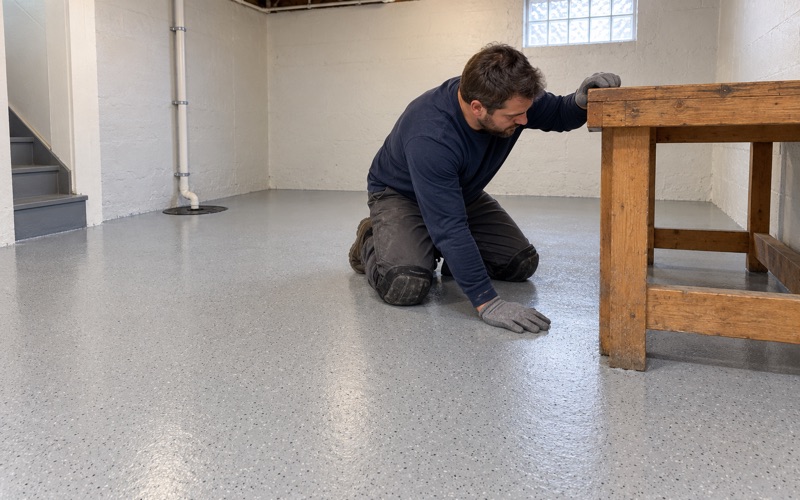
The village lists floods in 1986, 1987, 1995, 1997, 2008, 2010, 2011 and 2013, and FEMA identifies 25 repetitive loss properties here. The village’s own newsletter warned that water from surcharged street sewers will most likely end up “in basements of homes without flood control systems.” So we read a basement for past water first, because a coating does not stop seepage, a sewer backup or a sump that cannot keep up.
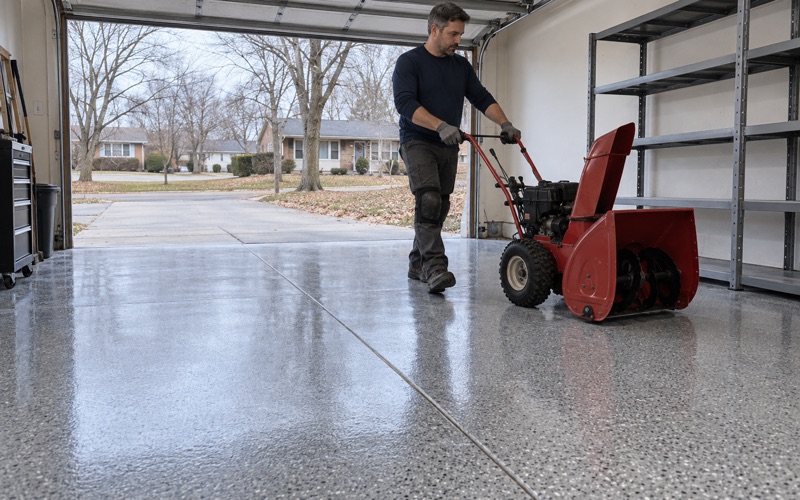
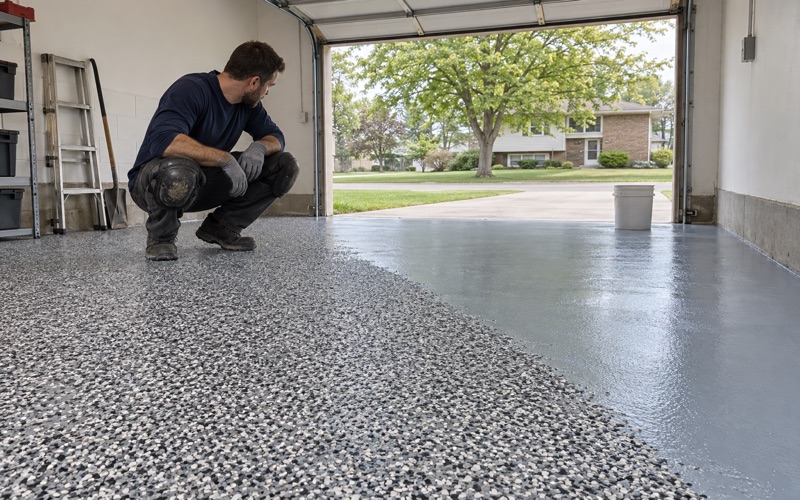
Moisture is also the first exclusion we name when we explain what a coating warranty leaves out. Garage floors get the same honesty, with systems chosen to stand up to the brine and rock salt that ride in on tires all winter. If that garage is unheated, a deep-winter job is told to wait for a warmer slab.
What a coating is not
A sealed drycleaner floor is part of a containment surface and nothing more. It is not vapor mitigation, it is not soil or groundwater cleanup, and it is not proof of eligibility for Drycleaner Fund insurance; those questions belong to the plant’s environmental advisers and the state. A coating is not radon reduction either, because in Illinois that is licensed mitigation work and we do not sell it.
On the permit side, the Village of River Grove Building Department at 2621 N. Thatcher Avenue requires a building permit for remodeling valued over $100, concrete work included. We confirm what the village asks of the job and of the contractor before anything is scheduled, and home jobs over the state threshold get a written contract and the Illinois Home Repair: Know Your Consumer Rights pamphlet before any grinding starts.
For a commercial plant, fire-code questions go to the River Grove Fire Department, a village department working from one station at 2601 Thatcher Avenue and staffed by part-time firefighters who work full-time elsewhere. We point owners to that department early rather than at the end of a job.
- 20+ Years Coating Concrete
- Moisture Tested Before Pricing
- Free Written Estimates