Lombard Epoxy Flooring has spent more than 20 years on epoxy flooring in Schiller Park and across the western suburbs, and the warehouse jobs we take most seriously are the ones where the floor cannot stop working. When a floor is damaged in the middle of a busy month, the owner needs two answers fast: is this a coating problem or a slab problem, and how long will the area be out of use. We give both in writing before any grinding starts.
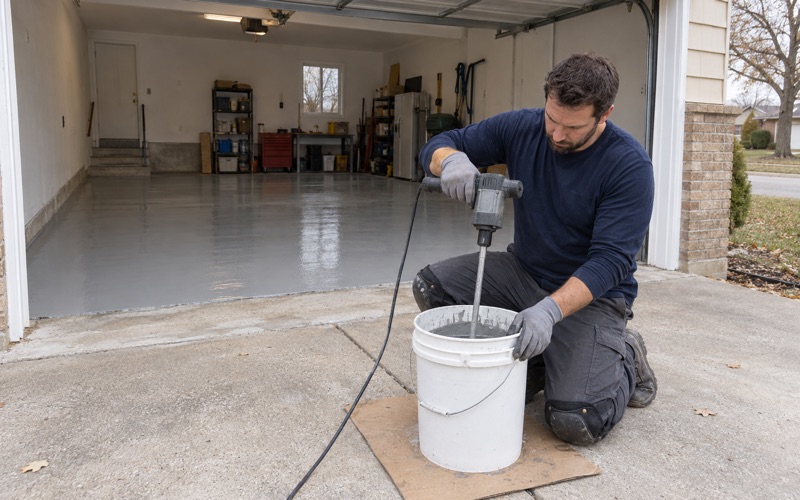
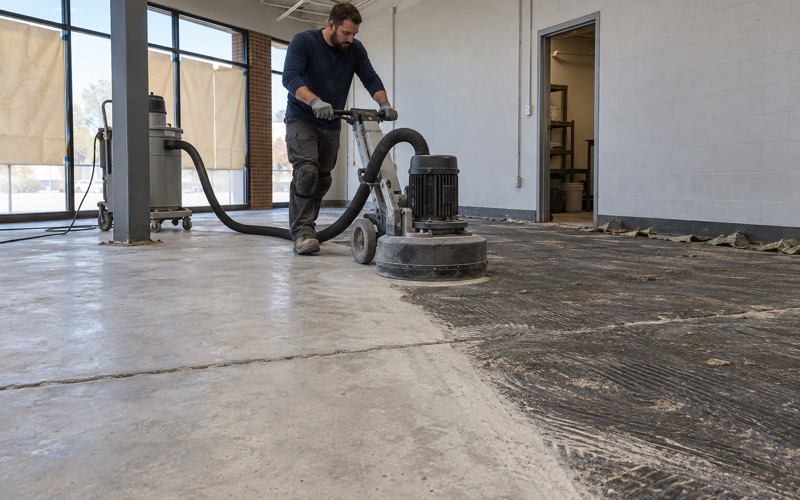
Every repair we scope starts the same way. Cracks, spalls, lifted edges and failed patches are mapped across the area, and if the slab needs structural attention before it should be coated, we say so rather than covering it. Surfaces are opened with a diamond grinder or a shot blaster, never an acid etch, and the dust is pulled into a vacuum at the machine instead of being washed toward a floor drain.
The proposal then names the product line, the number of coats and the finished thickness, so a facility manager can hold the finished floor up against the quote. What the warranty does not cover is explained before the job is sold, with moisture the first exclusion on that list.
A New Warehouse on an Old River Street Plant Site
Three Lots Consolidated Into One Building
On River Street in Schiller Park, a village in Leyden Township, Cook County, the village board adopted Ordinance 21-4286 on August 19, 2021. It approved a subdivision and PIN consolidation for 9435, 9465 and 9511 River Street in the I-1 industrial district, by a 6-0 vote. At the same meeting the mayor said the three new industrial projects were moving forward as planned.
The 9511 address is the one older directories give for Arpac, a maker of shrink and stretch packaging machinery. Arpac’s parent combined it with sister brands as nVenia and moved them into a new Wood Dale facility that opened in 2021, so the old plant is not what stands there now. The parcel carries a 52,100-square-foot building listed as built in 2022, and a map listing names the occupant Encore Warehouse, which specializes in event technology and production services.
We have not been inside that building, and nothing on this page describes its floor or its condition. What the listing does tell us is the kind of use a floor gets in a building like it, and that use is worth planning around.
A Floor That Never Empties
An event-production warehouse typically lives on a show calendar. Gear goes out on trucks, comes back from a job, is checked and repacked, and is turned around for the next one, so the floor is rarely clear for long. The same aisles and dock lanes take loading and unloading over and over, often on short notice.
That rhythm is what makes floor damage awkward. A chipped coating edge, a scuffed-through traffic lane or a delaminated patch is rarely found in a quiet week; it turns up mid-cycle, with a load-out on the schedule and crews moving through the area. A newer building does not rule this out, because a slab of any age can still crack.
For a building like this, the plan we write for the floor is less about a single big coating job and more about a repeatable routine: find damage early, isolate it, repair it in the right order and get the space back. The rest of this page walks through that routine.
Looking for epoxy-flooring closer to Warrenville? See Epoxy-Flooring Services in Warrenville.
OSHA’s Order: Inspect, Repair or Guard
The federal rule for walking-working surfaces, 29 CFR 1910.22(d), sets an order of operations that suits a working warehouse. It is the employer’s rule to follow, and no coating or repair satisfies it on anyone’s behalf. What a flooring contractor can do is make each step easier to carry out.
Surfaces Inspected Regularly
The rule’s first paragraph says walking-working surfaces are inspected regularly and as necessary, and maintained in a safe condition. In a building where equipment moves all day, that means someone walks the aisles on a set schedule, not only after a worker trips. A floor with a consistent color and a sound topcoat makes the walk faster, because a chip, a lifted edge or a stain that keeps coming back stands out against it.
We can help with the record side of it as well. When we map a floor before a job, the cracks, spalls and worn areas we find go onto a marked plan the owner keeps, which gives later inspections a baseline to compare against.
Repaired Before Use, or Guarded Until It Is Repaired
The second paragraph is the one that matters mid-cycle. A hazardous condition has to be corrected or repaired before an employee uses that surface again. If the repair cannot be made immediately, the hazard must be guarded until it is repaired, so that nobody walks or drives across it in the meantime.
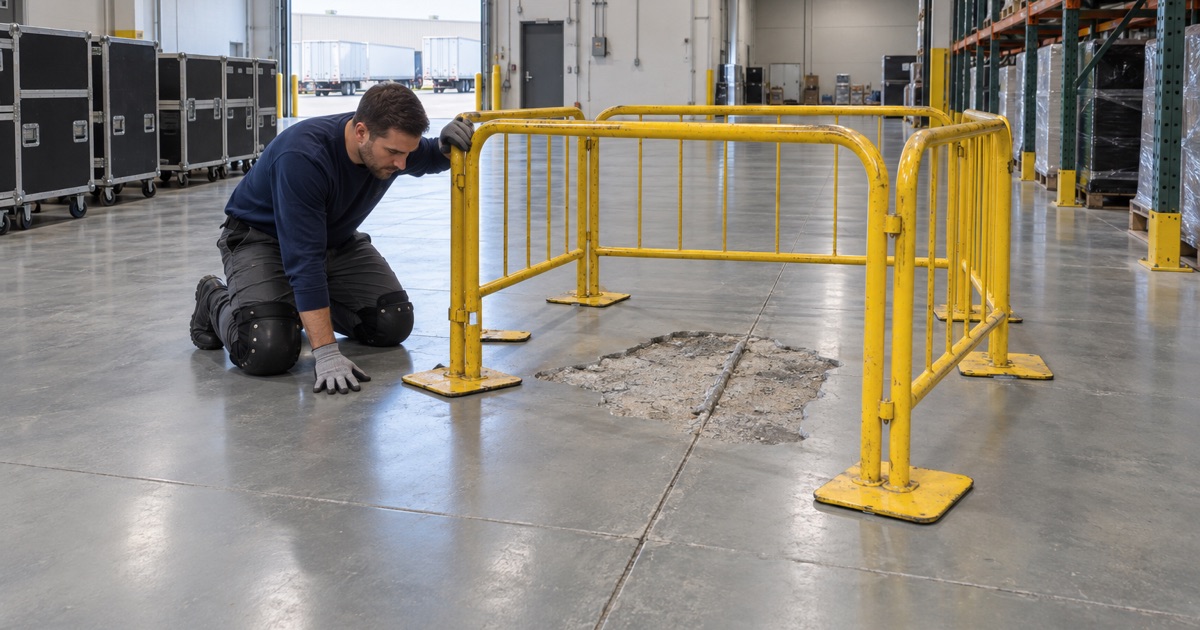
In practice, guarding means cones, a barricade or a marked perimeter around the damaged spot, set up the day the damage is found. The useful habit is to barricade the bay, not the building. A guarded section a few yards across lets the rest of the warehouse keep loading while the repair waits for its window, and it keeps a forklift from turning a small chip into a large spall.
When we schedule that kind of repair, the barricade line becomes the work area. The guarded edge stays in place until the coating has cured, and the space is handed back only when it is ready to carry traffic.
Cosmetic Chip or Structural Crack: Who Decides
The rule’s third paragraph draws a line we take seriously. When any correction or repair involves the structural integrity of the walking-working surface, a qualified person performs or supervises it. That person is the employer’s to choose, someone with the training and experience the structural work calls for, and the decision is theirs, not ours.
Sorting Coating Damage From Slab Damage
When we walk a damaged area, the first job is sorting which kind of damage it is. A scuffed topcoat, a chip at a coating edge or a patch that has let go of its primer is a coating problem, and it can be repaired in place. Settlement, a crack that keeps widening or a slab edge that has broken away is a different matter, because the coating is only reporting a problem in the concrete beneath it.
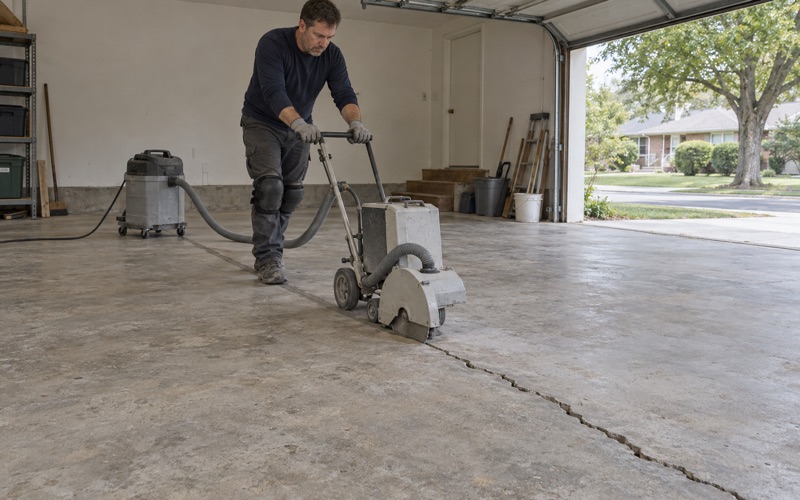
Some signs help with the sorting. A hairline that runs straight through both the coating and the concrete, a crack whose two sides sit at different heights, or concrete that crumbles at the edge of the chip all suggest the trouble is below the coating. A clean chip with sound concrete underneath usually does not.
Old coatings get the same scrutiny. A floor that has been patched several times over the years may carry layers that no longer bond well to each other, and a new patch is only as sound as the layer it sits on. We test the edges of the existing system before deciding whether a repair can tie into it or the area needs to come back to bare concrete.
The Structural Question Comes Before the Coating
Where the defect reaches the slab, we stop and say so in writing, so the owner can bring in their qualified person before anything is covered. Coating over a moving crack hides it for a while and then lets it telegraph back through the new surface. Once the structural repair is done, we can grind the area, prime it and blend the finish into the floor around it.
That order also protects the owner’s money. A coating applied over an unresolved structural problem is the first thing to fail when the slab moves again, and that is not something a coating warranty is written to cover. Answering the structural question first means the coating is only asked to do what a coating can do.
Repairs That Fit Between Load-Outs
Once coating-only repairs are sorted from structural ones, the question becomes timing. A warehouse on a show calendar rarely has a spare week, so the repair plan is built around when a bay can be out of service and how soon it has to carry traffic again.
Commercial floors we work on are phased around operating hours, and overnight and weekend windows are often where a warehouse repair fits best. A bay that closes after the last truck leaves on a Friday can be ground, patched and topcoated, then reopened once the cure readings allow, without stopping the rest of the building.
Fast-Return Repair Materials
Fast-return repair materials exist for exactly this situation. Polyaspartic and polyurea topcoats can put a patched area back under foot traffic, and then light vehicle traffic, much sooner than a standard epoxy topcoat. A 100% solids epoxy is still the right build coat where the window allows it to cure, and we say plainly which trade-off a short closure forces.
Speed has limits. A fast-setting product still needs a profiled surface to grip, so the patch area is opened with a grinder or shot blaster rather than scuffed by hand, and the edges are feathered so the new patch does not leave a raised lip at its border. The data sheet states the ICRI concrete surface profile it needs, and we grind to that number.
Cure by Slab Temperature, Not the Clock
Cure times on a data sheet assume a temperature, and a warehouse slab near an open dock door in January is not at that temperature. We schedule cure windows from the slab temperature and the dew point spread at the surface, and if the readings say a patch needs longer, the bay stays guarded longer. Cold, damp air over fresh epoxy can also leave amine blush, a waxy film that weakens the bond of the next coat.
Rushing a coating back into service is how one quick repair turns into the next one. A barricade that stays up an extra shift costs far less than a patch that peels under the first heavy load-out.
A Repair That Matches the Floor
A repair should not look like a repair. Where the original system can be identified, we match its color and texture, and slip resistance is specified by the broadcast and topcoat, such as a quartz aggregate broadcast locked under a clear topcoat, rather than promised in general terms. The proposal lists the products, coats and thickness for a patch the same way it would for a whole floor.
If you run a warehouse in Schiller Park on a calendar like this one, send us the dates when bays can close and the areas that worry you most. We will walk the floor, map what we find, separate the coating repairs from anything a qualified person needs to see, and give you a written plan that fits between load-outs.
- 20+ Years Coating Concrete
- Moisture Tested Before Pricing
- Free Written Estimates