Lombard Epoxy Flooring brings more than 20 years in the trade to epoxy flooring in Summit, and some of the floors that teach the most are the ones under a car on a lift. A brake job leaves two things behind: the dust that comes off pads and rotors, and the solvent sprayed to wash it off. Both end up on the slab unless something catches them first.
That order matters for how we plan a repair bay or a garage floor. The federal brake-work rule and the cleaner’s own label both put the job of containment on a basin, a rag or an absorbent, not on the floor. A coating’s role is to handle the drip that gets past them and clean up easily afterward.
So the conversation here starts with how the work is done over the floor, then moves to grinding, primer and topcoat. We would rather size a coating to a real drip pattern than sell a gloss that the first can of spray cleaner dulls. That approach holds whether the car sits on a shop lift or on jack stands in a home garage.
A General Repair Shop on Archer Road and Its Brake Work
What the shop lists
Midway Auto Care sits at 5805 S. Archer Road, an address that geocodes inside the Village of Summit on the Summit side of the Archer Road village line. Its own service menu runs from engine and transmission work to A/C, suspension, oil changes and muffler repair. The brake page offers a check of pads, rotors, calipers and hoses, along with new pads and rotor resurfacing for all makes and models.
That makes it a general repair shop rather than a body shop, and the floor question follows the work. Brake service means wheels off, an assembly exposed, and cleaning that happens right over the slab. We have no relationship with Midway, and we did not see how it cleans brakes or what its floor is; the shop is simply a clear local example of where this kind of floor wear begins.
Why brake work is a floor problem
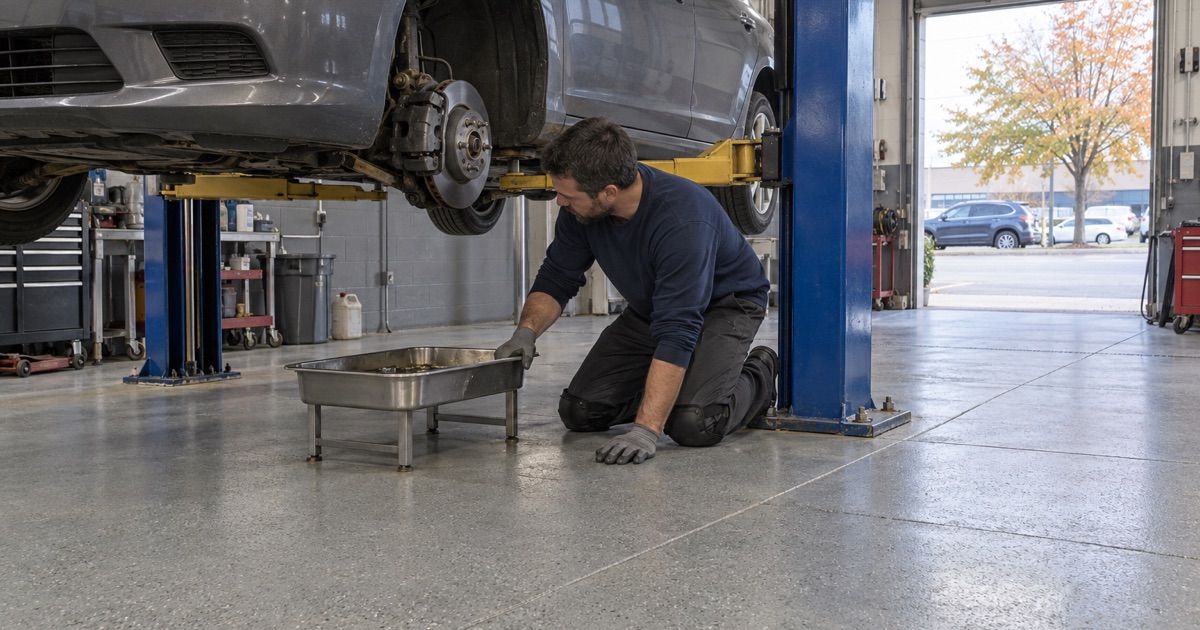
A brake assembly is cleaned where it hangs, so whatever runs off it falls straight down. Dust that is brushed loose drifts and settles across the bay, and solvent that misses the part pools near the tire or creeps toward a drain. Over months, the floor under one lift can look nothing like the floor a few steps away.
For an owner thinking about coating a bay like this, the useful first step is to watch a few brake jobs and note where the drips land. That map tells us where the floor needs the toughest topcoat and where a standard system is enough.
A shop that runs several brake jobs a day also puts tires, jacks and creepers across the same lanes, so the coating near a lift takes solvent and wear at once. That is where we expect the topcoat to dull first, and where we plan the thickest film and the easiest recoat. A worn lane can often be scuffed and topcoated again without stripping the whole floor.
Looking for epoxy-flooring closer to Justice? See Epoxy-Flooring in Justice.
OSHA’s Brake Appendix and What the Cleaner Label Says
A catch basin, wet methods, no dry brushing
OSHA’s asbestos standard, 29 CFR 1910.1001, carries a mandatory Appendix F for automotive brake and clutch inspection, disassembly, repair and assembly. Under its low pressure/wet cleaning method, “A catch basin shall be placed under the brake assembly, positioned to avoid splashes and spills,” and the assembly is gently flooded so dust does not become airborne. The use of dry brushing during that method is prohibited.
The appendix also allows a wet method for shops servicing no more than 5 pairs of brakes or 5 clutches a week. There, components are wiped clean with a cloth, any solvent spill is cleaned up immediately, and dry brushing is again prohibited. A negative-pressure enclosure with a HEPA vacuum is the other method named, and the appendix names no floor material at all. We quote the rule for its work practices, not as a claim about what a given brake pad contains.
What one brake cleaner’s label asks for
We read the label of one maker’s product, CRC Brakleen Brake Parts Cleaner Non-Chlorinated, No. 05085, which lists acetone, toluene and methanol. Its directions say to “Protect all rubber brake parts, plastic and painted surfaces from product and overspray,” and not to apply it directly on painted surfaces. Runoff “should be collected and disposed of properly,” and the disposal line rules out sewers, floor drains and the ground.
The label also warns that vapors are heavier than air and can accumulate in low areas, and its spill instruction is to use an absorbent and store it in closed containers. That is one maker’s product, not a claim about what any particular Summit shop sprays. Still, a resin-coated floor is close kin to the painted surfaces the label tells you to protect, so the sensible reading is to keep the product off it.
What the resin charts add
Manufacturer charts back up the label. One epoxy floor maker’s chart gives acetone a lower short-term rating than diesel or motor oil, noting color and gloss change, and another maker’s data rates its solvent-free epoxy coating 0, attacked on contact or within 2-3 hours, for methanol while rating its polyurethane coating 5. No coating is a substitute for catching the runoff, and we do not sell one as if it were.
Catching Runoff and Dust Before It Reaches a Coated Floor
The basin and the washer come first
On a coated floor, the catch basin or an aqueous brake washer goes under the assembly before the first spray. Aerosol cleaner is aimed at the part and away from the slab, and absorbent pads sit where the drips have been landing. Brake dust is collected in the basin or on a rag, not rinsed or swept across the floor toward a drain.
An aqueous brake washer has a practical edge on a coated floor: the reservoir holds the wash liquid, and the drip stays in the unit instead of spreading. Whatever system a shop uses, the basin is emptied and its waste handled as the label directs, never tipped onto the slab to evaporate.
Floor drains deserve their own mention in Summit. The village’s 2024 hazard mitigation annex states that sewer and rainwater are combined into one sewer, so a drain in a shop or garage floor is not a place for solvent or dusty rinse water, on top of what the label already says.
How we build the floor around that habit
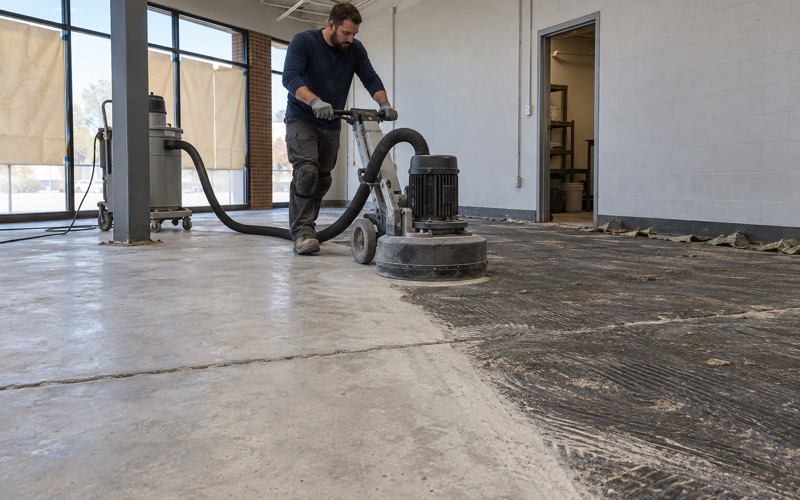
The slab is opened with a diamond grinder or a shot blaster, never acid, so the primer bites into a true profile, and the grinding dust is pulled into a vacuum at the machine instead of being washed toward that same drain. Where a lift or brake station sits, we look for a topcoat with a methanol row on its maker’s chart that it actually passes, rather than a general chemical-resistance claim. The proposal spells out the product line, the coat count and the finished thickness so the floor can be checked against it later.
A broadcast texture is set by the aggregate and topcoat we name, which matters on a floor that will see the occasional wet spot. Cure schedules follow slab temperature and dew point, so a bay is not put back in service before the coating is ready for solvent contact.
Permits and the address line
Building and permit questions for work inside the village go to the Village of Summit Building and Public Works department at 7321 W. 59th Street. Archer Road itself carries a village line, and 6400 S. Archer Road geocodes to Bedford Park, so we confirm which side an address falls on before assuming which permit desk applies.
Doing Your Own Brakes in a Coated Home Garage
Bring the shop habits home
A homeowner doing their own pads and rotors meets the same two problems on a smaller scale. A drain pan or plastic tub under the hub, a rag for wiping, and an absorbent mat beneath the work area keep cleaner off the coating. Spray at the part from close in, not in a broad sweep that drifts onto the floor.
The label reads “DANGER: EXTREMELY FLAMMABLE,” and because the vapors settle low, the garage door stays open while the cleaner is in use and a water heater or other ignition source nearby is a reason to move the job outside. Used absorbent goes into a closed container, as the label says, rather than loose into the trash or down the garage drain.
If cleaner does reach the coating, wipe it up while it is wet rather than letting it evaporate in place, then wash the spot with a mild detergent and water. A dull patch after a spill is a sign the topcoat took a hit, and it is far easier to recoat one spot early than to wait until the film wears through.
Choosing the system for a home mechanic
For a garage that sees brake work, we often look at a polyaspartic or polyurethane topcoat over a 100% solids epoxy base, chosen against the actual chemicals in the cleaner you use. If you bring us the can, we can spot-test it on a sample panel before the floor goes down. The same system has to stand up to the brine and rock salt that ride in on tires each winter, so it is chosen for both.
Color matters here too. A lighter floor shows brake dust and fresh drips right away, which makes a quick wipe more likely than a darker floor that hides them until they have sat for days. A vinyl flake broadcast hides wear but also hides spills, so we talk through that trade before the color is picked.
What we check before quoting
More than half of Summit’s housing, 52.8 percent, was built before 1960, so a garage slab here is often decades old and may carry patches, cracks or an old paint layer that has to come off first. Grinding takes that layer down to sound concrete, with the dust caught at the machine as on a shop floor.
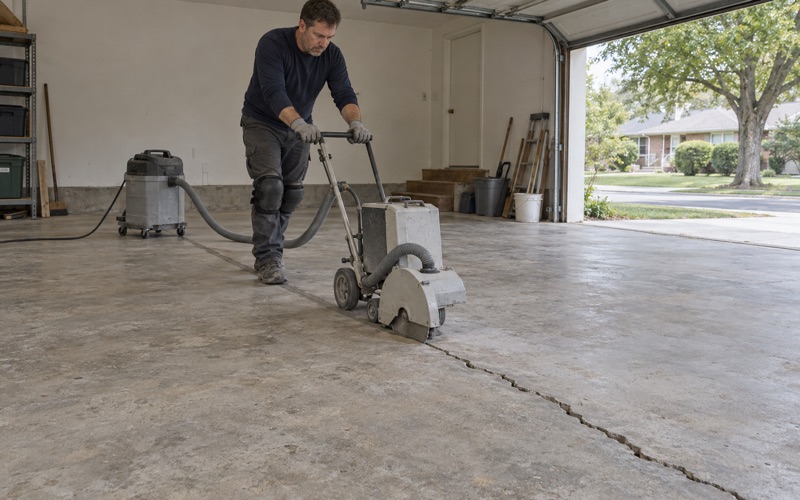
A moisture test on the garage slab is part of the written scope before the price is final, and cracks, spalls and old coatings are mapped first. If an older slab needs repair before it should be coated, we say so plainly. We also explain what the warranty leaves out before the job is sold, and moisture is the first exclusion we name.
- 20+ Years Coating Concrete
- Moisture Tested Before Pricing
- Free Written Estimates