Lombard Epoxy Flooring has spent more than 20 years putting epoxy flooring in Westchester basements and garages, and the basement jobs here have one thing in common that shapes the whole plan: the furnace. It stands on the same slab we are about to grind and coat, and more and more often it is a condensing unit with a drain line running across the floor.
That changes how we lay out the work. Before we price anything, we walk the floor and note where the furnace sits, where its condensate goes, what is clamped down, and where water would land if something backed up. The coating has to go around that hardware, leave it serviceable and protect the concrete around it.
This page explains why condensing furnaces matter to a floor coating, what the hardware on the slab looks like, how we work around it without moving it, and what a sealed floor can and cannot do when a condensate trap fails.
An HVAC Shop on Derby Lane and the Furnace on Your Slab
Westchester is a village in Cook County, a western suburb of Chicago with a population of 16,892 at the 2020 census. It is mostly houses, and mostly old ones: 48.4 percent of the housing stock was built in the 1950s, when the village grew from 4,308 people to 18,092 in a decade. Those postwar Georgians, ranches and split-levels grew up around a handful of pre-Depression English-style houses, and where one has a basement, the furnace stands directly on a slab now about seventy years old.
Derby Lane, a small trades pocket
Near Roosevelt Road on the east edge of the village, Derby Lane holds a short run of trade shops. Pro Temp of Illinois, at 9835 Derby Lane, is a mechanical contractor that installs, services and repairs residential and commercial heating and cooling systems. It has been in business since 1999 and is a Lennox dealer. TNP Machine Company is also on Derby Lane, at 9860.
We mention Pro Temp because it is the kind of local shop that installs furnaces, not because we work with it. We have no relationship with that company. We do no HVAC work, and nothing on this page is an offer to touch a furnace or its drain.
Why the furnace is a floor question
A replacement furnace changes the floor around it. An older unit vents hot exhaust and leaves the slab dry. A condensing unit pulls more heat out of its exhaust and leaves water behind, and that water has to travel across the basement to a drain. Once that line is on the floor, a coating plan that ignores it ends up with epoxy against the pipe, a clamp sealed into the finish, or a pump nobody can lift for service.
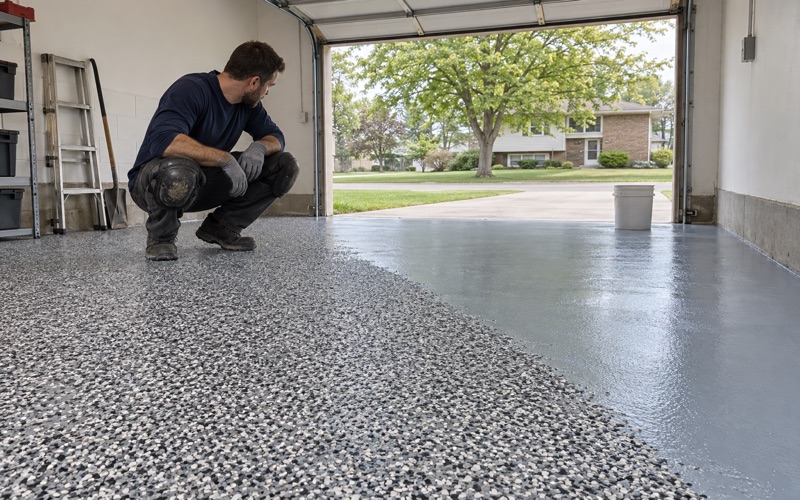
The house form matters too. In a split-level the furnace may sit on a lower slab at a different grade from the garage, so the basement and the garage are two separate floor jobs with separate prep and moisture readings, even when they are coated in the same week.
Looking for epoxy-flooring closer to Wood Dale? See Wood Dale Epoxy-Flooring.
Acidic Condensate and the Late 2028 Furnace Rule
The water a condensing furnace leaves behind is not clean tap water. A July 2024 trade article by the president of JJM Alkaline Technologies, a company that makes neutralizers, puts condensing-furnace condensate at a pH of 2.9 to 4.0 and says untreated condensate can corrode plumbing, concrete foundations, floor drains and cast-iron pipes common in older homes. That comes from a maker with an interest in selling neutralizers, so we treat it as trade guidance, not a measurement taken in any local house.
Why acid matters to a bare slab
The chemistry is simple. Portland cement paste is alkaline, and acidic water attacks it. On bare concrete, repeated drips leave a rough, sandy patch where the surface paste has been eaten away. On a coated floor, the resin takes the contact first, so a spill can be wiped up instead of soaking into the slab.
That also explains why an etched patch beside a furnace is not a reason to skip the grinder. The damaged paste is weak, and a coating bonded to it fails with it, so we grind past the soft layer to sound concrete before any primer goes down.
The DOE rule makes condensing units standard
The same article reports that the Department of Energy gas furnace rule, finalized in late 2023, takes effect in late 2028. It requires an annual fuel utilization efficiency of at least 95 percent for non-weatherized gas furnaces, and in practice that means a condensing design. In a village of 1950s basements, nearly every replacement gas furnace after that date will bring acidic condensate and a drain line to the floor.
For a homeowner deciding on a basement coating now, the timing matters. If the furnace is due for replacement, it can make sense to coat after the new unit and its condensate hardware are installed, so the floor is planned around what will actually be there. If the coating goes first, we leave a clean area around the furnace pad so the HVAC contractor has room to work.
The Neutralizer, the Pump and the Line Clamped to the Floor
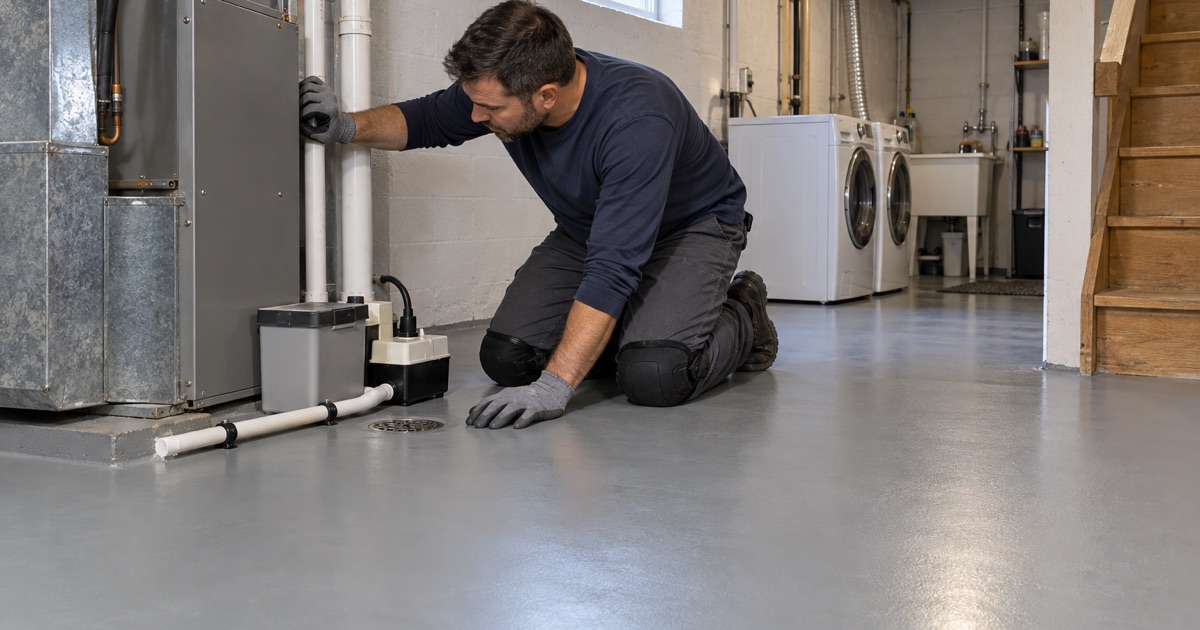
A condensate system usually has more than one piece on the floor. The furnace drains through a trap. From there the water often passes through a condensate neutralizer, a capsule or box filled with media that raises the pH before the water reaches the drain. If the floor drain is not low enough or close enough, a condensate pump lifts the water into a line that runs to the drain or a laundry tub.
What the installation manuals say
The makers’ manuals explain why this hardware sits where it does. Axiom’s NC-Series kit says to mount the capsule on the wall or floor with brackets, keep the kit below the appliance’s condensate outlet, and secure the corrosion-resistant piping to the floor or wall so it cannot move. JJM’s NBT-Series manual says the neutralizer can be mounted to the floor or wall, and that the drain piping should be clamped to the floor. Both treat the line’s position as part of the installation, not as clutter.
Mapping the run before we price it
On the walkthrough we sketch the condensate route on the floor plan: furnace, trap, neutralizer, pump, every clamp and the drain it ends at. That sketch goes into the written scope, so the homeowner can see which strips of slab stay bare and why. If a clamp is loose or the line already sags, we point it out and leave the fix to the heating contractor before we schedule.
Coating around it without moving it
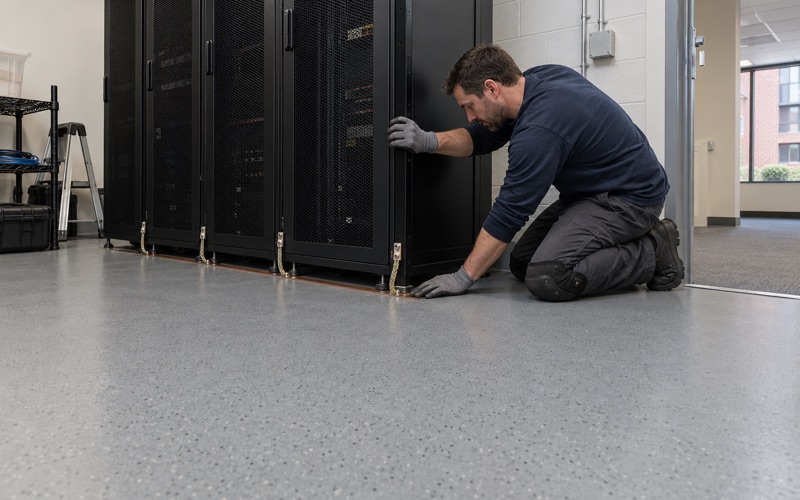
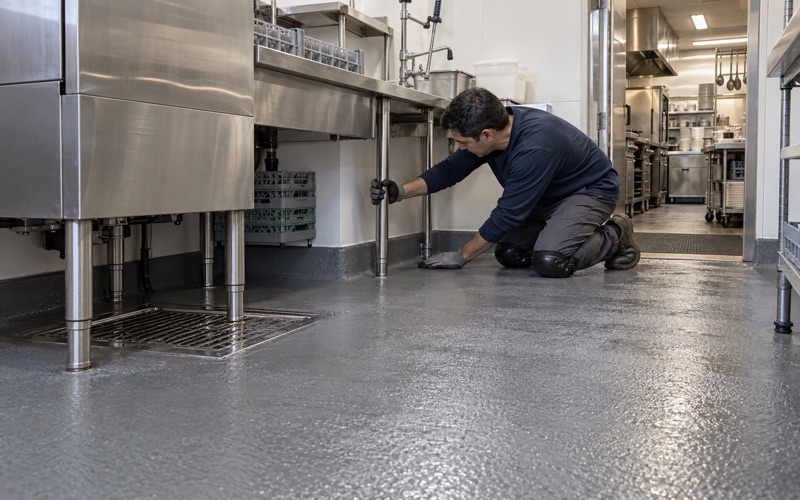
We work around the hardware where it sits. The neutralizer, the pump and every clamp stay where the installer put them. We grind and coat up to their footprints and stop short, so no resin locks a bracket to the slab or bonds a pipe in place. Moving, re-clamping or reconnecting any of it is the HVAC contractor’s job, and if a line truly has to move before coating, the homeowner books that with their heating contractor before we start.
Access matters as much as appearance. The Axiom manual calls for checking the pH at the neutralizer outlet once a year and replacing the media when it drops too low, and JJM warns never to run the neutralizer or traps dry. So we leave the run from furnace to drain open, with no new curb, cove or tight fit that makes the box hard to open or the pump hard to lift.
When the Trap Clogs: The Overflow and the Etched Floor
The Axiom manual recommends a Y or T fitting as a safety overflow in case the condensate drain clogs. That is the right design, and it is also the one point where acidic water is meant to reach the floor. A blocked trap or a pump that quits will put water there, sometimes for days before anyone goes downstairs.
What a sealed floor does, and what it does not
On bare concrete, that slow overflow etches the surface and stains it. On a properly bonded epoxy floor, the water sits on the coating where it can be seen and mopped up, and that is the real value near the furnace: a surface that shows a problem and cleans up after it. A coating does not repair a leaking trap, does not stand in for a dead neutralizer, and does not turn a basement into a dry room. If water is on the floor, the condensate system needs a service call.
How we prepare the slab around the furnace
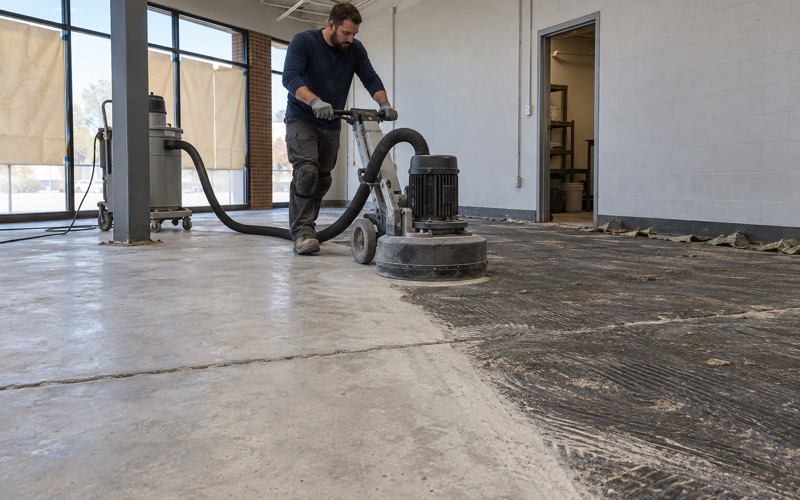
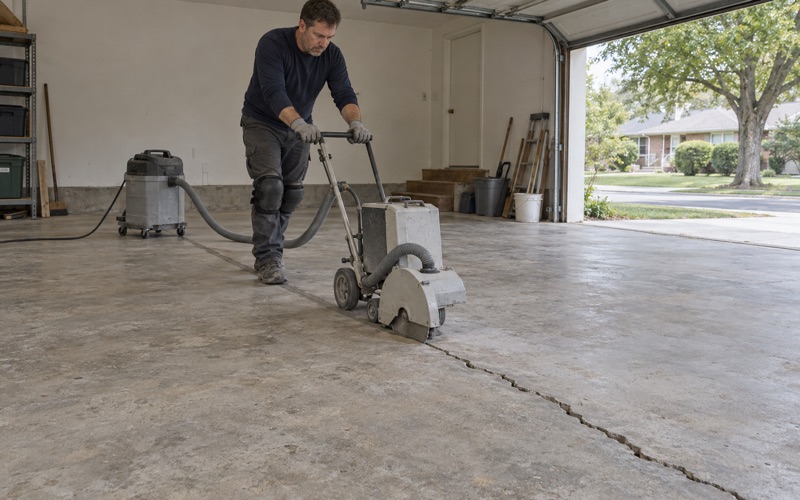
We open every slab with a diamond grinder or a shot blaster, never an acid wash, so the primer has a real profile to grip. Grinding dust is collected at the machine by a vacuum instead of being rinsed toward the floor drain the condensate line feeds. Old etched patches near a furnace are mapped with any cracks and spalls, and we say plainly when the concrete needs repair before a coating goes on.
A moisture test is written into the scope before the price is final, using methods such as the ASTM F1869 calcium chloride test or ASTM F2170 in-slab relative humidity probes. Moisture is also the first exclusion we explain in the warranty, before the job is sold. A slab poured in the 1950s may have no vapor retarder under it, and a basement that shows past seepage is one we read carefully first.
Cure timing follows the slab, not the calendar. We check slab temperature and the dew point spread at the surface before each coat, because a cool basement floor near a damp foundation wall can sit close to dew point and leave amine blush on fresh epoxy. The furnace usually keeps a basement steadier than an unheated garage, but we still measure rather than assume.
Westchester’s own basement rules
The village’s basement build-out sheet measures from the finished floor. Wall outlets must be at least 18 inches above it, the top of the storm basin must be 2 inches above it, and a floor drain is required in the same room as the water heater. A thin coating leaves those heights where they are, and that drain stays open with the floor still sloping toward it.
Permit and registration questions go to the Village of Westchester Community Development and Building Department before the work is scheduled. Our written proposal names the product line, the number of coats and the finished thickness, so the floor can be checked against the quote once the furnace room is back in use.
- 20+ Years Coating Concrete
- Moisture Tested Before Pricing
- Free Written Estimates