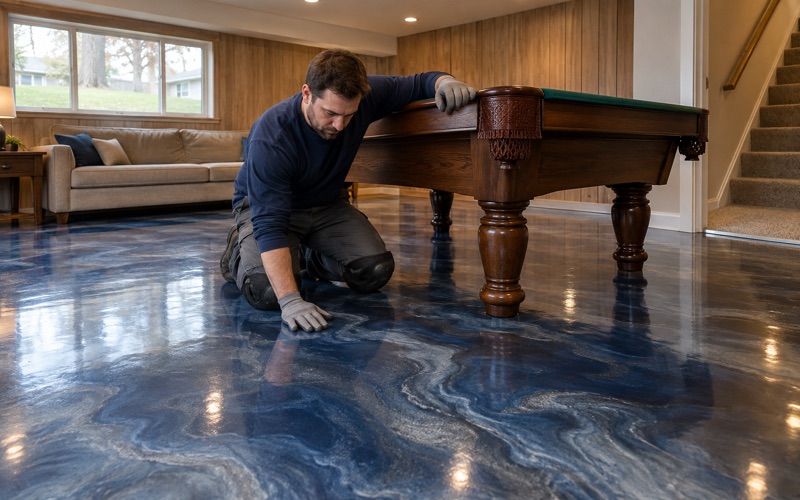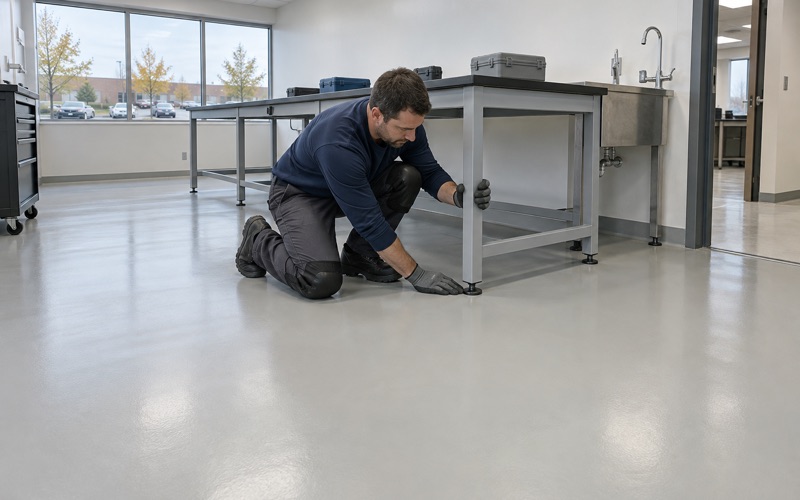
Lombard Epoxy Flooring brings more than 20 years of epoxy-flooring in Western Springs and across the western suburbs to slabs that are opened, tested and mapped before any resin goes down. Our work runs from the garage of a mid-century house to the back rooms of the food businesses downtown. The common thread is a floor that gets cleaned hard and often without letting water into the concrete.
This page is about a room most customers never see: the space where a food business keeps its trash, recycling and returnable containers until pickup. It gets wet, it gets washed with hot water and pressure, and it answers to the same floor expectations as the kitchen beside it. We walk through what that means for the coating, then what the same thinking does for the trash corner of a home garage.
Every proposal we write names the product line, the number of coats and the finished thickness. The floor on the ground can then be checked against the paper, line by line.
A Hillgrove Avenue Wine Bar and the Room Every Kitchen Has
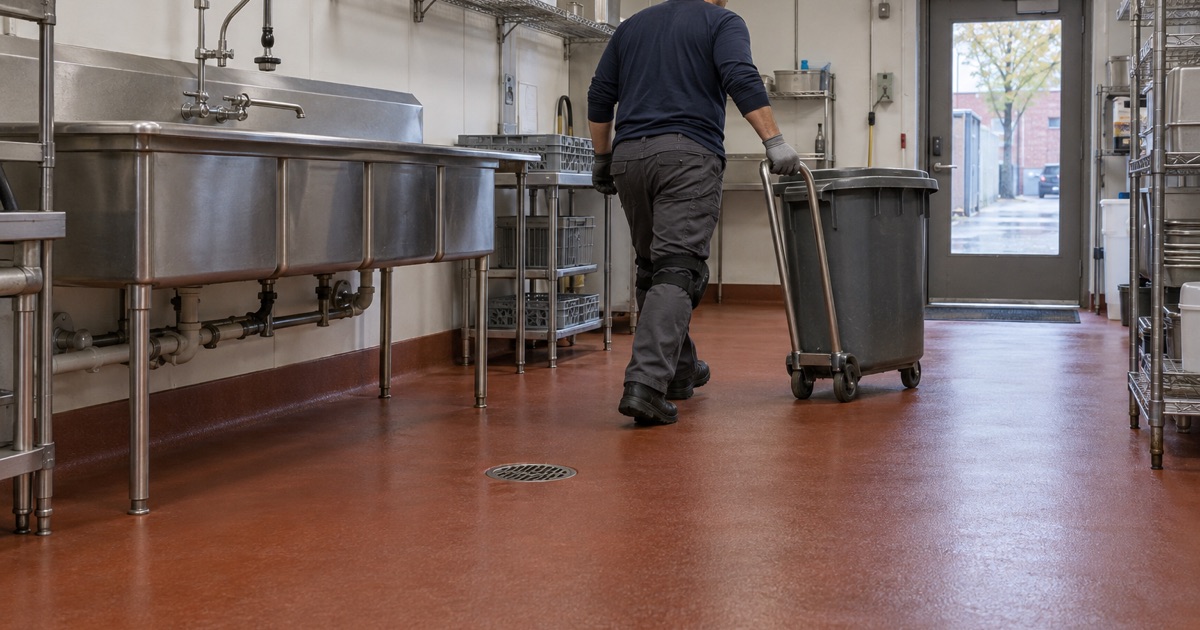
Empties, Cans and Cardboard
Davanti Enoteca, at 800 Hillgrove Avenue, calls itself a rustic Italian wine bar, serving imported wines, small plates, pizzas and Focaccia di Recco seven days a week. Happy hour runs Monday through Friday from 4:00 to 6:00 p.m., and the room also takes private events and group dining. A schedule like that produces a steady stream of empty bottles, cans, cardboard and kitchen scraps.
We have not seen Davanti’s back of house, and nothing here describes it. We use it as the example because any food business like it, on Hillgrove Avenue or anywhere else in Lyons Township, needs somewhere to hold refuse, recyclables, and returnables between pickups. That holding area is where the floor question starts.
The Food Code Treats the Recycling Room Like the Kitchen
The FDA Food Code 2022 is direct about this. Section 5-501.10 says that if a storage area for refuse, recyclables and returnables is located inside the food establishment, it must meet 6-101.11 and 6-201.11 through 6-201.18, the same floor, wall and ceiling rules written for the rest of the establishment. Put simply, the trash room is held to the kitchen’s floor standard.
The section also cites 6-202.15 and 6-202.16, which reach past the floor, so the rule covers more of the room than we do. Our part is narrow: the slab, the coating on it and the line where it meets the wall. We say that plainly so an operator knows which parts of the room remain someone else’s job.
Section 6-101.11 asks for indoor floors that are smooth, durable and easily cleanable, and nonabsorbent where they are subject to moisture, including areas that are flushed or spray cleaned. A bare slab, or one with only a penetrating sealer, that drinks rinse water does not meet that description, however neat it looks on a dry afternoon.
In Western Springs, food-service review belongs to the Cook County Department of Public Health. We are not inspectors, and a coating does not by itself make any room compliant. What we can deliver is a surface that matches the words the code uses.
Looking for epoxy-flooring closer to La Grange Park? See La Grange Park Epoxy-Flooring.
Hot Water, Steam and Pressure Where the Bins Live
What the Code Expects of the Containers
The Food Code also expects the containers themselves to stay clean. Section 5-501.13(A) calls for receptacles that are durable, cleanable, insect- and rodent-resistant, leakproof and nonabsorbent. Section 5-501.18(A) then requires suitable cleaning implements and supplies, such as high pressure pumps, hot water, steam and detergent, to be provided as necessary for effective cleaning of those receptacles and waste handling units.
The code allows approved off-premises cleaning services instead, but an operator who washes bins on site does it in the storage area or close to it. The floor there then takes the same hot water, steam, pressure and detergent the bins do, week after week.
What Washing Does to an Ordinary Floor
Hot water and steam swing the surface temperature quickly, and a pressure wand finds every weak edge. A thin roll-on paint lifts at its first chip, a sealer lets water through at a hairline crack, and the seams of a tile floor open and start holding grime underneath. A leakproof bin standing on a floor that soaks up its own rinse water is only half of what the code describes.
Weight adds to the wear. A loaded cart or a full recycling tote rolled in and out on small wheels concentrates its load on a narrow track, and that track is usually the same path the pressure wand follows. A thin film wears through along it long before the rest of the room shows age.
Illinois law points the same way. The state’s care-of-rooms provision, 410 ILCS 650/2, says food-establishment surfaces must not be kept unclean, unhealthful or insanitary, and that refuse able to decompose or ferment is removed daily. Daily removal plus frequent washing makes a room that is wet far more often than the dining room.
Specifying for the Wash Schedule
So we specify the floor for the cleaning routine first and the color last. That means a resin system that tolerates hot water and steam, a topcoat that stands up to the detergent the operator actually uses, and a wall detail that pressure cannot get behind. The test is whether the surface squeegees clean at the end of a long night.
A Seamless, Coved Floor for a Wash-Down Room
Opening and Testing the Slab
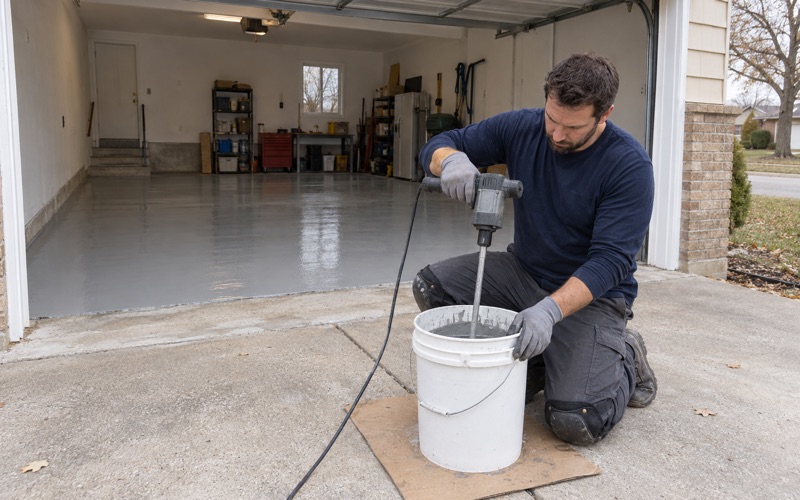
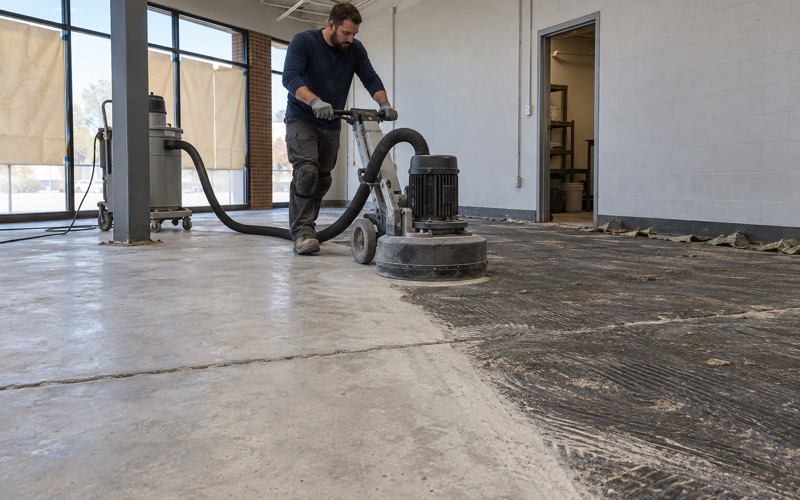
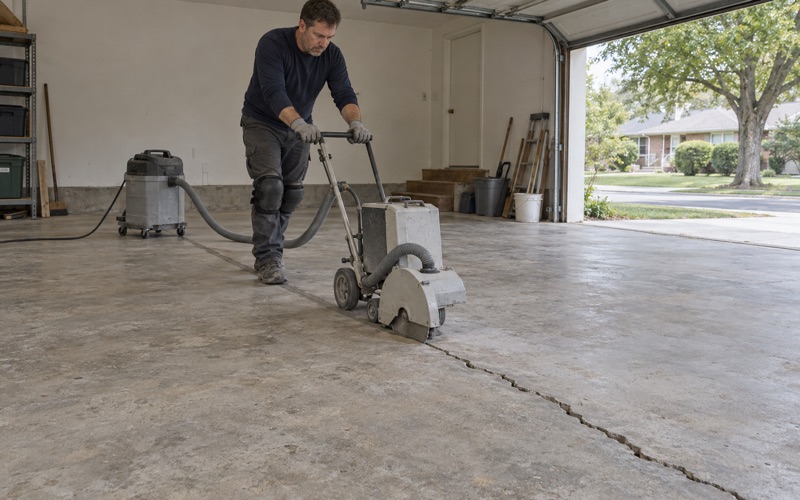
A wash-down floor can fail from below as well as from above, so the work starts with the concrete. We open every slab with a diamond grinder or a shot blaster, never an acid etch, to the ICRI concrete surface profile the system calls for. Cracks, spalls and old coatings are mapped first, and if the slab needs repair or replacement before it should be coated, we say so in writing.
If the room already carries tile, a painted coating or an old epoxy, that layer comes off or is proven sound before anything is bonded to it. A new system is only as strong as whatever it is glued to, and a failed layer underneath takes the new floor with it.
Moisture comes next. Depending on the slab, we use ASTM F2170 in-situ relative humidity probes, ASTM F1869 calcium chloride testing or the ASTM D4263 plastic sheet test, and the result is written into the scope before the price is final. A high reading calls for a moisture-mitigation primer, and moisture is also the first exclusion we explain when we walk through what the warranty leaves out.
Choosing the System
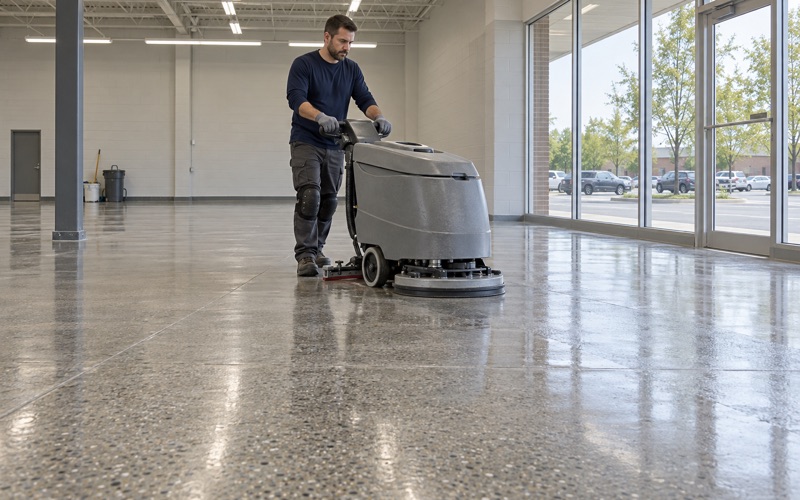
For a refuse and recycling room we usually look at a 100% solids epoxy base or a urethane cement, which generally handles the thermal shock of hot water and steam better than epoxy alone. A quartz aggregate broadcast locked in under the topcoat adds grip on a wet floor, and the Food Code’s antislip exception in 6-201.11 permits that kind of treatment where safety calls for it. We keep the texture fine, because excessive texture traps dirt and debris and makes the floor harder to clean.
Coving the Wall Line
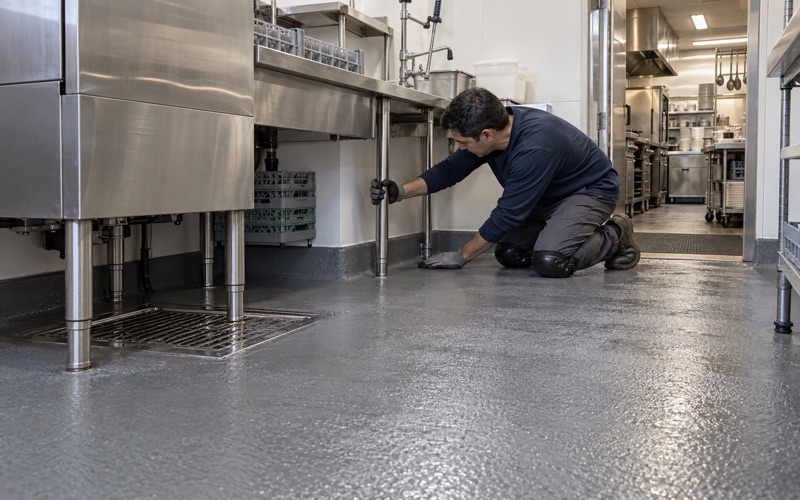
The weak line in any wash-down room is where the floor meets the wall. The Food Code’s 6-201.13 calls for floor and wall junctures to be coved and closed or sealed, and we build to that by running the resin up the wall as an integral cove. Floor and base become one piece, with no seam for pressure-washed water to drive behind.
Working Around Service
A food business rarely closes for a week, so we phase the job around operating hours, using overnight and weekend windows when the space cannot shut. Grinding dust is captured at the machine with a vacuum rather than washed across the room, and products are chosen inside the Illinois VOC limits for floor coatings under 35 Ill. Adm. Code Part 223, which bind whoever applies them.
Garage Trash and Recycling Corners at Home
The same thinking applies at home on a smaller scale. Most garages have a corner where the trash cart, the recycling bin and a bag of returnables wait for collection day, and that corner collects drips, leaking bags and the occasional hose-out.
Why the Corner Fails First
Western Springs is a Cook County village of 13,629 people as of the 2020 census, and its garages see the same small mess the commercial room does, only less often. A household cart is not held to the code’s leakproof standard, so whatever leaks from a bag pools under its wheels and sits on the slab until someone notices. On bare concrete that stain soaks in, and on a worn coating it finds the chip at the edge and works underneath.
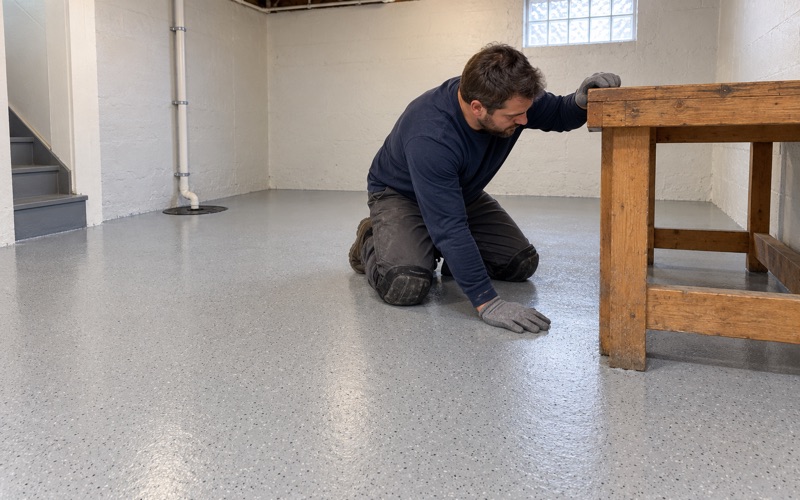
Before quoting a garage corner we look at the whole slab, because a stain under the trash cart can be the first visible sign of a wider problem. Cracks at the apron, flaking at the door line and old coating that lifts with a fingernail all go on the same map, and they shape the price as much as the square footage does.
The Garage System
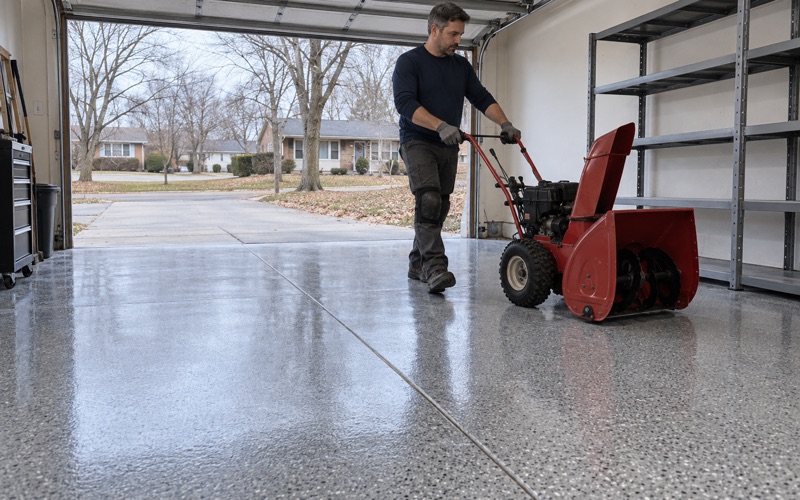
A trash and recycling corner gets the same system as the rest of the garage, chosen to hold up to the brine and rock salt that ride in on tires all winter. A vinyl flake broadcast under a polyaspartic topcoat hides scuffs and cleans with a hose and a deck brush, and a short cove at the wall keeps rinse water off the bottom plate. A full-build system rather than a thin kit coating is how we keep hot tire pickup out of the parking stall.
Timing matters at home too. Cure schedules follow slab temperature and the dew point spread at the surface, so an unheated garage in deep winter is told to wait rather than coated on a date that suits the calendar. A spring or early fall install usually gives the cleanest result.
Before Any Grinding Starts
Home jobs above the state threshold under the Illinois Home Repair and Remodeling Act get a written contract and the Home Repair: Know Your Consumer Rights pamphlet before we grind anything. Permit and contractor-registration questions go to the Village of Western Springs Community Development department at 708-246-1800 before the job is scheduled, including whether a slab is being coated or replaced. And a floor coating is never sold as radon reduction, because in Illinois that is licensed mitigation work.
- 20+ Years Coating Concrete
- Moisture Tested Before Pricing
- Free Written Estimates