Lombard Epoxy Flooring brings more than 20 years in business to epoxy-flooring in Wood Dale, and when the building in question used to hold desks, the first conversation is not about color or gloss. It is about what the concrete underneath was built to carry and what it will be asked to carry next.
A resin floor is a wear surface. It makes concrete easier to clean, keeps it from dusting and gives it a finish that stands up to traffic. What it cannot do is change the slab it sits on, so on any building going through a change of use we treat the coating as the last step of a sequence rather than the whole job.
That sequence is simple to say and slower to do: find out what the slab is, have it confirmed for the new use, repair what fails, then coat. The sections below walk through each step and what we put in writing along the way.
When an Office Building on Mittel Boulevard Turned Industrial
Wood Dale has a clear recent example of the kind of conversion this page is about. In January 2019, Hamilton Partners announced that Wood Dale officials had worked with the firm to redevelop the former office building at 1235 N. Mittel Boulevard into an 81,430-square-foot industrial building. Caesarstone USA, a quartz-surface company, was to run its Midwest showroom, distribution and sales operations there, and Heidolph NA, a German maker of laboratory equipment, its North American headquarters, sales and customer support. Both were relocating from Elk Grove Village.
We have no connection to that building, its owner or its tenants, and the public announcement does not say what the redevelopment did to the floor, the docks or the clear height. We mention it because it shows, at a real address in the city, the exact shift that changes what a floor contractor should be asking.
From Desks to Pallets
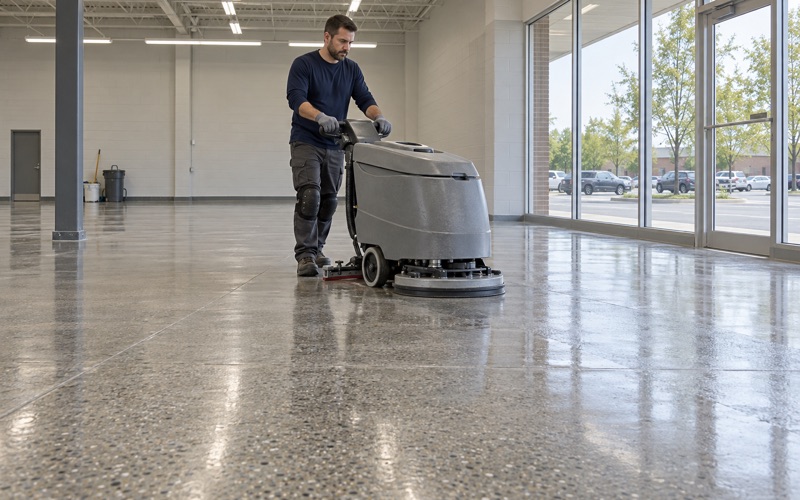
An office floor spends its life under carpet, partitions, filing cabinets and people walking. A showroom and distribution floor carries pallet stock, racking, and lift trucks moving loads between them. The traffic is different, the cleaning is different and, above all, the load the surface is expected to hold is different.
That last change is the one a coating conversation tends to skip. An owner sees a dull, stained slab once the carpet is gone and wants it to look like a warehouse floor. The finish is the easy part. The harder question is whether the concrete under it is fit for what the space is now meant to do.
The same building can also hold two very different floors at once. A showroom wants a clean, even finish that customers walk across in street shoes, while the distribution side wants a surface that shrugs off pallet traffic and is easy to sweep. Planning both from the start, with the same investigation behind them, keeps the transition between them from becoming an afterthought.
Why the Order Matters in a Conversion
Once a coating is down, the slab under it is harder to read. Cracks, old patches and soft areas sit under a uniform color, and testing or cutting into the floor later means damaging a finish someone just paid for. Doing the investigation and the repairs first is cheaper than doing them through a new floor.
Looking for epoxy-flooring closer to Hinsdale? See Epoxy-Flooring in Hinsdale.
OSHA’s Load Rule Comes Before the Finish
Federal workplace rules put the load question ahead of anything cosmetic. Under 29 CFR 1910.22(b), the employer must ensure that each walking-working surface can support the maximum intended load for that surface. In a converted building, the maximum intended load is set by the new use: the stock, the racking and the equipment that will travel across the floor, not by the desks the space was designed around.
That rule binds the employer, not the flooring contractor, and it is written about the surface as a whole. It does not ask whether the floor looks finished. It asks whether the floor will hold what the business plans to put on it, which is exactly the information an owner needs before deciding what kind of floor to buy.
What a Coating Adds and What It Does Not
A floor coating adds no structural capacity. Not a 100% solids epoxy, not a urethane cement, not a polyaspartic topcoat. Thickness and hardness improve abrasion and impact resistance at the surface; they do nothing for how much weight the slab can carry. If a slab is not fit for a new load, no resin system makes it fit, and we will not describe one as if it could.
What a coating does well is the work a converted floor actually needs from it: a surface that resists wear in the travel paths, stops concrete dust from settling on stock and shelving, and wipes clean after a spill. Those are real benefits on a slab that is already right for the job. They are the wrong reason to skip the question of whether it is.
Who Answers the Load Question
We are a flooring contractor, not engineers. Whether a particular slab can carry a particular set of loads is a judgment for a qualified person or an engineer the owner brings in. Our part is to make that review easier: we open the floor, map what we find and hand the owner a clear record of the slab’s condition so the right person can make the call before any coating is scheduled.
Finding Out What the Slab Is
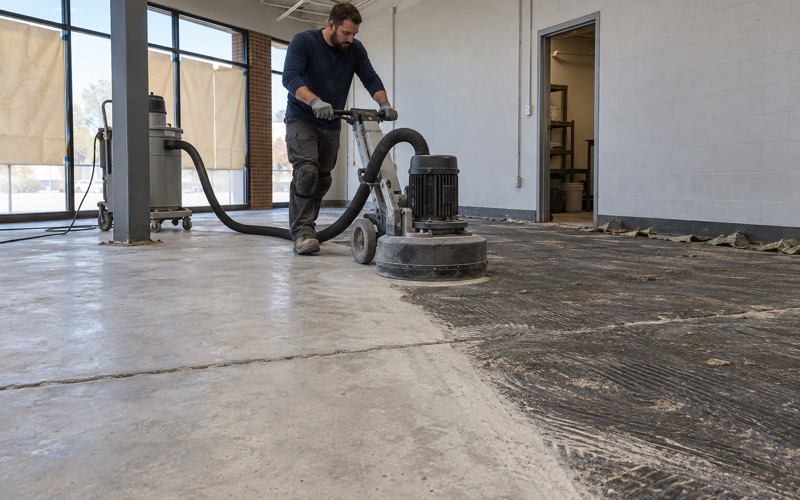
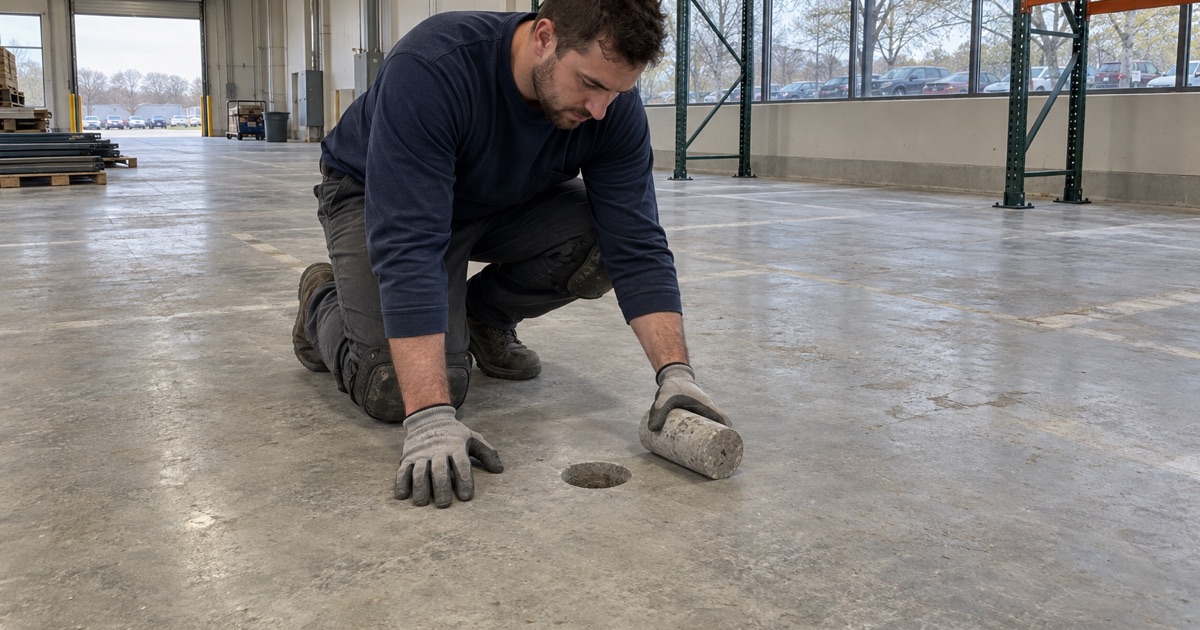
On a converted building, the investigation starts with getting down to bare concrete across the whole floor. Carpet, vinyl composition tile and the adhesives under them come up first, because nothing about the slab can be judged honestly through old office finishes. We remove those layers as a separate step, then look at what is actually there.
What We Map
With the floor exposed, we map cracks, spalls, joints and every place the concrete has been cut or patched. Office buildings collect a history in their slabs: patched trenches where plumbing or electrical runs were laid, utility cuts for floor boxes and cores, infill where walls once stood. Each of those is a place where the concrete may differ from the slab around it, and each goes on the map.
We also ask the owner for whatever records exist: drawings from when the building went up, notes from the redevelopment, any earlier testing. Paperwork rarely answers everything, but it tells the reviewer where to look first and can save cutting into a floor that has already been documented.
The questions an owner’s reviewer will want answered include the slab’s thickness and reinforcement, where its joints run, and whether any part of the floor is suspended or elevated rather than on grade. We note what we can see from the surface and say plainly what we cannot. Confirming what the slab is made of and what it can carry is beyond what a surface inspection shows.
Moisture Before Price
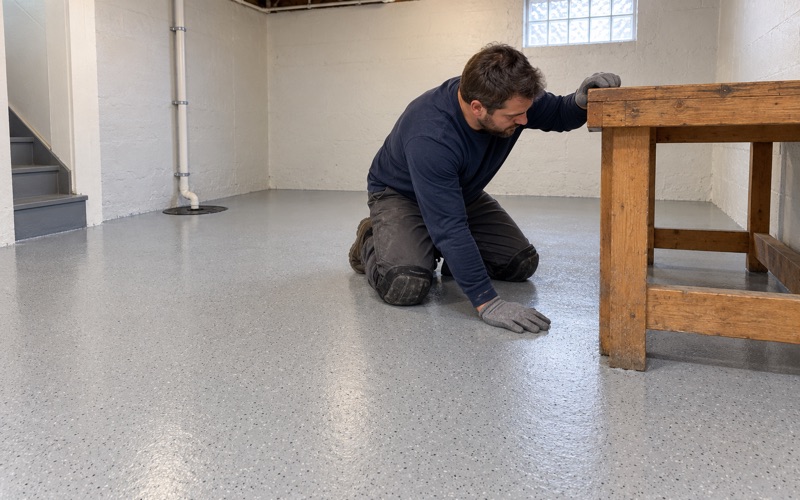
A moisture test is part of our written scope before the price is final. On a slab that spent years under carpet, we cannot assume it is dry just because it looked dry. We use ASTM F2170 in-situ relative humidity probes, ASTM F1869 calcium chloride testing or a quick ASTM D4263 plastic sheet check depending on the floor, and compare the readings with the coating maker’s limits.
If the numbers come back high, the plan changes before anyone is surprised: a moisture-mitigation primer, a different system, or a frank conversation about what the warranty will and will not cover. Moisture vapor transmission is the first exclusion we name, and we explain it before the job is sold rather than after a failure.
Then Repair, Then Coat
When the slab has been mapped and confirmed for the new use, repairs come next. When it has not, we say so, and we will tell an owner directly when a floor needs repair or replacement before it should be coated at all. That honesty costs us the occasional job; it saves the owner a finish that has to be torn out.
Repairs Matched to the Map
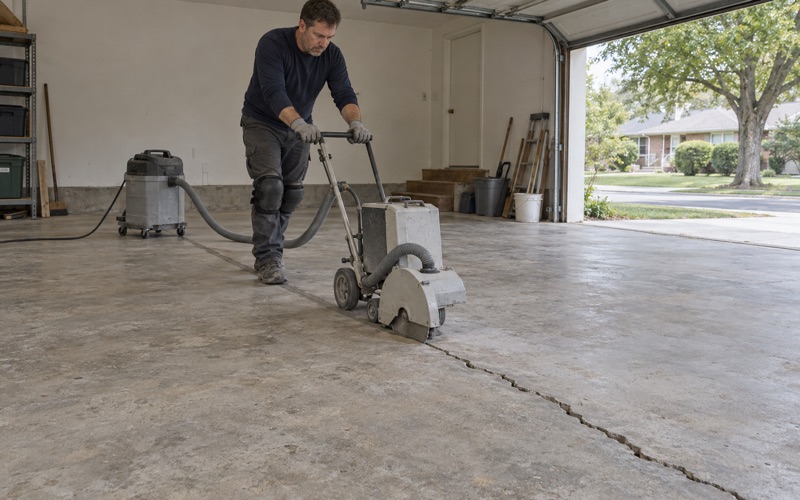
Repairs follow what the investigation found. Spalls and broken edges are cut back and filled with a repair material suited to the coating that will go over it, and cracks are routed and treated based on whether they are moving or dormant. Where structural repair is called for, that work belongs to the people qualified to design it, and our coating is scheduled after they are finished.
Some repairs need time before a coating can follow. Fresh patching material has its own cure and moisture to give up, so we build that wait into the schedule rather than coating over a repair that is still drying and blaming the bond later.
Opening the Surface the Right Way
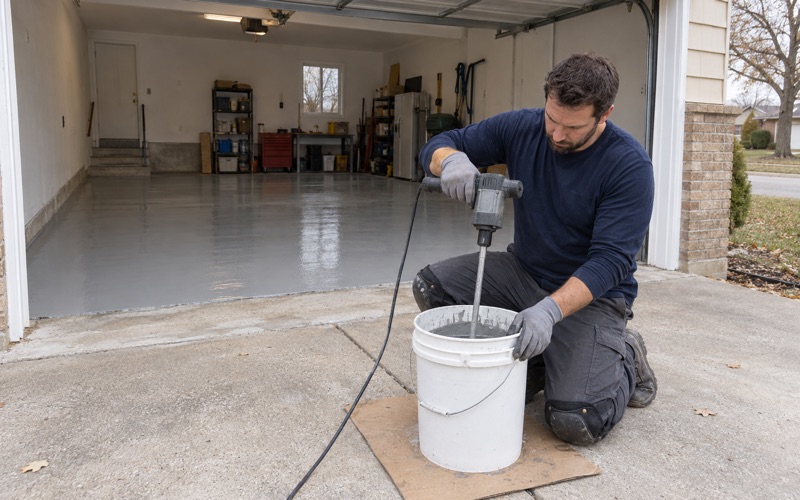
Every slab we coat is opened with a diamond grinder or a shot blaster, never an acid etch, so the coating has a real profile to grip. We match the profile to the system, typically within the ICRI CSP range the product calls for. Dust is captured at the machine with a vacuum rather than washed toward a floor drain or a storm inlet.
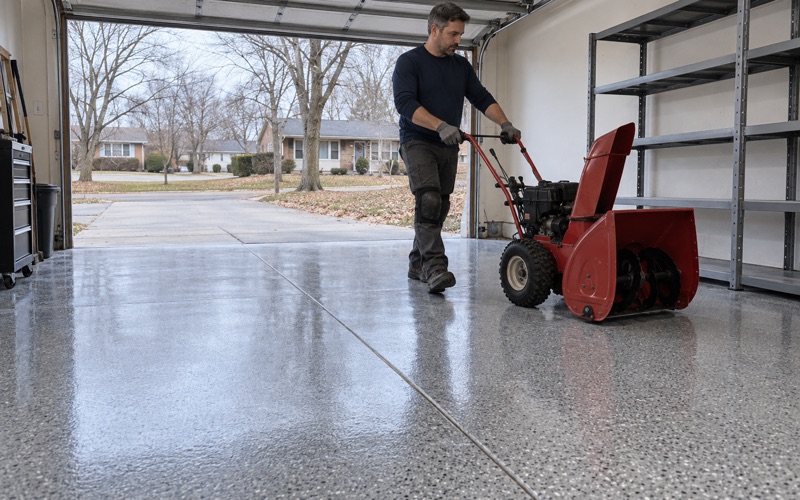
For a showroom and distribution floor, the usual choices are a 100% solids epoxy for build and abrasion resistance, a quartz aggregate broadcast where traction matters, and a topcoat chosen for the traffic it will see. Our proposal names the product line, the number of coats and the finished thickness, so the completed floor can be checked against the quote. A slip-resistant texture is specified by the broadcast and topcoat used, not promised as a slogan.
Scheduling, Cure and Paperwork in Wood Dale
The City of Wood Dale requires contractors to be registered with Community Development before a permit issues, with a certificate of insurance carrying $2,000,000 in public liability coverage that names the city as certificate holder. We sort out that paperwork, and whether the job needs a permit at all, before anything is scheduled.
Cure times follow slab temperature and the dew point spread at the surface, not the calendar, which matters in a building whose heating may still be set up for offices. Products are selected inside the Illinois VOC limits for floor and industrial coatings. Where a space is already operating, we phase the work in sections with overnight and weekend windows so stock and staff keep moving while the floor is finished.
- 20+ Years Coating Concrete
- Moisture Tested Before Pricing
- Free Written Estimates