Lombard Epoxy Flooring brings more than 20 years to epoxy flooring in Worth, and the work starts the same way on every job: with the slab, not the color chart. Each slab is opened by diamond grinding or shot blasting rather than an acid etch, so the coating bonds to a real concrete surface profile instead of a rinsed one. Before a price is final, a moisture test is written into the scope.
This page settles a question worth answering early for school, office and basement floors: what a floor coating has to do with radon. The short answer is that nothing a coating does counts as radon work. In Illinois, reducing radon is licensed mitigation, and we never sell a coating as radon reduction, on a house or on a public building.
What we do is the floor itself. The proposal names the product line, the number of coats and the finished thickness, so the result can be checked against the paper, and cracks, spalls and old coatings are mapped before anyone commits to a system.
New Classrooms at Worthwoods and What Illinois Recommends
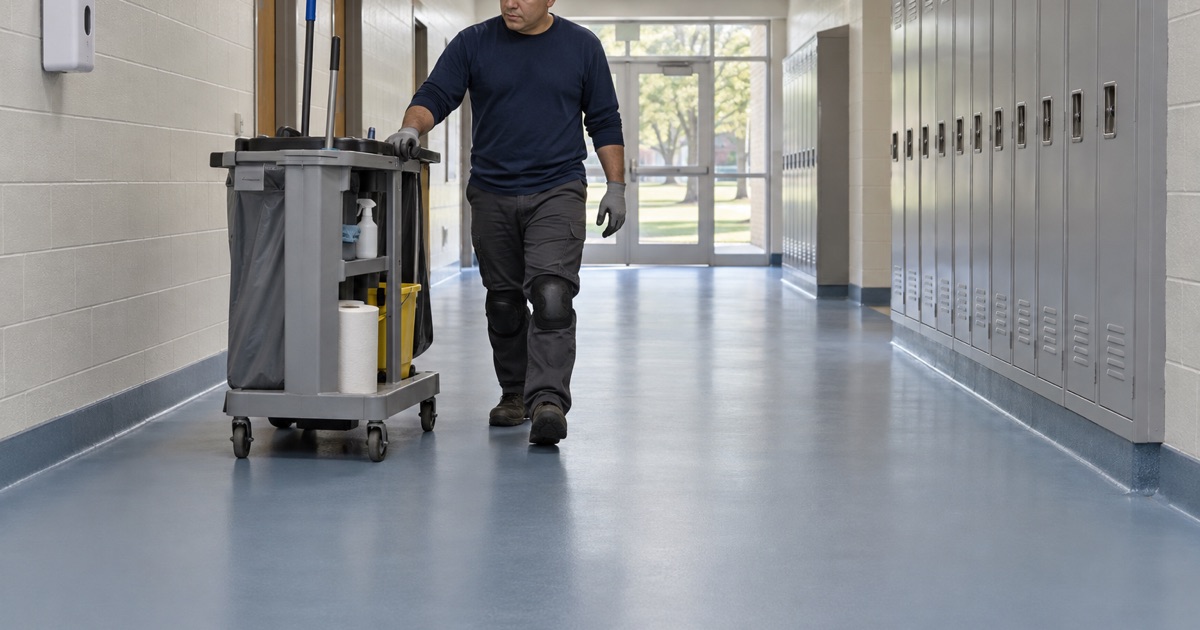
Worthwoods Elementary, on Oketo Avenue in Worth School District 127, has recently grown. A March 2024 Southwest Messenger Press report said construction there would begin April 1 and add classrooms, a media center and a multi-purpose room, with work completed by August 2025. The district had already finished a full renovation of the building in the summer of 2020.
We have not seen the school’s floors, its construction details or any radon result, and the district is not a customer of ours. The building is useful as an example of a common pattern in a Cook County village that counted 10,970 residents at the 2020 census: new rooms on new slabs, joined to an older structure, in a state whose school code speaks directly to radon.
Worth is divided at Harlem Avenue, with Worth Township to the east and Palos Township to the west, and the school sits on the Palos Township side. Neither township shapes the radon guidance discussed here; that comes from the state school code and the state licensing act.
Testing Every 5 Years
Section 10-20.48 of the Illinois School Code (105 ILCS 5/10-20.48) says “it is recommended that every occupied school building of a school district be tested every 5 years for radon,” following Illinois Emergency Management Agency rules. The wording matters. It is a recommendation, and bills that would have turned it into a hard duty were not shown to have been enacted.
Where IEMA grants an exemption, district employees may run screening tests; otherwise a licensed professional does the measuring. Screening kits must come from a laboratory licensed under the Radon Industry Licensing Act, and results may be shared with parents and staff and are reported to the State Board of Education. None of that testing is floor work, and none of it is ours.
Radon-Resistant New Construction
Subsection (b) adds a second recommendation aimed at buildings like a new classroom wing: new schools should be built using radon-resistant new construction techniques drawn from EPA guidance. Those techniques belong to how a building goes up, settled by its designers and builders before the slab is poured. A coating rolled onto that slab years later is not one of them.
Looking for epoxy-flooring closer to North Aurora? See Epoxy-Flooring in North Aurora.
4.0 pCi/L and Why a Coating Is Not Radon Work
The statute draws its line at a number. If a radon screening test comes back at 4.0 pCi/L or above, further measurement is done by a licensed professional, and the section recommends that affected areas be mitigated by a licensed radon mitigation professional.
The License Is the Dividing Line
The Radon Industry Licensing Act, at 420 ILCS 44/25, says no person may “perform a service to reduce the presence of radon or radon progeny in the indoor atmosphere” unless that person has been licensed by the Agency. A floor contractor pitching a coating as a way to lower radon would be offering exactly that service. We do not offer it, and we say so before a customer has to ask.
What a Floor Coating Is, and Is Not
An epoxy or polyaspartic floor is a wear surface. It is not a radon test, because it measures nothing, and it is not a mitigation system, because it was never designed or verified as one. Treating it as either would leave the people in a building trusting a product for something it was never shown to do.
There is a practical reason to keep the two apart, too. A licensed mitigator designs a system around measured results, the foundation and the building’s air pathways. A coating chosen for color, slip resistance and abrasion has none of that behind it, and calling it radon work blurs who answers for the result.
If a floor pitch ever mentions radon, that is the cue to ask whether the person making it is licensed by IEMA, and to set the claim aside if not. We would rather lose a sale than let a coating be bought for the wrong reason.
The Same Answer for a Basement
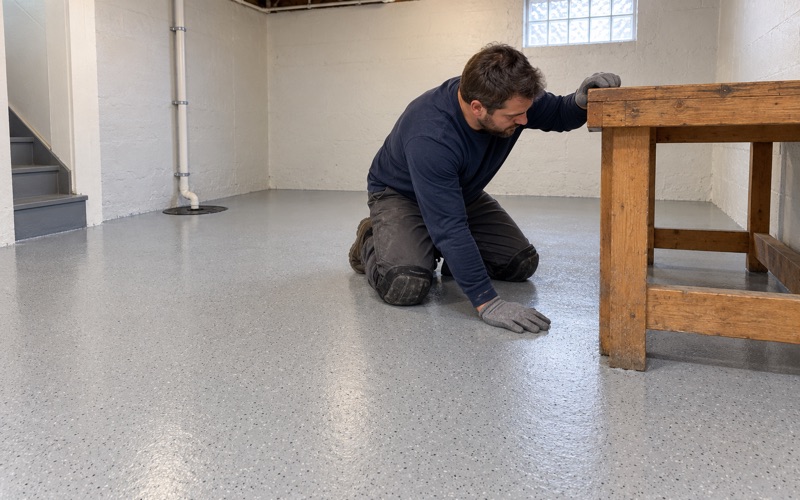
The same question comes up about basements, often after a home radon test. Our answer does not change with the building: get the result read, talk to a licensed mitigator if the number calls for it, and plan the floor around whatever that professional designs. Basement floors are also read for past water first, because a coating does not stop seepage, a backup or a sump that cannot keep up.
Where Floor Work Fits After a Radon Test
The right order is test first, decide second and coat last. Once results are in and any mitigation has been designed, the floor becomes an ordinary floor project again, governed by moisture, profile, cure and use. A school or homeowner who reverses that order ends up asking a floor contractor to answer a question only a radon measurement can.
Following a Mitigator’s Design
If a licensed mitigator’s plan calls for sealing slab cracks or joints, that work belongs to the plan and to the person who wrote it. Our floor work follows that design rather than replacing it, and we coordinate the sequence so a new coating does not cover something the mitigator still needs to reach or inspect. That can mean holding the coating back from a sealed joint or a test location, or detailing its edge so the mitigator’s work stays reachable. Where the plan says nothing about the floor, we do not volunteer a coating as a substitute.
Moisture and Surface Prep Come First
New slabs from an addition and older slabs from a renovated building behave differently under a coating. A younger slab can still be giving off moisture, so we test with ASTM F2170 in-situ relative humidity probes or an ASTM F1869 calcium chloride test, depending on the slab, and treat an ASTM D4263 plastic sheet test as a quick first read rather than the final word.
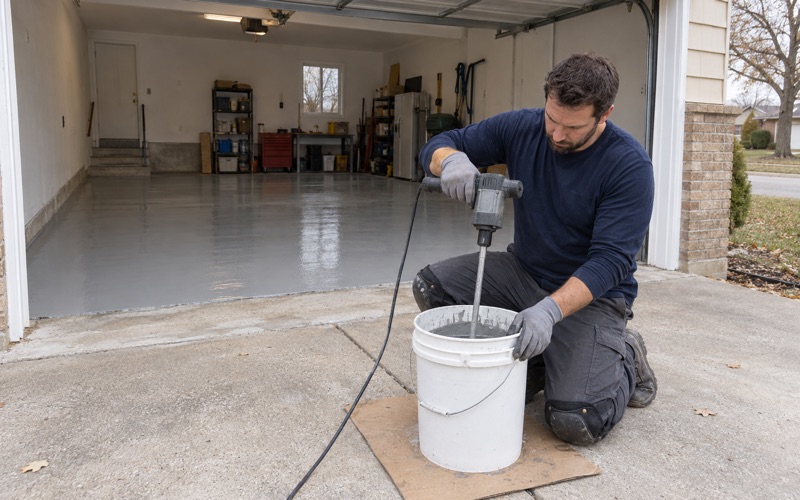
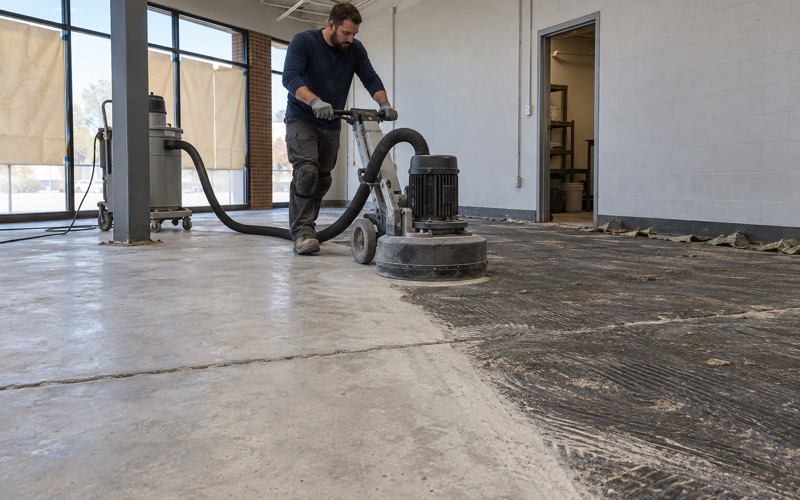
Grinding opens the surface to the ICRI concrete surface profile the system calls for, and the dust is captured at the machine by a vacuum rather than washed toward a floor drain or sump. Where vapor readings run high, a moisture-mitigation primer goes under the 100% solids epoxy, and we say plainly when a slab needs repair before it should be coated at all.
Picking the System for the Room
With any mitigation settled, the system is chosen for how the room is used. A multi-purpose room that takes folding chairs, carts and frequent mopping wants abrasion resistance and a texture that still grips when wet. Polyaspartic and polyurea topcoats can fit a short weekend window, while urethane cement suits floors that see hot water and heavy washing. A lithium silicate densifier is an option for bare concrete in back rooms that will not be coated.
Warranty Limits, Stated Up Front
What a coating warranty excludes is explained before the job is sold. Moisture vapor transmission and hydrostatic pressure head that list, and neither is something a topcoat can promise away. Nor is radon, which a warranty on a floor coating should never mention as a benefit.
Scheduling School, Office and Home Floors in Worth
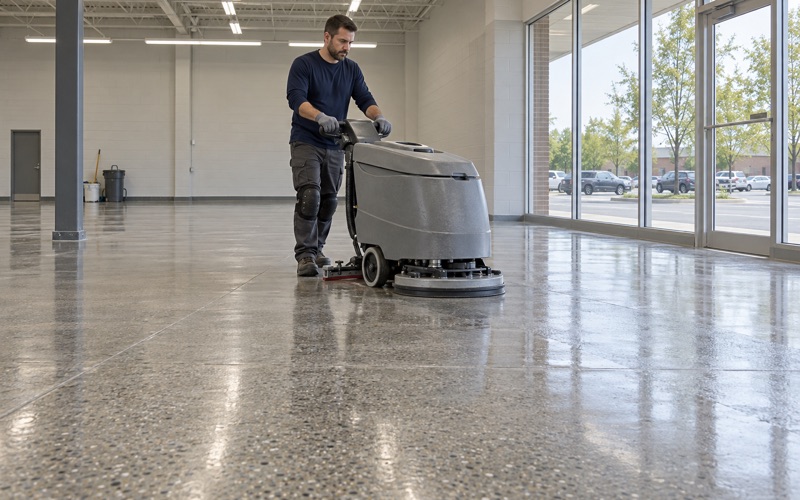
Classrooms, media centers and multi-purpose rooms rarely close for long. On school, office, clinic and store floors we phase the work around operating hours, using overnight and weekend windows when a space cannot shut down. Cure schedules follow slab temperature and the dew point spread at the surface rather than the calendar, and an unheated garage in deep winter is told to wait.
For a school, the practical windows are summer break, weekends and the nights between school days, and a coating that needs a longer cure is scheduled where the calendar can hold it. Odor during cure is a separate question from a product’s VOC content, so ventilation and occupancy are planned with the facility rather than assumed from a label.
Village Registration and Permits
The Village of Worth licenses contractors who work within its limits: a $110 registration, a certificate of insurance naming the village and a $10,000 surety bond. Its building department lists fences, pools, sheds, driveways, siding, gutters, and roof and window replacement among the remodeling projects that need permits, but flooring is not named either way, so the question goes to the department before a job starts rather than being assumed.
The village lists the 2006 International codes as its adopted building codes in its 2024 hazard-mitigation annex. Which rules govern floor work inside a public school is a question for the district and its designers, not one we settle from the outside.
Older Houses, Condos and Slip Resistance
Most of Worth’s housing dates from the 1950s through the 1970s, so a garage or basement floor is usually a retrofit over an older slab rather than fresh concrete. In the village’s larger apartment and condominium buildings, common garages, storage rooms and laundry floors are typically decided by an association or owner, not the unit occupant, so that is who approves the scope. For home jobs over the state threshold, a written contract and the Home Repair: Know Your Consumer Rights pamphlet come before any grinding starts.
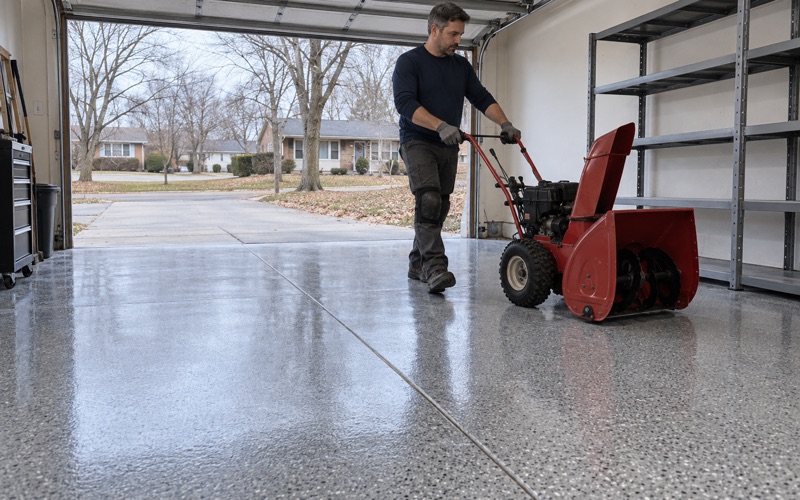
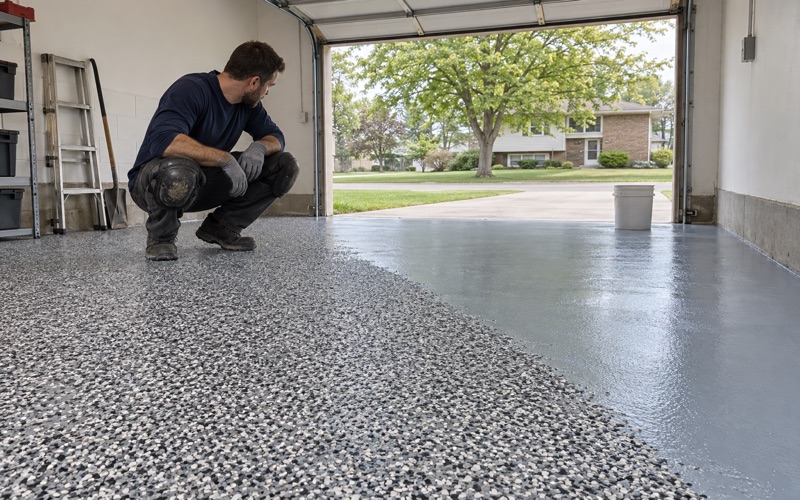
Garage systems are picked to stand up to the rock salt and brine that ride in on tires all winter, and slip resistance is specified by the broadcast and topcoat, whether vinyl flake or quartz aggregate, rather than promised as a slogan. Products stay inside the Illinois VOC limits for floor and industrial coatings, which bind the person applying them as well as the seller.
- 20+ Years Coating Concrete
- Moisture Tested Before Pricing
- Free Written Estimates